Home > Destinations > Europe > Italy > Tuscany and Umbria > Florence > In Depth
Bookstore Travel Talk - Our Message Boards Tips and Tools Book a Trip Deals and News Trip Ideas, Activities, Lifestyles Hotels Destinations Frommers.com Home
Frommer's - The best trips start here. Frommer's - The best trips start here.
Sign up for our FREE Newsletters! Win a FREE Trip
  Email This Article Email Print This Article Print Get Frommer's RSS Feed RSS

In Depth

A Man & His Dome

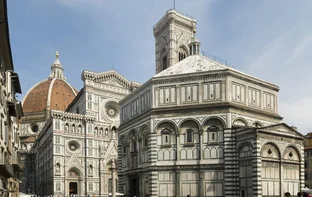
Filippo Brunelleschi, a diminutive man whose ego was as big as his talent, managed in his arrogant, quixotic, suspicious, and brilliant way to literally invent Renaissance architecture. Having been beaten by Lorenzo Ghiberti in the famous contest to cast the baptistery doors , Brunelleschi resolved he'd rather be the top architect than the second-best sculptor and took off for Rome to study the buildings of the ancients. On returning to Florence, he combined subdued gray pietra serena stone with smooth white plaster to create airy arches, vaults, and arcades of classically perfect proportions in his own special variant on the ancient Roman orders of architecture. Apart from designing the serene San Lorenzo, Santo Spirito, and the elegant Ospedale degli Innocenti, his greatest achievement by far was erecting the dome over Florence's cathedral.

The Duomo, then the world's largest church, had already been built, but nobody had been able to figure out how to cover the daunting space over its center without spending a fortune and without filling the church with the necessary scaffolding -- plus no one was sure whether they could create a dome that would hold up under its own weight. One of the many ridiculous solutions was making it of pumice (so it would be light) and filling the church with dirt studded with small coins. (After the work was done, the populace would be invited to dig for the money and thus remove the dirt.) Brunelleschi kept insisting he had the answer, but he wouldn't share it, fearful others would use his ideas and get the job over him.

After becoming so heated during several meetings of the Dome Erection Committee that he had to be carried out, he finally came in bearing an egg and issued a challenge (or so Vasari says). He bet he was the only one of the learned architects and councilmen in the room who could make an egg stand on its end. A marble slab was procured for the balancing act but, try as they might, the others couldn't get the egg to stay vertical. Brunelleschi took the egg in his hand, and with one quick movement slammed it down on the marble, smashing its end -- but leaving it standing. The others protested that they, too, could have easily done that, to which Brunelleschi replied they would say the same thing if he showed them his plans for the dome. He was granted the commission and revealed his ingenious plan -- which may have been inspired by close study of Rome's Pantheon.

He built the dome in two shells, the inner one thicker than the outer, both shells thinning as they neared the top, thus leaving the center hollow and removing a good deal of the weight. He also planned to construct the dome of giant vaults with ribs crossing over them, with each of the stones making up the actual fabric of the dome being dovetailed. In this way, the walls of the dome would support themselves as they were erected. In the process of building, Brunelleschi found himself as much an engineer as architect, constantly designing remarkable new winches, cranes, and hoists to carry the materials faster and more efficiently up to the level of the workmen. He was even farsighted enough to build in drainage systems for the rain and iron hooks to support interior scaffolding for future cleanings or paint jobs.

His finished work speaks for itself, 45m (148 ft.) wide at the base and 90m (295 ft.) high from drum to lantern -- Florentines proudly claim they've lived their whole lives within sight of the dome. For his achievement, Brunelleschi was accorded a singular honor: He's the only person ever buried in Florence's cathedral, under his ingenious and revolutionary dome.

Michelangelo: The Making of a Renaissance Master

Irascible, moody, and manic-depressive, Michelangelo was quite simply one of the greatest artists of all time. Many feel he represents the pinnacle of the Italian Renaissance, a genius at sculpture, painting, and architecture, and even a master poet.

In 1475, Michelangelo Buonarroti was born near Arezzo in the tiny town of Caprese, where his Florentine father was serving a term as a podestà (visiting mayor). He grew up on the family farm at Settignano, outside Florence, and was wet-nursed by the wife of a local stonecutter -- he used to joke that he sucked his skill with the hammer and chisel along with the mother's milk. He was apprenticed early to the fresco studio of Domenico Ghirlandaio who, while watching the young apprentice sketching, once remarked in shock, "This boy knows more about it than I do." After just a year at the studio, Michelangelo was recruited by Lorenzo the Magnificent de' Medici to become part of his new school for sculptors.

Michelangelo learned quickly, and soon after his arrival at the school took a chunk of marble and carved it to copy the head of an old faun from an ancient statue in the garden. Lorenzo happened by and saw the skill with which the head was made, but when he saw that Michelangelo had departed from his model and carved the mouth open and laughing with teeth and a tongue, he commented only, "But you should have known that old people never have all their teeth and there are always some missing." The young artist reflected on this. When Lorenzo returned a while later, he found Michelangelo waiting anxiously, eager to show he had not only chipped out a few teeth but also gouged down into the gums of the statue to make the tooth loss look more realistic. Impressed, Lorenzo decided to take the boy under his wing and virtually adopted him into the Medici household.

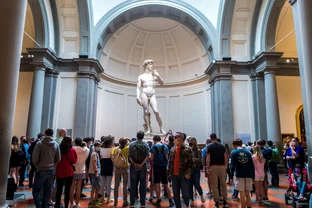
After his success at age 19 with the Pietà sculpture in Rome, Michelangelo was given the opportunity by the city council to carve the enormous block of marble that became David. He worked on it behind shuttered scaffolding so few saw it until the unveiling. Legend has it that when Soderini, the head of the city council, came to see the finished work, he remarked the nose looked a tad too large. Michelangelo, knowing better but wanting to please Soderini, climbed up to the head (out of view), grabbed a handful of leftover plaster dust, and while tapping his hammer lightly against his chisel, let the dust sprinkle down gradually as if he were actually carving. "Much better," remarked Soderini when Michelangelo climbed down again and they stepped back to admire it. "Now you've really brought it to life."


Back to Top


Note: This information was accurate when it was published, but can change without notice. Please be sure to confirm all rates and details directly with the companies in question before planning your trip.


  Email This Article Email Print This Article Print Get Frommer's RSS Feed RSS
Frommer's Florence, Tuscany & Umbria, 6th Edition Frommer's Florence, Tuscany & Umbria, 6th Edition

Author: John Moretti
Pub Date: January 22, 2008
Price: $21.99

Buy Now!
Related Titles:
Frommer's 24 Great Walks in Rome, 1st Edition
Frommer's Florence & Tuscany Day by Day, 1st Edition
Frommer's Italy 2008
Add Frommers.com RSS Feed  Add Frommers.com RSS Feed (What's This?)
Add Frommers.com Deals & News to Your Web Site
Add to My Yahoo!     Add to My MSN     More RSS Readers
Add Frommers.com Podcast Add Frommers.com Podcast (What's This?)
Home > Destinations > Europe > Italy > Tuscany and Umbria > Florence > In Depth