Home > Destinations > Europe > Italy > Tuscany and Umbria > Florence > Attractions > Museo Nazionale del Bargello (Bargello Museum)
Bookstore Travel Talk - Our Message Boards Tips and Tools Book a Trip Deals and News Trip Ideas, Activities, Lifestyles Hotels Destinations Frommers.com Home
Frommer's - The best trips start here. Frommer's - The best trips start here.
Sign up for our FREE Newsletters! Win a FREE Trip
  Email This Article Email Print This Article Print Get Frommer's RSS Feed RSS

Florence Map: Museo Nazionale del Bargello (Bargello Museum)Museo Nazionale del Bargello (Bargello Museum) Frommer's Very Highly Recommended

Hours Daily 8:30am-6pm
Address Via del Proconsolo 4
Transportation Bus: A, 14, or 23
Phone 055-238-8606
Web site www.polomuseale.firenze.it/english/musei/bargello
Prices Admission 4€ ($5.20)
Season Closed 2nd and 4th Mon and 1st, 3rd, and 5th Sun of each month
Other Reserve tickets at tel. 055-294-883 or www.firenzemusei.it

Frommer's Review

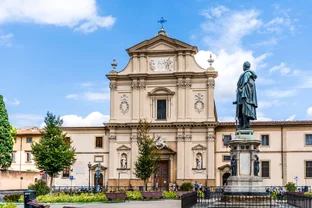
Inside this 1255 Gothic palazzo is Florence's premier sculpture museum, with works by Michelangelo, the della Robbias, and Donatello.

In the palazzo's old armory are 16th-century works, including some of Michelangelo's earliest sculptures. Carved by a 22-year-old Michelangelo while he was visiting Rome, Bacchus (1497) was obviously inspired by the classical antiquities he studied there but is also imbued with his own irrepressible Renaissance realism -- here is a (young) God of Wine who's actually drunk, reeling back on unsteady knees and holding the cup aloft with a distinctly tipsy wobble. Michelangelo polished and finished this marble in the traditional manner, but from 1503 to 1505, soon after finishing his famous David with a high polish, he carved the Pitti Tondo here, a schiacciato Madonna and Child scene in which the artist began using the textures of the partially worked marble itself to convey his artistic message. One of his weaker works here is the so-called Apollo-David (art historians can't agree on which hero the unfinished work was meant to be), but the master is back in top form with the bust of Brutus (ca. 1539). Some people like to see in this sculpture an idealized portrait of Michelangelo himself; a more accurate and less contentious representation sits nearby, the famous and oft-cast bronze bust of Michelangelo by his pupil Daniele da Volterra. Also in this room is Giambologna's Flying Mercury (ca. 1564), looking for all the world as if he's on the verge of taking off from the ground -- justifiably one of this Mannerist's masterpieces.

The palazzo's inner courtyard -- one of the few medieval cortile in Florence to survive in more-or-less its original shape -- is studded with the coats of arms of various past podestà (mayors) and other notables. The grand stairwell leads up to a second-story loggia filled with a flock of whimsical bronze birds cast by Giambologna for the Medici's gardens. The doorway leads into the old Salone del Consiglio Generale (General Council Room), a vast space with a high ceiling filled with glazed terra-cotta Madonnas by Luca della Robbia and his clan, and some of the most important sculptures of the early Renaissance.

Donatello dominates the room, starting with a mischievously smiling Cupid (ca. 1430-40). Nearby is his polychrome bust of Niccolò da Uzzano, a bit of hyperrealism next to two much more delicate busts of elfin-featured characters by Desiderio da Settignano. Donatello sculpted the Marzocco, lion symbol of the Florentine Republic, out of pietra serena between 1418 and 1420. The marble David (1408) is an early Donatello, but the bronze David (1440-50) beyond it is a much more mature piece, the first free-standing nude since antiquity. The figure is an almost erotic youth, with a shy, detached air that has little to do with the giant severed head at his feet. Against the far wall is St. George, carved in 1416 for a niche of Orsanmichele. The relief below it of the saint slaying his dragon is an early example of the sculptor's patented schiacciato technique, using thinly etched lines and perspective to create great depth in a very shallow space.

In the back right corner of this room are two bronze relief panels by Brunelleschi and Ghiberti of the Sacrifice of Isaac, finalists in the famous 1401 competition for the commission to cast the Baptistery's doors. Ghiberti's panel won for the greater dynamism and flowing action in his version.

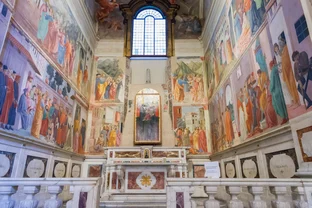
Out the other end of the room is the Islamic Collection, a testament to Florence's wide and profitable trade network. Decorative arts from the Roman era through the 16th century fill the long corridor, at the end of which is the small Cappella Maddalena, where condemned prisoners spent their last moments praying for their souls; it was frescoed by Giotto's studio. A perpendicular corridor houses the largest collection of ivories in the world, from the 5th to 17th centuries.

Upstairs are rooms with glazed terra cottas by Andrea and Giovanni della Robbia and another room devoted to the sculptural production of Leonardo da Vinci's teacher Verrocchio, including yet another David (1465), a haughty youth with a tousle of hair inspired by the Donatello version downstairs.

Note: This information was accurate when it was published, but can change without notice. Please be sure to confirm all rates and details directly with the companies in question before planning your trip.


Back to Top


  Email This Article Email Print This Article Print Get Frommer's RSS Feed RSS


Frommer's Florence, Tuscany & Umbria, 6th Edition Frommer's Florence, Tuscany & Umbria, 6th Edition

Author: John Moretti
Pub Date: January 22, 2008
Price: $21.99

Buy Now!
Related Titles:
Frommer's 24 Great Walks in Rome, 1st Edition
Frommer's Florence & Tuscany Day by Day, 1st Edition
Frommer's Italy 2008
Add Frommers.com RSS Feed  Add Frommers.com RSS Feed (What's This?)
Add Frommers.com Deals & News to Your Web Site
Add to My Yahoo!     Add to My MSN     More RSS Readers
Add Frommers.com Podcast Add Frommers.com Podcast (What's This?)
Home > Destinations > Europe > Italy > Tuscany and Umbria > Florence > Attractions > Museo Nazionale del Bargello (Bargello Museum)