|
|
||||||||||||||||||||||||||||||||||||||||||||||||||||||||||||||||||||||||||||||||||||||||||||||||||||||||||||||||||||||||||||||||||||||||||||||||||||||||||||||||||||||||||||||
| Hours | Tues-Sun 8:15am-6:50pm; last admission 30 min. before close | ||
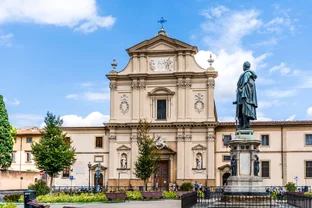
| Address | Via Ricasoli 58-60 | ||
| Transportation | Bus: 1, 6, 7, 10, 11, 17, 25, 31, 32, 33, 67, 68, or 70 | ||
| Phone | 055-238-8609, 055-238-8612. Reserve tickets at 055-294-883 | ||
| Web site | www.sbas.firenze.it/accademia | ||
| Prices | Admission 6.50€ ($8.45) adults, 3.25€ ($4.25) children | ||
| Other | Reserve tickets at tel. 055-294-883 or www.firenzemusei.it | ||
Frommer's Review
Though tour-bus crowds flock here just for Michelangelo's David, anyone with more than a day in Florence can take the time to peruse some of the Accademia's paintings as well.
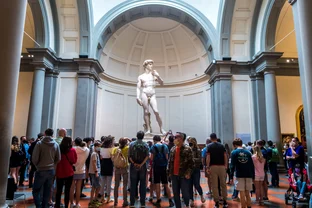
The first long hall is devoted to Michelangelo and, though you pass his Slaves and the entrance to the painting gallery, most visitors are immediately drawn down to the far end, a tribune dominated by the most famous sculpture in the world: Michelangelo's David. A hot young sculptor fresh from his success with the Pietà in Rome, Michelangelo offered in 1501 to take on a slab of marble that had already been worked on by another sculptor (who had taken a chunk out of one side before declaring it too strangely shaped to use). The huge slab had been lying around the Duomo's work yards so long it earned a nickname, Il Gigante (The Giant), so it was with a twist of humor that Michelangelo, only 29 years old, finished in 1504 a Goliath-size David for the city.
There was originally a vague idea that the statue would become part of the Duomo, but Florence's republican government soon wheeled it down to stand on Piazza della Signoria in front of the Palazzo Vecchio to symbolize the defeated tyranny of the Medici, who had been ousted a decade before (but would return with a vengeance). During a 1527 anti-Medicean siege on the palazzo, a bench thrown at the attackers from one of the windows hit David's left arm, which reportedly came crashing down on a farmer's toe. (A young Giorgio Vasari came scurrying out to gather all the pieces for safekeeping, despite the riot going on around him, and the arm was later reconstituted.) Even the sculpture's 1873 removal to the Accademia to save it from the elements (a copy stands in its place) hasn't kept it entirely safe -- in 1991, a man threw himself on the statue and began hammering at the right foot, dislodging several toes. The foot was repaired, and David's Plexiglas shield went up.
The hall leading up to David is lined with perhaps Michelangelo's most fascinating works, the four famous nonfiniti ("unfinished") Slaves, or Prisoners. Like no others, these statues symbolize Michelangelo's theory that sculpture is an "art that takes away superfluous material." The great master saw a true sculpture as something that was already inherent in the stone, and all it needed was a skilled chisel to free it from the extraneous rock. That certainly seems to be the case here, as we get a private glimpse into Michelangelo's working technique: how he began by carving the abdomen and torso, going for the gut of the sculpture and bringing that to life first so it could tell him how the rest should start to take form. Whether he intended the statues to look the way they do now or in fact left them only half done has been debated by art historians to exhaustion. The result, no matter what the sculptor's intentions, is remarkable, a symbol of the master's great art and personal views on craft as his Slaves struggle to break free of their chipped stone prisons.
Nearby, in a similar mode, is a statue of St. Matthew (1504-08), which Michelangelo began carving as part of a series of Apostles he was at one point going to complete for the Duomo. (The Pietà at the end of the corridor on the right is by one of Michelangelo's students, not by the master as was once thought.)
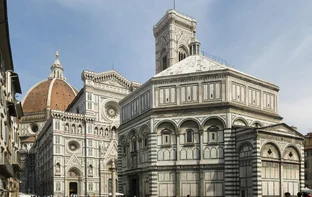
Off this hall of Slaves is the first wing of the painting gallery, which includes a panel, possibly from a wedding chest, known as the Cassone Adimari, painted by Lo Scheggia in the 1440s. It shows the happy couple's promenade to the Duomo, with the green-and-white marbles of the baptistery prominent in the background.
In the wings off David's tribune are large paintings by Michelangelo's contemporaries, Mannerists over whom he had a very strong influence -- they even say Michelangelo provided the original drawing from which Pontormo painted his amorous Venus and Cupid. Off the end of the left wing is a long 19th-century hall crowded wall-to-wall and stacked floor-to-ceiling with plaster casts of hundreds of sculptures and busts -- the Accademia, after all, is what it sounds like: an academy for budding young artists, founded in 1784 as an offshoot of the Academy of Art Design that dates from Michelangelo's time (1565).
Seeing David -- The wait to get in to see David can be up to an hour if you didn't reserve ahead. Try getting there before the museum opens in the morning or an hour or two before closing time.
Note: This information was accurate when it was published, but can change without notice. Please be sure to confirm all rates and details directly with the companies in question before planning your trip.
| Back to Top |
| RSS | |||||||
| Frommer's Florence, Tuscany & Umbria, 7th Edition | |
| 0 stars | Frommer's Recommended | |
| 1 stars | Frommer's Highly Recommended | |
| 2 stars | Frommer's Very Highly Recommended | |
| 3 stars | Frommer's Exceptional |
Frommer's ranks every hotel, restaurant, attraction, shop, and nightlife establishment it reviews for quality, value, service, amenities, and special features using a star-rating scale, an expression of the strong compare-and-contrast opinions that are a brand hallmark.
Other ratings provide stars based primarily on price and amenities; the Frommer's star rating is meant to quantify the kind of intangible, experiential elements that help travelers make informed decisions.
The "baseline" recommendation is zero stars--every hotel, restaurant, attraction, shop, and nightlife establishment that Frommer's chooses to review is recommended; otherwise, we simply wouldn't include it.