Home > Destinations > Europe > Spain > Madrid > Restaurants
Frommers.com Frommers.com
Most Recent Madrid Forum Posts
Most Recommended Articles
Most Commented Articles
  Print This Article Print Get Frommer's RSS Feed RSS

Restaurants

Madrid boasts the richest variety of cuisine in Spain. You can actually take a gourmet tour of the country without leaving the capital. Its national eating spots cover everything from Andalusian gazpacho and Valencian paella (most famed of all Spain's rice and seafood dishes) to Galician pulpo (octopus), Asturian fabada (rich pork stew), and Basque bacalao (cod). And let's not forget Madrid's very own cocido (lamb and vegetable stew) and neighboring Castile's outrageously delicious lechona (roast suckling pig). The latter dishes are both hearty and logical, given the setting and winter climate, but the big surprise is that though Madrid is a landlocked city, surrounded by a vast arid plateau, it receives a daily supply of fish transported from the Atlantic north to supply top restaurants like La Trainera and Cabo Mayor with the country's best and freshest seafood.

International restaurants also abound, and you can take your pick from a variety of European, Latin American, North African, Middle Eastern, and Asian options. Add to all that a new wave of sophisticated polyglot fusion cuisine -- deft, brilliant, and light years away from the full-bodied traditionals mentioned above -- and the scene takes on another dimension. Thanks to highly inventive and imaginative chefs like Sergi Arola, Santi Santamaría, and Ferran Adrià, Spanish cuisine is no longer considered provincial; and Adrià in particular has gained such fame (the New York Times recently described him as the "dean of molecular gastronomy") that, for many, he eclipses even Gallic giants like Paul Bocuse. Adrià's most famed Catalan eating spot, incidentally, is the Bulli in the northern Costa Brava, but his Madrid restaurant is the almost equally impressive Terraza del Casino, right in the center.

While browsing this guide, keep in mind that restaurants are categorized by the average cost of one entree, an appetizer, and glass of wine. Very Expensive means a meal averages 30€ ($48) per person and up; Expensive, 19€ to 30€ ($30-$48); Moderate, 13€ to 19€ ($20-$30); and Inexpensive, under 13€ ($20).

Picnic, Anyone? -- On a hot day, do as the Madrileños do: Secure the makings of a picnic lunch and head for Casa de Campo (Metro: El Batón), those once-royal hunting grounds in the west of Madrid across the Manzanares River. Children delight in this adventure, as they can also visit a boating lake, the Parque de Atracciones, and the Madrid zoo.

Your best choice for picnic fare can be bought right in the center at Rodilla, Preciados 25 (tel. 91-522-54-67; Metro: Callao), where you can find neatly prepared, squeaky clean, European-sized (that is, smaller than the huge old Spanish half-loaf size) sandwiches, pastries, and takeout tapas. The sandwiches, including vegetarian, meat, and fish options, begin at 1.50€ ($2.40). It's open Monday and Tuesday from 8:30am to 10:30pm; Wednesday, Thursday, and Sunday from 9am to 11pm; Friday and Saturday from 9am to 11:30pm.

Meal Times

Breakfast (desayuno) is taken in cafes or in your hotel between 7:30 and 10am, though if you want to make a very early start you'll find the occasional bar open around 5:30 or 6am.

It's the custom in Madrid to consume lunch (almuerzo) as the big meal of the day, from 2 to 4pm. After a recuperative siesta, Madrileños enjoy tapas -- and indeed, no Madrid culinary experience would be complete without a tour of the city's many tapas bars.

All this nibbling is followed by a lighter dinner (cena) in a restaurant, usually from 9:30pm to as late as midnight. Many restaurants, however, start serving dinner at 8pm to accommodate visitors from other countries who don't like to dine so late.

Most restaurants close 1 day a week, so be sure to check ahead. Hotel dining rooms are generally open 7 days. Generally, reservations are not necessary, except at popular, top-notch restaurants.

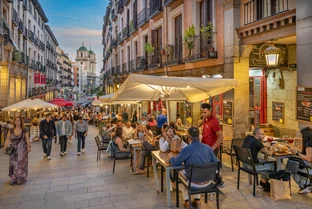
The Best of the Tascas -- Don't starve waiting around for Madrid's fashionable 9:30 or 10pm dinner hour. Throughout the city you'll find tascas, bars that serve wine and platters of tempting hot and cold hors d'oeuvres known as tapas: mushrooms, salads, baby eels, shrimp, lobster, mussels, sausage, ham, and, in one establishment, bull testicles. Keep in mind that you can often save euros by ordering at the bar rather than occupying a table.

Types of Restaurants & Menus

Cafeterias usually are not self-service establishments but restaurants serving light, often American, cuisine. Go for breakfast instead of dining at your hotel, unless it's included in the room price. Some cafeterias offer no hot meals, but many feature combined plates of fried eggs, french fries, veal, and lettuce-and-tomato salad, which make adequate fare, or snacks like hot dogs and hamburgers.

Restaurants share one thing in common that cafeterias do not: By law, they must offer a fixed-price lunch menu that includes two main courses, a dessert and (usually) wine. In simple, basic budget-priced economicas, these may cost as little as 9€ ($14) all-inclusive, while in top-quality deluxe eating spots with famous-name chefs -- where more exotic and esoteric "tasting menus" are offered -- they can be as high as 150€ to 200€ ($240-$320) per head (often without wine). In between these two extremes -- though distinctly nearer the economicas in price -- comes a middle (14€-30€/$22-$35) range that includes historic tabernas, all-purpose eating spots serving an eclectically national and international choice of dishes, and regional restaurants that concentrate on the specific cuisines of different parts of Spain (Asturias and Galicia are most commonly represented here).

Order the menú del día (menu of the day) or cubierto (fixed price) -- both fixed-price menus are based on what is fresh at the market that day. These are the dining bargains in Madrid, although often lacking the quality of more expensive a la carte dining. Usually each will include a first course, such as fish soup or hors d'oeuvres, followed by a main dish, plus bread, dessert, and the house wine. You won't have a large choice. The menú turístico is a similar fixed-price menu, but for many it's too large, especially at lunch. Only those with big appetites will find it the best bargain.

Tipping & Local Customs

Meals include service and tax (7%-12%, depending on the restaurant) but not drinks, which add to the tab considerably.

In most cases, service can seem perfunctory by North American standards. Waiters are matter-of-fact, do not fawn over you, nor do they return to the table to ask how things are going. This can seem off-putting at first, but if you observe closely, you'll see that Spanish waiters typically handle more tables than their North American counterparts and they generally work quickly and more efficiently.

Follow the local custom and don't overtip. Theoretically, service is included in the price of the meal, but it's customary to leave an additional 10%.

Top restaurants, such as Zalacaín, have a formal dress policy (jacket and tie for men). Call ahead if you're unsure.

Till the Last Gasp -- At the beginning of 2006, Spain totally banned smoking in office buildings, malls, cultural centers, and public transportation. Cafes, bars, and restaurants were allowed to use their own discretion when deciding whether smoking on the premises should be allowed or not. Unwilling to lose customers, the vast majority opted for the former, much to the dismay of Spain's antismoking lobby. Though premises over 100 sq. m (1,100 sq. ft.) in area are required to have a small nonsmoking zone, entirely smoke-free locales remain almost as rare in Madrid as a pub in Saudi Arabia. Nicotine haters can nevertheless find solace in the occasional clear-aired oasis such as the inimitable and increasing ubiquitous Starbucks and the vegetarian restaurant Elqui

In the years since this law came out, no further progress has been made in spite of sterling efforts by nonsmoking factions; and Spain has not followed the example of France, who, in 2007, banned smoking in all bars and eating spots as well as general public places, joining the illustrious company of Britain, Ireland, and most German states. Evidently, there's a north-south divide in Europe on this issue. As in other southern European countries like Greece and Portugal, the smoking culture remains as firmly embedded as in the Spanish psyche, and it would take a very brave government indeed to enforce a total ban. At the moment, it's still up to each individual bar or restaurant to decide. Of the two totally nonsmoking restaurants that appeared in my last guide 2 years ago, Dosa Grill Café, in Chueca, has closed and the Urban Cowboy, in Huertas, has apparently succumbed to public demand and now permits smoking. The Hispanic nicotine aficionado clearly plans to hold out till the last gasp, and to hell with all that nonsense about smoking being bad for you.

Going Veg in Madrid

Being a "veggie" has long ceased to mean you need feel you're an outsider in the Spanish capital. Over the past 15 years, the traditional dominance of carnivore-oriented establishments has been challenged by an ever-growing number of vegetarian restaurants. In this chapter, you'll find ten of the best.

You don't have to confine yourself to 100% green establishments to get the goods, though, as many standard Spanish eating spots offer a large choice of noncarnivorous platos.

Apart from the ubiquitous tortilla (made, naturalmente, with eggs Spanish-style and not from cornmeal Mexican-style), check out their menus for dishes like pimientos fritos (fried peppers), berengenas al horno (eggplant baked in the oven), calabaza guisada (stewed pumpkin), setas al jerez (mushrooms cooked in sherry), and pisto (Spain's answer to ratatouille with tomatoes, peppers, eggplant courgettes, and onions all cooked in oil and garlic; avoid the Manchego version though, as this has bits of ham in it). Jamón (Mountain or cooked, Serrano or York), is scarcely regarded as "real" meat in Spain and can even appear in apparently innocuous dishes such as caldo (broth), so confirm with the waiter before you order.

Arabic, Indian, and Italian restaurants may also provide what you're looking for, with their inventive range of couscous, rice, and pasta-based dishes; and if fish is an acceptable option, there are, of course, plenty of seafood restaurants to choose from, though these tend to be expensive.

Potato power: Anyone wanting a ración, or single dish, of something cheap and meat-free should try patatas bravas (potatoes sautéed brown and served in a picante sauce). Between Puerta del Sol and Tirso de Molina a trio of eating spots all called Las Bravas specialize in this simple but filling dish (still a modest 3.50€/$5.60 a dish). The real McCoy of the three is on Pasaje Matheu 5 (off Calle Victoria; tel. 91-521-51-41; Sun-Thurs 12:30-4pm and 7:30pm-midnight, Fri-Sat 12:30-4pm and 7:30pm-1am). Patatas bravas are also widely available in tapas bars, sometimes at even cheaper prices.

Vineyards & Wineries

Spanish red wines are some of the best in the world and its famed Riojas and Penedeses are widely available and remarkably affordable. Better value still -- and barely known even in the rest of Spain -- are the honest traditional wines emerging from Madrid province's own underrated vineyards.

Three of the top wine-producing regions in the Madrid province are Colmenar de Oreja, San Martín de Valdeiglesias, and Chinchón. Colmenar de Oreja's prize-winning red and white Jesús Díaz wines are made from the Malvar and Airén grapes, while San Martín de Valdeiglesias' strong (13%-13.5% alcohol) Señoría de Valderrábano reds are made from the Garnacha variety. Chinchón (of anis fame) also produces a hearty and palatable red called Viña Galinda. Look for these and other Comunidad de Madrid wines from Arganda del Rey and Villarejo del Salvanés in the supermarkets (2.50€-4€/$4-$6 a bottle) and restaurants (7€-10€/$11-$16 a bottle). They're worth a try.

For wider information on Spanish wines in general, contact Wines from Spain, c/o the Commercial Office of Spain, 405 Lexington Ave., 44th Floor, New York, NY 10174-0331 (tel. 212/661-4959; www.winesfromspain.com).


Back to Top


Best Dining Bets     List All Restaurants


Maps

Note: This information was accurate when it was published, but can change without notice. Please be sure to confirm all rates and details directly with the companies in question before planning your trip.


  Print This Article Print Get Frommer's RSS Feed RSS
Destination Guide
Destination Guide Destination Guide Destination Guide
Destination Guide Destination Guide Frommer's Madrid, 3rd Edition Destination Guide Frommer's Madrid, 3rd Edition

Author: Peter Stone
Pub Date: January 20, 2009
Price: $17.99

Add to Cart
Destination Guide Destination Guide Destination Guide Related Titles:
Frommer's 24 Great Walks in Barcelona, 1st Edition
Destination Guide
Frommer's 25 Great Drives in Spain
Destination Guide
Frommer's Barcelona Day by Day, 1st Edition
Destination Guide
Destination Guide Destination Guide
Destination Guide Destination Guide Destination Guide
Destination Guide
Destinations
Destinations
Home > Destinations > Europe > Spain > Madrid > Restaurants