Home > Destinations > Europe > Spain > Madrid > Walking Tours > Walking Tour 4
Bookstore Travel Talk - Our Message Boards Tips and Tools Book a Trip Deals and News Trip Ideas, Activities, Lifestyles Hotels Destinations Frommers.com Home
Frommer's - The best trips start here. Frommer's - The best trips start here.
Sign up for our FREE Newsletters! Win a FREE Trip
  Email This Article Email Print This Article Print Get Frommer's RSS Feed RSS

Walking Tour 4

Walking Tour 4: Gran Vía, Malasaña & Chueca

Start: Edificio Metropolis at junction of Gran Vía and Calle Alcalá.

Finish: Casa de las Siete Chimeneas in Chueca.

Time: 2 to 3 hours.

Best Times: Weekends or midmornings.

Worst Times: Rush-hour times 8 to 10am or 5 to 7pm (especially on the Gran Vía).

This comprehensive walk takes you from east to west along the city's great central artery and returns via the intricate, narrow-laned districts of Malasaña and Chueca with their traditional squares and architecture.

1. Edificio Metrópolis

The French-styled Metropolis building, built in 1911 for the Union and Fenix Español insurance company, stands at the beginning of the Gran Vía on the corner of the junction with Alcalá. An essential part of the central Madrid skyline, it looks back toward the equally symbolic Cibeles fountain and Correos building. On the pavement in front of it is a small statue in honor of La Violetera, or violet seller, representing all the young ladies who used to sell flowers, "Pygmalion" style, to theatergoers. (International movie buffs may wish to note that it was the theme of an early flick starring Sara Montiel, Spain's answer to Elizabeth Taylor.)

Start walking up the Gran Vía and then make an immediate deviation to the left into Calle Caballero de Gracia to the:

2. Oratorio del Caballero de Gracia

One of the city's least-known ecclesiastical gems, this late-18th-century church is considered one of the finest examples of neoclassical work in Madrid. The Gran Vía was actually rerouted during its construction so that it could be preserved.

Return to the Gran Vía at the junction of Calle Montera and the San Luis roundabout. Passing the imposing 1924 Edificio Telefónica on your right, in its time Madrid's highest building, continue up the Gran Vía to the:

3. Plaza de Callao

Named after a naval battle fought between Spain and allied South American forces off Peru in 1866, this busy square stands just over halfway along the Gran Vía. Running off it toward the Puerta del Sol are the central pedestrian-only streets of Preciados and del Carmen with their big shopping stores, and on either side of it are some of Madrid's longest-established cinemas and theaters (Spanish-language showings only).

Continue on down to the end of the Gran Vía where you reach the:

4. Plaza de España

Separating the Gran Vía from Calle Princesa, this large, perennially busy square is famed as much for its Don Quixote and Sancho Panza statue (on horseback in front of a taller one of Cervantes) as for the two concrete Francoist structures that tower beside it: Edificio España, built between 1947 and 1953, has 23 stories, while Torre Madrid (nicknamed "the Giraffe"), completed in 1953 with 10 more stories, was at its time the largest concrete building in the world.

Cross the square at its northwesterly corner and walk up Calle Ferraz to Calle de Ventura Rodriguez. Turn right into it and on your right is the:

5. Museo Cerralbo

This highly personal 19th-century mansion-museum provides an intimate contrast with the grandeur of the Paseo del Prado's "Big Three." It contains the lifetime personal collection of former owner Enrique de Aguilera y Gamboa, the 17th Marquis of Cerralbo, who died in 1922. All is as he left it, from his Japanese armor collection to his Goya and Zurbarán masterpieces.

Leaving the museum, turn left along Ventura Rodriguez and cross Calle Ferraz to look at the:

6. Templo de Debod

Situated at the far end of the Parque del Oeste on the western edge of the city (beside the tiny Ferraz gardens), this remarkable 4th-century temple built by the Pharaoh Zakheramon was transferred stone by stone from Egypt, in thanks for help given by Spain in building the Aswan dam. There are spectacular views west from the edge of the park of the Casa del Campo and distant Guadarrama mountains.

Return across Calle Ferraz and along Calle Ventura Rodríguez to reach Calle Princesa. Cross here to the:

7. Palacio de Liria

This marvelous neoclassical 18th-century palace can only be visited if you book in a group beforehand. The tours take place each Friday at 10:45am, 11:30am, and 12:15pm and are free. From outside, the gardens and imposing facade convey all the grandeur of an elegant bygone era. Formerly the private residence of the Duchess of Alba, the palace has an art collection with paintings by Rembrandt, Rubens, and Goya (Princesa 20; tel. 91-547-53-02; or send a letter by fax 91-541 03-77).

Next take the lane to the right of the palace to join the Calle de Conde Duque, which leads to the:

8. Centro Cultural Conde Duque

Converted from a huge 18th-century barracks built for Felipe V's guards, complete with two spacious courtyards, this ambitious arts center provides around a dozen different exhibitions a year as well as concert performances and conferences. There's also a well-stocked video library.

Continue to the end of Calle Conde Duque and turn left (east) into Calle Alberto Aguilera, following the northern border of the Malasaña district. Cross the Glorieta (roundabout) de Ruíz Giménez and continue to the Glorieta de Bilbao.

Take a Break -- Here's a chance to step back in time and sample what literary cafe life was like at the turn of the last century. The Café Comercial, Glorieta de Bilbao 7 (tel. 91-521-56-55), has dauntlessly clung to its age-old mood of unadorned -- almost spartan -- charm where other establishments have yielded to crass developers. Its roomy interior, spare marble-topped tables, and painted iron pillars create a stimulatingly low-keyed aura. Coffee drinkers can spend hours uninterrupted here over their books, notepads, or thoughts or exchange profound ideas on life with their companions. Along with the mellow -- and let's face it, snootier -- Gijon in Recoletos, it's a survivor from another age. (The only concession to modernity is the Internet cafe upstairs.)

Return into the Malasaña district by crossing Calle Fuencarral, which runs south, into the narrow Calle Mañuela Malasaña, named after the young woman who, so one story goes, was executed for carrying a dangerous weapon (namely scissors) by the occupying French forces during the Peninsula War. Turn left into Calle Andrés to reach another potent symbol of rebellion, the:

9. Plaza del Dos de Mayo

This small square, less impressive aesthetically than in its historical associations, celebrates the uprising of the populace against the French army on May 2, 1808. Formerly, it was the site of the Monteléon barracks where captains Daoiz and Velarde launched their famed counterattack. Today a statue in their memory stands in the plaza, and the streets to west and east of the square are named after them. An archway representing the main barracks gate stands next to the statue. The liveliest time here is during the San Isidro festivities in May when concerts and outdoor parties are held. (Less salubrious was the trash-strewn aftermath of youngsters' impromptu weekend botellón soirées, which lasted till dawn, though these have now theoretically been cleaned up by urban authorities.)

Head east from the square along Calle Velarde and then turn right (south) into Calle Fuencarral. On your left after Calle Barceló is the:

10. Museo Municipal

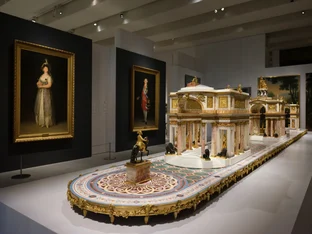
Originally built as a 17th-century orphanage, this museum bears an ornate facade by Pedro de Ribera featuring San Fernando, patron saint of orphans. Inside is a vast array of maps, drawings, and photos of Madrid up to 1840. A major attraction is the superb large model of the whole city as laid out in 1833. It was reopened to the public after renovation work in 2005.

Continue south down Calle Fuencarral and take the sixth street on your left, Calle August Figueroa. Continue along this road across Calle Hortaleza. Two streets later you'll see Calle Barbieri on your right. Opposite this on your left is:

11. Plaza de Chueca

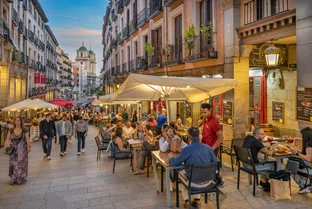
Dedicated to the zarzuela composer Federico Chueca, who died in 1908, this tiny square with its surrounding 19th-century buildings has evolved into the bustling epicenter of gay Madrid. In summer the square is packed with as many cafe tables and raucous crowds as is humanly possible. Around the square, the Chueca district's intricate network of narrow lanes shelter what is probably the highest concentration of cafes, restaurants, bars, and clubs -- some straight, most of them not -- in the city. On weekends the area barely sleeps. (Not surprisingly, inhabitants of the apartments overlooking the square feel compelled to hang signs from their balconies pleading for a reduction in noise.)

From here return to Augusto Figueroa and turn left (east) till you reach Calle Barquillo. Turn right (south) and continue till you see on your right the:

12. Casa de las Siete Chimeneas

Built in 1585, The "House of the Seven Chimneys" achieved fame as the place where Charles I of England stayed in 1624 during a marriage-seeking visit to Madrid (in the end, his plan to wed the Infanta María was unsuccessful). Designed by Juan de Herrera, the Escorial architect, this superb Habsburg building is a surviving gem of Felipe II's regal Madrid, quietly set beside a charming plaza and topped by -- of course -- seven tall chimneys. Just a few minutes yet a world away from Plaza de Chueca.


Back to Top


Maps

Note: This information was accurate when it was published, but can change without notice. Please be sure to confirm all rates and details directly with the companies in question before planning your trip.


  Email This Article Email Print This Article Print Get Frommer's RSS Feed RSS
Frommer's Madrid, 2nd Edition Frommer's Madrid, 2nd Edition

Author: Peter Stone
Pub Date: January 23, 2007
Price: $17.99

Buy Now!
Related Titles:
Frommer's Barcelona Day by Day, 1st Edition
Frommer's Barcelona, 2nd Edition
Frommer's Mediterranean Spain with Your Family: From Tranquil Villages to the Bustling Costas, 1st Edition
Add Frommers.com RSS Feed  Add Frommers.com RSS Feed (What's This?)
Add Frommers.com Deals & News to Your Web Site
Add to My Yahoo!     Add to My MSN     More RSS Readers
Add Frommers.com Podcast Add Frommers.com Podcast (What's This?)
Home > Destinations > Europe > Spain > Madrid > Walking Tours > Walking Tour 4