| Home > Destinations > Europe > Spain > Madrid > In Depth > History |
|
|
||||||
![]() |
||||||
FREE Newsletters! |
Win a FREE Trip! |
|||||
|
|
||||||
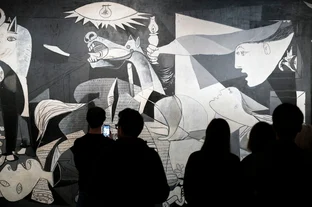
HistoryBarbarian Invasions, the Moorish Kingdom & Reconquest -- Around 200 B.C. the Romans vanquished the Carthaginians and laid the foundations of the present Latin culture. Traces of Roman civilization can still be seen today. By the time of Julius Caesar, Spain (Hispania) was under Roman law and had begun a long period of peace and prosperity. When Rome fell in the 5th century, Spain was overrun, first by the Vandals and then by the Visigoths from eastern Europe. The chaotic rule of the Visigothic kings lasted about 300 years, but the barbarian invaders did adopt the language of their new country and tolerated Christianity as well. In A.D. 711, Moorish warriors led by Tarik crossed over into Spain and conquered the disunited country. By 714, they controlled most of it, except for a few mountain regions around Asturias. For 8 centuries the Moors occupied their new land, which they called al-Andalús, or Andalusia, with Córdoba as the capital. A great intellectual center, Córdoba became the scientific capital of Europe; notable advances were made in agriculture, industry, literature, philosophy, and medicine. The Jews were welcomed by the Moors, often serving as administrators, ambassadors, and financial officers. But the Moors quarreled with one another, and soon the few Christian strongholds in the north began to advance south. In A.D. 852, under Emir Mohamed I Córdoban, Moors constructed the wooden Alcázar (fortress) in Mayrit -- subsequently named Magerit and later Madrid -- on the site of the present Palacio Real (Royal Palace). Its strategic position deterred 11th-century Castilian invaders who mistook what was then little more than a rural village for the bigger city of Toledo. The Reconquest, the name given to the Christian efforts to rid the peninsula of the Moors, slowly reduced the size of the Muslim holdings, with Catholic monarchies forming in northern areas. The three powerful kingdoms of Aragón, Castile, and León were joined in 1469, when Ferdinand of Aragón married Isabella of Castile. Catholic kings, as they were called, launched the final attack on the Moors and completed the Reconquest in 1492 by capturing Granada. That same year Columbus, the Genoese sailor, landed in the West Indies, laying the foundations for a far-flung empire that brought wealth and power to Spain during the 16th and 17th centuries. The Spanish Inquisition, begun under Ferdinand and Isabella, sought to eradicate all heresy and secure the primacy of Catholicism. Non-Catholics, Jews, and Moors were mercilessly persecuted, and many were driven out of the country. Around this time, Madrid was chiefly of interest as a great hunting area, much favored by the monarchs of Castile, and today the El Prado Park north of the city still contains a host of protected wildlife. The Golden Age & Later Decline -- Columbus's voyage to America and the conquistadors' subsequent exploration of that land ushered Spain into its golden age. In the first half of the 16th century, Balboa discovered the Pacific Ocean, Cortés seized Mexico for Spain, Pizarro took Peru, and a Spanish ship (initially commanded by the Portuguese Magellan, who was killed during the voyage) circumnavigated the globe. The conquistadors took Catholicism to the New World and shipped cargoes of gold back to Spain. The Spanish Empire extended all the way to the Philippines. Charles V, grandson of Ferdinand and Isabella, was the most powerful prince in Europe -- king of Spain and Naples, Holy Roman Emperor and lord of Germany, duke of Burgundy and the Netherlands, and ruler of the New World territories. But much of Spain's wealth and human resources were wasted in religious and secular conflicts. First Jews, then Muslims, and finally Catholicized Moors were driven out -- and with them much of the country's prosperity. When Philip II ascended the throne in 1556, Spain could indeed boast vast possessions: the New World colonies; Naples, Milan, Genoa, Sicily, and other portions of Italy; the Spanish Netherlands (modern Belgium and the Netherlands); and portions of Austria and Germany. But the seeds of decline had already been planted. Philip II, a bureaucrat of the first order, made Madrid his capital in 1561 for the simple reason that it was the geographical center of the country, and apart from a temporary 6-year transfer to Valladolid in 1600, the city has occupied that position ever since. As a result of Phillip's decision, the population suddenly expanded fourfold to over 80,000 in barely 40 years, and some of the city's finest sights, from the Plaza Mayor to the Monastery of the Descalzas Reales, emerged in their full glory. Also a fanatic Catholic, Phillip devoted his energies to subduing the Protestant revolt in the Netherlands and to becoming the standard-bearer for the Counter-Reformation. He tried to return England to Catholicism, first by marrying Mary I ("Bloody Mary") and later by wooing her half-sister, Elizabeth I, who rebuffed him. When, in 1588, he resorted to sending the Armada, it was ignominiously defeated; and that defeat symbolized the decline of Spanish power. In 1700, a Bourbon prince, Philip V, raised at Versailles, became king, and the country fell under the influence of France. Many of the changes in Madrid around this time, such as the rebuilding of the Palacio Real and construction of La Granja near Segovia, demonstrate this "Europeanizing" effect. Philip V's right to the throne was challenged by the Archduke Charles of Austria, thus giving rise to the War of the Spanish Succession. When it ended, Spain had lost Flanders, its Italian possessions, and Gibraltar (still held by the British today). During the 18th century, Spain's direction changed with each sovereign. The "enlightened" Charles III (1759-88) developed the country economically, culturally, and aesthetically. He cleaned up the by then "dark foul smelling" capital by building sewers, introducing street lights, constructing monuments, and creating the wide tree-lined Prado Avenue and incomparable Botanical Gardens. But his successor, Charles IV, became embroiled in wars with France, and the weakness of the Spanish monarchy allowed Napoleon to place his brother Joseph Bonaparte on the throne in 1808. The Madrileños put up a spirited but hopeless resistance against these superior odds and it was 4 more years before an allied force under the duke of Wellington was able to drive out the French and restore Madrid and Spain to the Spaniards. The 19th & 20th Centuries -- Although Britain and France had joined forces to restore the Spanish monarchy, the European conflicts encouraged Spanish colonists to rebel. Ultimately, this led the United States to free the Philippines, Puerto Rico, and Cuba from Spain in 1898. In 1876, Spain became a constitutional monarchy. But labor unrest, disputes with the Catholic Church, and war in Morocco combined to create political chaos. Conditions eventually became so bad that the Cortés, or parliament, was dissolved in 1923, and Gen. Miguel Primo de Rivera formed a military directorate. Early in 1930, Primo de Rivera resigned, but unrest continued. On April 14, 1931, a revolution occurred, a republic was proclaimed, and King Alfonso XIII and his family were forced to flee. Initially, the liberal constitutionalists ruled, but soon they were pushed aside by the socialists and anarchists. These adopted a constitution separating church and state, secularizing education, and containing several other radical provisions (for example, agrarian reform and the expulsion of the Jesuits). The extreme nature of these reforms fostered the growth of the conservative Falange party (Falange española, or Spanish Phalanx), modeled after Italy and Germany's fascist parties. By the 1936 elections, the country was divided equally between left and right, and political violence was common. On July 18, 1936, the army, supported by Mussolini and Hitler, tried to seize power, igniting the Spanish Civil War. Gen. Francisco Franco, coming from Morocco to Spain, led the Nationalist (rightist) forces in fighting that ravaged the country. The popular front opposing Franco was forced to rely mainly on untrained volunteers, including a few heroic Americans called the "Lincoln brigade." For those who want an insight into the era, Ernest Hemingway's novel For Whom the Bell Tolls is a good read. It took time to turn untrained militias into an army fit to battle Franco's forces, and time was something the popular front didn't have. It was a war that would attract the attention of the world. By the summer of 1936, the USSR was sending rubles to aid the revolution by the republicans. Even Mexico sent war materiel to the popular front. Most -- but not all -- the volunteers were communists. Italy and Germany contributed war materiel to Franco's forces. Madrid, controlled by the popular front, held out through a brutal siege that lasted for 28 months. Eventually, the government of the popular front moved to Valencia for greater safety in 1936. But in the winter of 1936-37, Franco's forces slowly began to establish power, capturing the Basque capital of Bilbao and eventually Santander. The war shocked the world with its ruthlessness (World War II hadn't happened yet). Churches were burned, and mass executions occurred, especially memorable in the Basque town of Guernica, which became the subject of one of Picasso's most fabled paintings. By October 1, 1936, Franco was clearly in charge of the leadership of nationalist Spain, abolishing popular suffrage and regional autonomy -- in effect, launching a totalitarian rule for Spain. The republicans were split by internal differences, and spy trials were commonplace. At the end of the first year of war, Franco held 35 of Spain's provincial capitals. In 1937, the republican forces were cut in two, and Madrid was left to fend for itself. The last great offensive of the war began on December 28, 1938, with an attack by Franco's forces on Barcelona, which fell on January 26 after a campaign of 34 days. Republican forces fled toward France, as a succession of presidents occurred. On March 28 some 200,000 nationalist troops marched into Madrid, meeting no resistance. The war was over the next day when the rest of republican Spain surrendered. The war lasted 2 years and 254 days, costing some one million lives. To get a sense of the Spanish Civil War, visitors can travel to El Valle de los Caídos (the Valley of the Fallen) outside El Escorial. Although Franco adopted a neutral position during World War II, his sympathies obviously lay with Germany and Italy. Spain, although a nonbelligerent, assisted the Axis powers. This action intensified the diplomatic isolation into which the country was forced after the war's end -- in fact, it was excluded from the United Nations until 1955. Before his death, General Franco selected as his successor Juan Carlos de Borbón y Borbón, son of the pretender to the Spanish throne. After the 1977 elections, a new constitution was approved by the electorate and the king; it guaranteed human and civil rights, as well as free enterprise, and canceled the status of the Roman Catholic Church as the church of Spain. It also granted limited autonomy to several regions, including Catalonia and the Basque provinces, both of which, however, are still clamoring for complete autonomy. In 1981 the fledgling democracy overcame its first test. A group of right-wing military officers seized the Cortés (parliament building) in Madrid and called upon Juan Carlos to establish a Francoist state. The king, however, refused, and the conspirators were arrested. The government's second major accomplishment -- under the Socialist administration of Prime Minister Felipe González, the country's first leftist government since 1939 -- was to gain Spain's entry into the European Community (now Union) in 1986. The '80s was a progressive decade for Madrid, with a highly innovative and imaginative Socialist mayor Enrique Tierno Galván at the helm, still revered and honored with a park in his name today. This was the effervescent and optimistic period of the movida, when the creative arts, long repressed, exploded with an inventive energy that was unprecedented. (It was alas subsequently dampened by his pallid and reactionary '90s Partido Popular successor Alvarez de Manzano, who -- unlamented -- ceded his role in 2004 to the potentially more promising but as yet unproven Alberto Ruiz-Gallardón.) The most shocking news for 2000 was not political, or artistic, but social. Spain came under increasing pressure to conform to short lunch breaks like those in the other E.U. countries. What? No 3-hour siesta? It was heresy. Pro-siesta forces in Spain cited the American custom of "power naps" as reason to retain their beloved afternoon break. In spite of the opposition, large companies began to cut lunch to 2 hours. So the siesta appears to be under serious attack, perhaps as a consequence of the Spanish economy's upswing, which created more new jobs than in any other country in the E.U. More and more families are moving to the suburbs, and more women are joining the workforce. A survey has revealed that only 25% of Spaniards still take the siesta. On other fronts, Spain moved ahead as an economic powerhouse in Latin America, where only 20 years ago it was a minor economic presence. Today, the long-held monopoly of the U.S. in the region is being challenged for the first time since the Spanish-American War of 1898. In the last tally, Spaniards in 1 year poured $20 billion worth of investment value into Latin America. Spain officially abandoned its time-honored peseta and went under the euro umbrella in March 2002. During the transition period, as Spaniards struggled to adjust to the new currency, counterfeiters had a field day. The tragedy of March 11, 2004, when Al Qaeda-linked terrorists blew up three suburban trains in and near the main station of Atocha, causing nearly 200 deaths, revealed the subsequent unity, resilience, and individuality of spirit of the Madrileños. "We were all on that train" became a popular slogan. Three days later -- after 8 years in the wilderness -- the PSOE (Spanish Socialist Party) was reelected to power in an overt rejection of former President Aznar's policy in general and his contribution to the Iraq incursion in particular. The country's populace held him and his party responsible for these terrible consequences. Only time will tell how Aznar's successor, the idealistic, youthful, and yet untried President Zapatero, succeeds in guiding the new democracy. In 2005 Madrid lost out to London in its bid to host the 2012 Olympics, but is still surging ahead with city development plans originally aimed to coincide with that event. It's even advanced some projects so that they'll be ready in time for the municipal elections in 2007. After 4 decades of violence aimed indiscriminately at the military and civil population alike, the Basque terrorist organization ETA announced a "permanent" ceasefire in 2006. As they had already announced a ceasefire several years back only to renege on it 18 months later, the first reaction to this statement was one of extreme caution. However, general revulsion at the 2004 atrocity was such that terrorist groups in Spain have lost most of their remaining supporters, and the likelihood is that this truce will hold. In all events the PSOE is anxious to go ahead with negotiations, with or without the help of the PP, who refuse under any circumstances to deal with ETA.
Note: This information was accurate when it was published, but can change without notice. Please be sure to confirm all rates and details directly with the companies in question before planning your trip.
|
||||||||||||||||||||||||||||||||||||||||||||||||||||||||||||||||||||||||||||||||||||||||||||||||||||||||||||||||||||||||||||||||||||||||||||||||||||||||||||||||||||||||||||||||||||||||||||||||||||||||||||||||||||||||||||||||||||||||||||||||||
| Home | Destinations | Hotels | Trip Ideas | Deals & News | Book a Trip | Tips & Tools | Travel Talk | Bookstore | ||||||||||||||||||||||||
| About Frommer's | FAQ | Contact Us | Help | Site Map | Privacy Policy | Advertise With Us | ||||||||||||||||||||||||
|
||||||||||||||||||||||||
| © 2000-2008 by Wiley Publishing, Inc. All rights reserved. | ||||||||||||||||||||||||
| Home > Destinations > Europe > Spain > Madrid > In Depth > History |