Home > Destinations > Europe > Spain > Madrid > Planning a Trip > Getting Around
Frommers.com Frommers.com
Most Recent Madrid Forum Posts
Most Recommended Articles
Most Commented Articles
  Print This Article Print Get Frommer's RSS Feed RSS

Getting Around

By Metro (Subway)

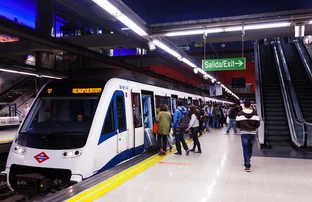
The metro has undergone a huge expansion and modernization program since 2000, first extending to Barajas airport and as far south as Arganda del Rey (29km/18 miles from the center), and today creeping even farther to the north and west. Out of a total of 12 lines, all easily identified by their different colors on the underground map, no less than seven (nos. 1 to 5, 7, and 11) were extended and completed between 2007 and 2008, in addition to a new Metronorte line (complementing the 7-year-old Metrosur line linking the southern satellite towns of Mostoles, Fuenlabrada, and Leganes), which extends the service to Alcobendas and San Sebastian de los Reyes on the north easterly outskirts of the city. In 2007, a metro ligero (literally, "light subway" or jet-age tram similar to the service currently operating in Bilbao and eastern Barcelona) opened on separate lines to the affluent westerly residential towns of Pozuelo de Alarcón and Boadilla del Monte and northerly suburbs of Sanchinarro and Las Tablas. Other outlying new towns are easily reached by the excellent cercanías (suburban lines).

The metro system is perfectly straightforward to learn and use, and it's by far the quickest, simplest, and cheapest way to travel about the city. The central converging point is Sol station (Puerta del Sol), and trains run every 3 to 5 minutes during the day and every 10 to 15 minutes at night. Service begins at 6am (7am on Sun) and finishes around 1:30am. Avoid rush hours 8 to 10am, 1 to 2pm, and 4 to 6pm. Fares are determined by zones traveled. The fare is 1€ ($1.60) for a one-way trip on zone A stops (central) and 1.50€ ($2.40) for zone A and B stops (includes trips to outer Madrid stations such as Arganda del Rey on line 9 and Mostoles on Metrosur). A combined metro and metro ligero ticket costs 1.90€ ($3) one-way. You can save money on public transportation by purchasing a combined ten-in-one metrobus ticket, costing 7€ ($11) from any metro ticket office counter or vending machine as well as at most estancos (tobacco and stamp shops) and in many newspaper kiosks. It covers zone A stops plus trips on red metropolitan buses. For information, call tel. 91-429-31-77.

In the past couple of years, the metro facilities have been radically improved. Shiny comfortable modern trains are gradually replacing the older -- barely post-Civil War -- stock, and stations have been modernized, redecorated in brighter colors, and more warmly lit. Formerly lax no-smoking rules are now rigidly enforced, and traveling underground is now an altogether more agreeable experience (except, inevitably, during the above-mentioned rush hours).

Go to www.metromadrid.es and click on the link at the top-right corner to change to the English page.

By Bus

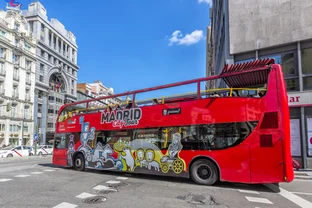
A 150-line network of red buses also services the city and suburbs, with routes clearly shown at each stop on a schematic diagram. The buses, which have the first and last stop on their routes clearly marked, are fast and efficient because they travel along special lanes. Varied schedules operate generally between 6am and 11:30pm, and the time between buses varies from 5 to 20 minutes, depending on the service. Night service operates half-hourly from midnight to 3am and hourly from 3 to 6am, with departure points at Cibeles and Sol and was considerably bolstered in May 2006 with the introduction of a quarter-hourly buhometro (literally "night-owl metro") weekend and fiesta day bus service, which follows all the routes usually covered by the metro when it closes down between 1:30 and 6 or 7am. As with the metro, these bus services charge 1€ ($1.60) per zone A (central) ride and 7€ ($11) for a 10-trip metrobus ticket. In addition to being available at the above-mentioned metro counters, vending machines, estancos (tobacconists), and newspaper kiosks, tickets are also sold at Empresa Municipal de Transportes, Alcántara 24 (tel. 91-406-88-00), where you can buy a guide to the bus routes. The office is open daily from 8am to 2pm.

If you want to go farther afield from Madrid, there are two major bus terminals (Estaciones de Autobuses) and three smaller terminals that provide long and shorter distance bus services to and from Madrid. Though their journeys are more leisurely than those of the faster trains, the long-distance ones are comfortable and economical and use excellent highway systems.

The biggest station, covering mainly southern and southeastern destinations, such as Granada, Sevilla, Málaga, and Valencia, with the operator Avanza (www.avanzabus.com for timetables and routes), is Estacion Sur, Calle Méndez Álvaro (tel. 91-468-42-00; 6:30am to midnight; Metro: Mendez Álvaro). It's also the focal point for a huge variety of international destinations ranging from Morocco to Romania.

Second biggest is the central underground Avenida de America bus and metro station (tel. 91-745-63-00). The Continental Auto company (tel. 91-533-04-00) runs the most buses out of here, providing regular long-distance national services to northern and northeastern cities, including Oviedo, Santander, Bilbao, San Sebastian, Pamplona, and Barcelona.

If you prefer exploring nearby areas in the Comunidad de Madrid or Province of Madrid, as well as nearby provincial cities like Segovia, there are three other stations to know about:

The semi-urban Moncloa (tel. 91-896-90-28) bus and metro station -- adjoining the Parque del Oeste close to University City -- was renovated in 2007 (a busy year). Services run from here to destinations inside Madrid province such as El Escorial, Aranjuez, and Alcalá de Henares.

The Estación La Sepulvedana (tel. 91-530-48-00) was immaculately renovated in 2007 and is now located underground next to the Príncipe Pío railway station . From here, buses run to Segovia and other destinations near Madrid.

And the Plaza Castilla terminus in the north of the city near Chamartín railway station , which in early 2008 metamorphosed into a brand new, well-planned underground terminus -- taking 95% of the traffic away from the antiquated and congested lines of surface stops -- now only runs a skeleton service to a handful of Comunidad de Madrid towns.

By Cercanías (Suburban Line) Train

This excellent provincial train service has 10 lines (C-1 to C-10) operating economically and punctually to a variety of key towns radiating outward from the capital, including Aranjuez and San Lorenzo de El Escorial. Atocha station, Glorieta del Emperador Carlos V (Metro: Atocha RENFE) is the best departure point for southerly destinations, and Chamartín station, Calle Agustín de Foxá (Metro: Chamartín) for northerly ones. Trains run between the two stations and either station, in practice, can be used for all destinations. Tickets (one-way or round-trip) are obtainable from station ticket offices or from machines on which the destinations are clearly marked.

Estación Príncipe Pío or Norte, Paseo del Rey 30 (Metro: Príncipe Pío) is nestled below the Palacio Real, close to the Manzanares River -- and known in Franco's time as the Estación Norte or Estacion de Francia when it served as the main exit and arrival point for northerly European destinations -- and now provides a mainly commuter connection with El Escorial, Alcalá de Henares, and nearby "dormitory" towns, as well as with neighboring provincial capitals such as Avila and Guadalajara. Adjoining the station is a vast commercial center of shops and eating spots, plus a multiplex.

By Taxi

Madrid city cabs are easy to identify as they are black or white and have a red band and small insignia of a bear and madroño tree -- symbols of Madrid -- on the side. You can hail them in the street or pick them up at taxi stands all over the city. A green light on the roof indicates that they're free (libre). When you flag down a taxi, the meter should register 1.75€ ($2.80); for every kilometer thereafter, the fare increases by 1€ ($1.60). A supplement is charged for trips to the railway station or the bullring, as well as on Sunday and holidays.

Warning: Make sure the meter is turned on when you get into a taxi. Otherwise, some drivers assess the cost of the ride, and their assessment, you can be sure, will involve higher mathematics.

Also, there are unmetered taxis that hire out for the day or the afternoon. They are legitimate, but some drivers operate as gypsy cabs. Since they're not metered, they can charge high rates. They are easy to avoid -- always take a black taxi with horizontal red bands or a white one with diagonal red bands.

If you take a taxi outside the city limits, the driver is entitled to charge you twice the rate shown on the meter.

To call a city taxi, dial tel. 91-447-51-80.

By Car

Driving in congested Madrid is a nightmare and potentially dangerous. It always feels like rush hour, although theoretically, these are from 8 to 10am, 1 to 2pm, and 4 to 6pm Monday through Saturday. Parking is next to impossible except in expensive garages. About the only time you can drive around Madrid with a minimum of hassle is in August, when thousands of Madrileños have taken their cars and headed for Spain's vacation oases on the Mediterranean or Atlantic coasts or up in the mountains. Save your car rentals for excursions from the capital. If you drive into Madrid from another city, ask at your hotel for the nearest garage or parking possibility and leave your vehicle there until you're ready to leave.

On the other hand, a car can be useful if you want to really get off the beaten track and explore Madrid Province -- although bus and train transport to all the main places of interest (such as Chinchón, Alcalá de Henares, Aranjuez, El Escorial) is extremely efficient and economical.

Car Rentals -- If you decide you want to rent a car while in Madrid to explore its environs or even to move on, you have several choices.

Although several Spanish car-rental companies exist, I've received lots of letters from readers of previous editions telling me they've had hard times resolving billing irregularities and insurance claims, so you might want to stick with the U.S.-based rental firms.

Note that tax on car rentals is a whopping 15%, so don't forget to factor that into your travel budget. Usually, prepaid rates do not include taxes, which will be collected at the rental kiosk. Be sure to ask explicitly what's included when you're quoted a rate.

Avis (tel. 800/331-1212; www.avis.com) maintains about 100 branches throughout Spain, including about a dozen in Madrid. If you reserve and pay for your rental by telephone at least 2 weeks before your departure from North America, you'll qualify for the company's best rate, with unlimited kilometers included. In addition to its office at Barajas Airport (tel. 91-393-72-22), Avis has a main office in the city center at Gran Vía 60 (tel. 91-547-20-48). You can also get competitive rates from Hertz (tel. 800/654-3131; www.hertz.com), which has an office at Barajas Airport (tel. 91-393-72-28) and another in the heart of Madrid in the Edificio España, Gran Vía 88 (tel. 91-542-58-03).

Two other agencies of note include Kemwel Holiday Auto (tel. 877/820-0668; www.kemwel.com) and Auto Europe (tel. 800/223-5555; www.autoeurope.com).

The companies above require that drivers be at least 21 years of age and, in some cases, not older than 72. To be able to rent a car, you must have a passport and a valid driver's license; you must also have a valid credit card or a prepaid voucher. An international driver's license is not essential, but you might want to present it if you have one; it's available from any North American office of the American Automobile Association (AAA). Most cars hired in Spain are stick shift, not automatic, and are air-conditioned.

Petrol/Gas -- Most cars run on unleaded gas (current cost 1.35€/$2.15 per liter, or 5.10€/$8.15 per gallon) and there's no shortage of gas stations.

Driving Rules -- Spaniards drive on the right side of the road. Drivers should pass on the left; local drivers sound their horns when passing another car and flash their lights at you if you're driving slowly (slowly for high-speed Spain) in the left lane. Autos coming from the right have the right-of-way.

Spain's express highways are known as autopistas, which charge a toll, and autovías, which don't. To exit in Spain, follow the SALIDA (exit) sign, except in Catalonia, where the exit sign says SORTIDA. On most express highways, the speed limit is 120kmph (75 mph). On other roads, speed limits range from 90kmph (56 mph) to 100kmph (62 mph). You will see many drivers far exceeding these limits.

The greatest number of accidents in Spain is recorded along the notorious Costa del Sol highway, Carretera de Cádiz.

If you must drive through Madrid -- or any other Spanish city -- try to avoid morning and evening rush hours. Never park your car facing oncoming traffic, as that is against the law. If you are fined by the highway patrol (Guardia Civil de Tráfico), you must pay on the spot. Penalties for drinking and driving are very stiff (breathalyzers are now being far more strictly used than in the past). The limit amounts to two standard glasses of beer or wine, so take care when washing down those tapas. A new penalty points system used against local drivers for speeding, overtaking on double lines, and other infractions has reduced accidents to a small extent, thus in theory making it fractionally safer on the roads, though the volatile Latin temperament is still loudly and frequently expressed by incontinent horn blowing.

Maps -- For one of the best overviews of the Iberian Peninsula (Spain and Portugal), get Michelin map no. 990 (folded version) or map no. 460 (spiral-bound version). For more detailed looks at Spain, Michelin has a series of six maps (nos. 441-446) showing specific regions, complete with many minor roads.

For extensive touring, purchase Mapas de Carreteras -- España y Portugal, published by Almax Editores and available at most leading bookstores in Spain. This cartographic compendium of Spain provides an overview of the country and includes road and street maps of some of its major cities.

The American Automobile Association (www.aaa.com) publishes a regional map of Spain that's available free to members at most AAA offices in the United States. Incidentally, the AAA is associated with the Real Automóvil Club de España (RACE; tel. 90-240-45-45; www.race.es). This organization can supply helpful information about road conditions in Spain, including tourist and travel advice. It will also provide limited road service, in an emergency, if your car breaks down.

Breakdowns -- These can be a serious problem. If you're driving a Spanish-made vehicle that needs parts, you'll probably be able to find them. But if you are driving a foreign-made vehicle, you may be stranded. Have the car checked before setting out on a long trek through Spain. On a major motorway, you'll find strategically placed emergency phone boxes. On secondary roads, call for help by asking the operator to locate the nearest Guardia Civil, which will put you in touch with a garage that can tow you to a repair shop.

As noted above, the Spanish affiliate of AAA can provide limited assistance in the event of a breakdown.

By Bicycle

While it's hardly recommendable to try and ride a bike in the city center due to the twin dangers of inhaling polluted air and getting knocked off your bike by hordes of impatient car drivers, there are, surprisingly, parts of the capital where you can enjoy a spin, such as the wooded parklands of the Casa de Campo and Dehesa de la Villa, which are full of easily navigable trails. Also, some city streets are closed to traffic on Sunday from 11am to 2pm (Calle Fuencarral, for example, between the Bilbao and Quevedo roundabouts), giving you a brief, hassle-free opportunity to explore more urban areas on two wheels. The ever-expanding network of urban bicycle trails presently totals 70km (44 miles).

The following two companies rent bicycles at reasonable prices:

You can hire a bike from Karacol Sport, Calle Tortosa 8 (tel. 91-539-9633; www.karacol.com; daily 10:30am-3pm and 5-8pm [Thurs till 9:30pm]; Metro: Atocha) for 18€ ($29) per day. A cash deposit of 50€ ($80) and photocopy of your passport are required. Their offices are conveniently located near Atocha railway station so it's easy to put the bike on the train and journey in relaxed style as far as amenable places such as Aranjuez, where the terrain is flat and you can explore parks and riverside trails.

At Bicimania, Calle Palencia 20 (tel. 91-533-11-89; www.bicimania.com; Mon-Sat 10:30am-2pm and 5-8:30pm; Metro: Alvarado), in the westerly Tetuan district, you can rent a bike for all-day and weeklong excursions. It costs 18€ ($29) for a single weekday, 30€ ($48) for an entire weekend, or 80€ ($130) for the week; and a cash deposit of 150€ ($240) is required (500€/$800 for bikes with back suspension). You'll also need to bring a copy of your passport.

For general information on cycling around Madrid province, go online to the Spanish only website www.amigosdelciclismo.com/rutas/madrid.


Back to Top


Note: This information was accurate when it was published, but can change without notice. Please be sure to confirm all rates and details directly with the companies in question before planning your trip.


  Print This Article Print Get Frommer's RSS Feed RSS
Destination Guide
Destination Guide Destination Guide Destination Guide
Destination Guide Destination Guide Frommer's Madrid, 3rd Edition Destination Guide Frommer's Madrid, 3rd Edition

Author: Peter Stone
Pub Date: January 20, 2009
Price: $17.99

Add to Cart
Destination Guide Destination Guide Destination Guide Related Titles:
Frommer's 24 Great Walks in Barcelona, 1st Edition
Destination Guide
Frommer's 25 Great Drives in Spain
Destination Guide
Frommer's Barcelona Day by Day, 1st Edition
Destination Guide
Destination Guide Destination Guide
Destination Guide Destination Guide Destination Guide
Destination Guide
Destinations
Destinations
Home > Destinations > Europe > Spain > Madrid > Planning a Trip > Getting Around