| Home > Destinations > Europe > Spain > Madrid > In Depth > Food & Drink |
|
|
||||||
![]() |
||||||
FREE Newsletters! |
Win a FREE Trip! |
|||||
|
|
||||||
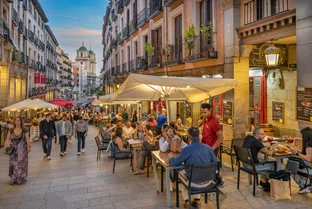
Food & DrinkMeals are an extremely important social activity in the Spanish capital, whether that means eating out late at night or hosting large family gatherings for lunch. Although the city is faster paced than it once was, few Madrileños race through a meal on the way to an appointment. The food choices in the capital are extremely varied, and culinary traditions from all over the country are well represented. Portions are immense, but prices, by North American standards, can be high. Whenever possible, try the traditional Castilian specialties. Most restaurants close 1 day a week, so be sure to check ahead. Hotel dining rooms are generally open all week long. Generally, reservations are not necessary, except at the most popular or highly acclaimed restaurants. Meals Breakfast -- The day starts with a continental breakfast of coffee, hot chocolate, or tea, with assorted rolls, butter, and jam. Spanish breakfast might also consist of churros (fried fingerlike doughnuts) or porras (basically larger churros that Madrileños habitually down in threes; note, however, that you should be wary of eating more than a couple yourself -- they're very filling). Either version can be accompanied by hot chocolate that is very sweet and thick, but most Spaniards simply have coffee, usually strong, served with hot milk: either a café con leche (half coffee, half milk) or cortado (a shot of espresso "cut" with a dash of milk). If you find it too strong and bitter for your taste, you might ask for a more diluted café americano. Lunch -- The most important meal of the day in Spain, lunch is comparable to the farm-style midday "dinner" in the United States. It usually includes three or four courses, beginning with a choice of soup or several dishes of hors d'oeuvres called entremeses. Often a fish or egg dish is served after this, and then a meat course with vegetables. Wine is always part of the meal. Dessert is usually pastry, custard, or assorted fruit -- followed by coffee. Lunch is served from 1 to 4pm, with "rush hour" at 2pm. Tapas -- After the early evening stroll, many Spaniards head for their favorite tascas, bars where they drink wine and sample assorted tapas, or snacks, such as bits of fish, eggs in mayonnaise, or olives. Because many Spaniards eat dinner very late, they often have an extremely light breakfast, certainly coffee, and perhaps a pastry. However, by 11am they are often hungry and lunch might not be until 2pm or later, so many Spaniards have a late-morning snack, often at a cafeteria. Favorite items to order are an empanada (slice of meat or fish pie from Galicia) or tortilla (Spanish omelet with potatoes) accompanied by a copa of wine or a caña (small glass) of beer. (If you want a larger beer ask for a doble.) Many request a large tapa, such as calamares (squid) or callos (tripe) also served with bread and wine (or beer). Dinner -- Dinner in Madrid is another extravaganza. A typical meal starts with a bowl of soup, followed by a second course, often a fish dish, and by another main course, usually veal, beef, or pork, accompanied by vegetables. Again, desserts tend to be fruit, custard, or pastries. Naturally, if you had a heavy and late lunch and stopped off at a tapas bar or two before dinner, supper might be much lighter, perhaps some cold cuts, sausage, a bowl of soup, or even a Spanish omelet made with potatoes. Wine is always part of the meal. Afterward, you might have a demitasse and a fiery Spanish brandy, orujo (equivalent of the gritty French marc or Italian grappa) or anís (anise-flavored liquor, a specialty of nearby Chinchón). The normal dining hour is 10 or 10:30pm. The Cuisine Soups & Appetizers -- Soups are usually served in big bowls. Cream soups, such as asparagus and potato, can be fine; too often, however, they are made from powdered envelope soups such as Knorr and Liebig. Served year-round, chilled gazpacho is tasty and particularly refreshing during the hot months. The combination is pleasant: olive oil, garlic, ground cucumbers, and raw tomatoes with a sprinkling of croutons. Spain also offers several varieties of fish soup -- sopa de pescado -- and many of these are superb. In the paradores (government-run hostelries) and top restaurants, as many as 15 tempting hors d'oeuvres are served. In lesser-known places, avoid these entremeses, which often consist of last year's sardines and shards of sausage left over from the Moorish conquest. Eggs -- These are served in countless ways. A Spanish omelet, a tortilla española, is made with potatoes and usually onions. A simple omelet is called a tortilla francesa. A tortilla portuguesa is similar to the American Spanish omelet. Fish -- Spain's fish dishes tend to be outstanding and vary from province to province. One of the most common varieties is merluza (sweet white hake). Langosta, a variety of lobster, is seen everywhere -- it's a treat but terribly expensive. (Gourmets relish the seawater taste; others find them tasteless.) Rape (pronounced "rah-peh") is the Spanish name for monkfish, a sweet, wide-boned ocean fish with a scalloplike texture. Also try a few dozen half-inch baby eels. They rely heavily on olive oil and garlic for their flavor, but they taste great. Squid cooked in its own ink is suggested only to those who want to go native. Charcoal-broiled sardines, however, are a culinary delight -- a particular treat in the Basque provinces. Trout Navarre is one of the most popular fish dishes, usually stuffed with bacon or ham. Among the superb shellfish brought in daily from Spain's Atlantic coasts, gambas (prawns) and mejillones (mussels) are widely available. Gambas al ajillo (prawns cooked in garlic in a small earthenware dish) and mejillones al vapor (steamed mussels) are two popular variations. Paella -- You can't go to Spain without trying the country's celebrated paella. Flavored with saffron, paella is an aromatic rice dish usually topped with shellfish, chicken, sausage, peppers, and local spices. Served authentically, it comes steaming hot from the kitchen in a metal pan called a paellería. (Incidentally, what is known in the U.S. as Spanish rice isn't Spanish at all. If you ask an English-speaking waiter for Spanish rice, you'll be served paella.) Meats -- Don't expect Kansas City steak, but do try the spit-roasted suckling pig, so sweet and tender it can often be cut with a fork. The veal is also good, and the Spanish lomo de cerdo, loin of pork, is unmatched anywhere. Tender chicken is most often served in the major cities and towns today, and the Spanish are adept at spit-roasting it until it turns a delectable golden brown. However, in more remote spots of Spain, "free-range" chicken is often stringy and tough. Vegetables & Salads -- Through more sophisticated agricultural methods, Spain now grows more of its own vegetables, which are available year-round, unlike days of yore, when canned vegetables were used all too frequently. Both potatoes and rice are a staple of the Spanish diet, the latter a prime ingredient, of course, in the famous paella originating in Valencia. Salads don't usually get the attention they do in California, here often made simply with just lettuce, onions, and tomatoes. Desserts -- The Spanish do not emphasize dessert, often opting for fresh fruit. Flan, a home-cooked egg custard, appears on all menus -- sometimes with a burnt-caramel sauce in a version known as crema catalana. Ice cream appears on nearly all menus as well. Your best bet is to ask for a basket of fruit, which you can wash at your table. Homemade pastries are usually moist and not too sweet. As a dining oddity -- although it's not at all odd to Spaniards -- many restaurants serve fresh orange juice for dessert. Olive Oil & Garlic -- Olive oil is used lavishly in Spain, the largest olive grower on the planet. If you prefer your fish grilled in butter, the word is mantequilla. (In some instances, you'll be charged extra for the butter.) Garlic is also an integral part of the Spanish diet, and even if you love it, you may find Spaniards love it more than you do and use it in even the oddest combinations. What to Drink Water -- It is generally safe to drink water in Madrid. If you're traveling in remote areas, play it safe and drink bottled water. Among the most popular noncarbonated bottled drinks in Spain are Font Vella from Cataluña, Solan de Cabras from Cuenca, Lanjarón from Granada, and Solares, which is from Andalusia. Nearly all restaurants and hotels have it. Bubbly water is agua mineral con gas (Vichy Catalan is a good one to try here); noncarbonated, agua mineral sin gas. Note that bottled water in some areas may cost as much as the regional wine. Soft Drinks -- In general, avoid the carbonated citrus drinks on sale everywhere. Most of them never saw an orange, much less a lemon. If you want a citrus drink, order old, reliable Schweppes. An excellent noncarbonated drink for the summer is called Tri-Naranjus, which comes in lemon and orange flavors. Your cheapest bet is a liter bottle of gaseosa, which comes in various flavors. In summer you should also try an horchata. Not to be confused with the Mexican beverage of the same name, the Spanish horchata is a sweet, milklike beverage made of tubers called chufas. In hot weather granizados (crushed-ice drinks) of lemon, orange or even coffee are very popular but watch the price if you're having one in an outdoor cafe in the Castellana avenue or Retiro park. Coffee -- Even if you are a dedicated coffee drinker, you may find the café con leche (coffee with milk) a little too strong. I suggest leche manchada, a little bit of strong, freshly brewed coffee in a glass that's filled with lots of frothy hot milk. If you're really desperate for American-style coffee, you can now try Starbucks, which has opened several Madrid branches in the past couple of years. Milk -- In the largest cities you get bottled milk, but it loses a great deal of its flavor in the process of pasteurization. In all cases, avoid untreated milk and milk products. The best brand of fresh milk is Lauki. Beer -- Beer (cerveza) is now drunk everywhere and is rapidly superseding wine as the most popular tipple. Domestic brands include San Miguel, Aguila, Cruz Blanca, Cruzcampo, and, last but not least, Mahou (which is made in Madrid). Bottled or draft versions of the latter are widely available, usually in the form of a caña, a small glass drawn from the barril or cask. Note: There is an old Madrid ruling that alcoholic drinks -- beer, wine, vermut -- must be accompanied by a nourishing tidbit in order to "lesson their noxious influence," so you usually get a small free tapa thrown in with your tipple, especially in the cheaper, more traditional bars. Wine -- Sherry (vino de Jerez) has been called "the wine with a hundred souls." Drink it before dinner (try the topaz-colored finos, a dry and very pale sherry) or whenever you drop into some old inn or bodega for refreshment; many of them have rows of kegs with spigots. Manzanilla, a golden-colored medium-dry sherry, is extremely popular. The sweet cream sherries (Harvey's Bristol Cream, for example) are favorite after-dinner wines (called olorosos). While the French may be disdainful of Spanish table wines, they can be truly noble, especially two leading varieties, Rioja and Navarra. Wines from westerly Extremadura are also beginning to make an impact, and several Extremeño wine bars have recently opened in the capital. If you're not too exacting in your tastes, you can always ask for the vino de la casa (house wine) wherever you dine. (This is likely to be a quaffable drop from Toledo or La Mancha.) The Priorat of Catalonia, meanwhile, is heavy, though its rival Penedès comes across as a more subtle vino. From Andalusia comes the fruity sherry-like Montilla. Spain has some good local sparkling wines (cavas), such as Freixenet and Codorníu, especially the Non Plus Ultra variety. One brand, Benjamín, comes in individual-size bottles. Beginning in the 1990s, based partly on subsidies and incentives from the European Union, Spanish vintners have scrapped most of the country's obsolete winemaking equipment, hired new talent, and poured time and money into the improvement and promotion of wines from even high-altitude or arid regions not previously suitable for wine production. Thanks to irrigation, improved grape varieties, technological developments, and the expenditure of billions of pesetas, bodegas and vineyards are sprouting up throughout the country, opening their doors to visitors interested in how the stuff is grown, fermented, and bottled. These wines are now earning awards at wine competitions around the world for their quality and bouquet. Even Madrid province wines, ignored for years and still straining at the leash to prove themselves, have improved out of all recognition. The Jesús Díaz bodega from Colmenar de Oreja, south of the capital near Chinchón, has already won several prizes for its fragrant reds. Interested in impressing a newfound Spanish friend over a wine list? Consider bypassing the usual array of Riojas, sherries, and sparkling Catalonian cavas in favor of, say, a Galician white Albariño from Rías Baixas, which some connoisseurs consider the perfect accompaniment for seafood. Among reds, make a beeline for vintages from the fastest-developing wine region of Europe, the arid, high-altitude district of Ribera del Duero, near Burgos, whose alkaline soil, cold nights, and sunny days have earned unexpected praise from winemakers (and encouraged massive investments) in the past 5 years. For more information about these or any other of the 10 wine-producing regions of Spain (and the 39 officially recognized wine-producing Denominaciones de Orígen scattered across those regions), contact Wines from Spain, c/o the Commercial Office of Spain, 405 Lexington Ave., 44th Floor, New York, NY 10174-0331 (tel. 212/661-4959). Sangria -- The all-time favorite refreshing drink in Spain, sangria is a red-wine punch that combines wine with oranges, lemons, gaseosa (seltzer), and sugar. Be careful, however; many joints that do a big tourist trade produce a sickly-sweet Kool-Aid version of sangria for unsuspecting visitors. Other places may also add an unwelcome amount of cheap coñac or anís to the drink. Whiskey & Brandy -- Imported whiskeys are available at most Spanish bars but at a high price. If you're a drinker, switch to brandies and cognacs, where the Spanish reign supreme (though Spanish coñacs tend to be sweeter and darker than their French counterparts). Try Fundador, made by the Pedro Domecq family in Jerez de la Frontera. If you find this a bit raw and want a slightly smoother coñac, ask for the "103" white label, while for something yet more mellow -- and pricey -- Magno or Carlos III are an appreciable step up. If money is no object, splash out on a Lepanto or Gran Duque de Alba, both of which are served from decanters and guaranteed to send you floating in a mellow haze up the Gran Vía.
Note: This information was accurate when it was published, but can change without notice. Please be sure to confirm all rates and details directly with the companies in question before planning your trip.
|
||||||||||||||||||||||||||||||||||||||||||||||||||||||||||||||||||||||||||||||||||||||||||||||||||||||||||||||||||||||||||||||||||||||||||||||||||||||||||||||||||||||||||||||||||||||||||||||||||||||||||||||||||||||||||||||||||||||||||||||||||
| Home | Destinations | Hotels | Trip Ideas | Deals & News | Book a Trip | Tips & Tools | Travel Talk | Bookstore | ||||||||||||||||||||||||
| About Frommer's | FAQ | Contact Us | Help | Site Map | Privacy Policy | Advertise With Us | ||||||||||||||||||||||||
|
||||||||||||||||||||||||
| © 2000-2008 by Wiley Publishing, Inc. All rights reserved. | ||||||||||||||||||||||||
| Home > Destinations > Europe > Spain > Madrid > In Depth > Food & Drink |