Home > Destinations > Europe > Spain > Madrid > Getting to Know > Getting There
Bookstore Travel Talk - Our Message Boards Tips and Tools Book a Trip Deals and News Trip Ideas, Activities, Lifestyles Hotels Destinations Frommers.com Home
Frommer's - The best trips start here. Frommer's - The best trips start here.
Sign up for our FREE Newsletters! Win a FREE Trip
  Email This Article Email Print This Article Print Get Frommer's RSS Feed RSS

Getting There

By Plane

Madrid's international airport, Barajas, lies 15km (9 miles) east of the center. The airport has four terminals -- three for international traffic (terminals 2, 3, and 4), and one (terminal 1) for domestic. Terminals 1 to 3, all easily reached from the city center by bus or Metro, are connected by a moving sidewalk. The vast and impressively modernistic Terminals 4 and 4S, which opened in February 2006, have greatly increased the amount of international traffic handled by the airport and are currently reached by bus either from the Colon underground terminal in the center of Madrid, from Barajas town (which adjoins the airport), or from Terminal 2. (By 2007, a Metro link is scheduled to operate from the city center directly to Terminals 4 and 4S.) All terminals have a wide selection of shops and eating spots. For flight information, call tel. 90-235-35-70. Note: It's usually best to allow half an hour to get from the center to the airport.

The most frequent and economical route into the city center from Barajas airport is by bus: Take number 200 bus from Terminals 1 and 2 or 204 bus from Terminal 4. Both these red-colored municipal buses take you to the Avenida de America Metro (subway) and coach station. A one-way ticket costs 1€ ($1.25), and lines operate daily from 6am to 11:30pm. Travel time runs from 20 and 30 minutes, depending on the traffic. Please note that only euros are accepted on this service. (For more information, contact the municipal bus service at tel. 90-250-78-50; Spanish only spoken). From the Avenida de America Metro, lines 4, 6, 7, and 10 link up with the rest of central Madrid.

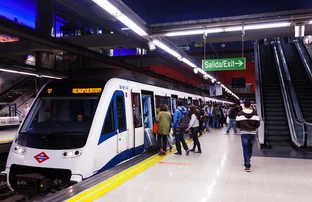
Another convenient way to reach the center is via Metro line 8 (marked pink on the metro map), which departs from Terminal 2. Fitted with luggage racks, trains make the trip in only 12 minutes with three stops along the way. A one-way ticket costs 1€ ($1.25), and the line operates daily from 6am to 1:30am. Trains from Barajas arrive at the Nuevos Ministerios section of Madrid, north of the center. From here you'll have access to two other Metro lines, 10 bus routes, and a number of commuter train lines. The facility at Nuevos Ministerios also has 34 check-in counters for departing flights such as those on Iberia. It's possible to check your luggage and receive boarding passes up to 24 hours in advance, except for the popular Madrid/Barcelona air shuttle.

Terminals 1, 2, and 4 are all linked by a free airport bus shuttle called Bustránsit, which runs every few minutes.

If you go by taxi, expect to pay 25€ to 30€ ($31-$38) and up, plus surcharges, for the trip to the airport and for baggage handling. If you take an unmetered limousine, make sure to negotiate the price in advance.

For more airport information, call the Barajas Airport Authority company Aena at tel. 90-240-47-04 (English spoken) or contact its website www.aena.es.

By Train

Madrid has two major railway stations: Atocha (Av. Ciudad de Barcelona next to the Glorieta del Emperador Carlos V; Metro: Atocha RENFE) and Chamartín (just above Plaza Castilla at Agustín de Foxá; Metro: Chamartín) and one smaller station, Estación Príncipe Pío (also known as Norte; Paseo del Rey 30; Metro: Príncipe Pío).

Originally designed by the late-19th-century architect Alberto del Palacio in a classic Industrial Revolution amalgam of iron and glass, the impressive, ever-expanding Atocha now boasts a comprehensive range of shops, restaurants, and cafes, as well as an indoor tropical garden/conservatory complete with frond-covered ponds inhabited by turtles (don't feed them!). Trains to and from the station connect mainly with southern and eastern Spanish destinations. The high-speed AVE trains to Cordoba (2 hr.) and Seville (2 hr., 40 min.; total refund if it's more than 10 min. late!) depart from Atocha, as do Altaria trains to Valencia (3 hr., 30 min.) and Barcelona (5 hr., 30 min.). You check in at an imposing airport-departure-style lounge.

Chamartín, currently in the throes of a drastic renovation, is scheduled for expansion by 2007 into a combined Metro, train, and bus intercambiador, or junction. The new bus station will eventually replace the current antiquated and congested Plaza Castilla terminus. The Metro station reopened in May 2006 after months of renovation work and by spring 2007 should accommodate four lines instead of the present three. Chamartín currently also has cercanías (suburban train line) connections with Atocha and Nuevos Ministerios. Long-distance trains from here connect with northern cities such as Santander, Burgos, Bilbao, San Sebastian, and Barcelona (a slower service than from Atocha, however) and to many European capitals.

Príncipe Pío, nestled below the Palacio Real close to the Manzanares River, is also known as the Estación Norte. (In Franco's time when it served as the main exit and arrival point for northern European destinations, it was often referred to as the Estación de Francia.) Although the station contains a vast commercial center of shops and eating spots, plus a multiscreen cinema, its sphere of operations has nevertheless become more local, in large part providing a commuter connection with El Escorial, Alcalá de Henares, and nearby "dormitory" towns as well as with neighboring provincial capitals such as Avila.

For information on connections from any of these stations, call RENFE (Spanish Railways) at tel. 90-224-02-02, daily 7am to 11pm. (For a Eurailpass to travel from Madrid to other European countries including neighboring Portugal, visit www.raileurope.com.)

For tickets, go to the principal office of RENFE, Alcalá 44 (tel. 91-506-63-29; Metro: Banco de España). The office is open Monday through Friday 9:30am to 8pm.

The Fast and the Furious -- The Spanish railway system is getting faster and more efficient by the year, while still managing to be a highly affordable means of transport. The quickest way to get to Toledo (30 min.) is now by train. Outstripping that are plans for new high speed AVE by 2007 between Madrid and Valladolid which will do the 200 kilometer trip in 55 minutes (stopping en route after a mere 22 min. at Segovia), and an Altaria connection with Valencia which will take an amazing hour and a half -- cutting nearly 2 hours off the present schedule. Barcelona's connection will be similarly reduced from its present 5 1/2-hour duration to 3 1/4 hours, more than halving its 7 1/2 hour slog of a mere 3 years back.

By Bus

Madrid has two major bus terminals (Estaciones de Autobuses) and two smaller terminals providing long and shorter distance bus services to and from Madrid. Though their journeys take longer than those of the faster trains, they are comfortable and economical and use excellent highway systems.

The biggest bus terminal, covering mainly southern and southeastern destinations such as Granada, Sevilla, Málaga, and Valencia with the operator Auto Res (visit www.auto-res.net for timetables and routes), is Estación Sur, Calle Méndez Alvaro (tel. 91-468-42-00; Metro: Méndez Alvaro). It's also the focal point for a wide variety of international destinations ranging from Morocco to Romania.

At the underground Avenida de America station nearer the center, Continental Auto provides services to northern and northeastern cities including Oviedo, Santander, Bilbao, San Sebastian, Pamplona, and Barcelona.

Conde Casal, close to the northeastern corner of the Retiro Park, operates services to surrounding Castilian destinations such as Zamora, Salamanca, and Cuenca as well as to Alicante and the Costa Blanca.

From the smaller Príncipe Pío terminus opposite the railway station of the same name , La Sepulvedana runs buses to Segovia and other destinations near Madrid.

By Car

Driving in congested Madrid is a nightmare and even potentially dangerous. It always feels like rush hour, although "official" rush hours are Monday through Saturday from 8 to 10am, 1 to 2pm, and 4 to 6pm. Parking is next to impossible except in expensive garages. About the only time you can drive around Madrid with a minimum of hassle is in August, when thousands of Madrileños have taken their cars and headed for Spain's vacation oases. Save your car rentals for excursions from the capital. If you drive into Madrid from another city, ask at your hotel for the nearest garage or parking possibility and leave your vehicle there until you're ready to leave.


Back to Top


Note: This information was accurate when it was published, but can change without notice. Please be sure to confirm all rates and details directly with the companies in question before planning your trip.


  Email This Article Email Print This Article Print Get Frommer's RSS Feed RSS
Frommer's Madrid, 2nd Edition Frommer's Madrid, 2nd Edition

Author: Peter Stone
Pub Date: January 23, 2007
Price: $17.99

Buy Now!
Related Titles:
Frommer's Barcelona Day by Day, 1st Edition
Frommer's Barcelona, 2nd Edition
Frommer's Mediterranean Spain with Your Family: From Tranquil Villages to the Bustling Costas, 1st Edition
Add Frommers.com RSS Feed  Add Frommers.com RSS Feed (What's This?)
Add Frommers.com Deals & News to Your Web Site
Add to My Yahoo!     Add to My MSN     More RSS Readers
Add Frommers.com Podcast Add Frommers.com Podcast (What's This?)
Home > Destinations > Europe > Spain > Madrid > Getting to Know > Getting There