Frommers.com Frommers.com
Most Recent Destination Forum Posts
Most Recommended Articles
Most Commented Articles
  Print This Article Print Get Frommer's RSS Feed RSS

History

Located at the far western end of Tennessee, Memphis sits on a bluff overlooking the Mississippi River. Directly across the river lies Arkansas, and only a few miles to the south is Mississippi. The area, which was long known as the "fourth Chickasaw bluff," was chosen as a strategic site by Native Americans as well as French, Spanish, and finally American explorers and soldiers. The most important reason for choosing this site for the city was that the top of the bluff was above the high-water mark of the Mississippi and, thus, was safe from floods.

Habitation of the bluffs of the Mississippi dates from nearly 15,000 years ago, but it was between A.D. 900 and 1600, during the Mississippian period, that the native peoples of this region reached a cultural zenith. During this 700-year period, people congregated in large, permanent villages. Sun worship, a distinctive style of artistic expression, and mound building were the main characteristics of this culture. The mounds, which today are the most readily evident reminders of this native heritage, were built as foundations for temples and can still be seen in places such as the Chucalissa Archaeological Museum. However, by the time the first Europeans arrived in the area, the mound builders had disappeared and been replaced by the Chickasaw Indians.

As early as 1541, Spanish explorer Hernando de Soto stood atop a 100-foot bluff and looked down on the mighty Mississippi River. More than 100 years later, in 1682, French explorer Sieur de La Salle claimed the entire Mississippi River valley for his country. However, it would be more than 50 years before the French would build a permanent outpost in this region.

In 1739, the French built Fort Assumption on the fourth Chickasaw bluff. From this spot, they hoped to control the Chickasaw tribes, who had befriended the English. By the end of the 18th century, the Louisiana Territory had passed into the hands of the Spanish, who erected Fort San Fernando on the bluff over the Mississippi. Within 2 years the Spanish had decamped to the far side of the river and the U.S. flag flew above Fort Adams, which had been built on the ruins of Fort San Fernando.

A treaty negotiated with the Chickasaw Nation in 1818 ceded all of western Tennessee to the United States, and within the year, John Overton, General James Winchester, and Andrew Jackson (who would later become president of the United States) founded Memphis as a speculative land investment. The town was named for the capital of ancient Egypt, a reference to the Mississippi being the American Nile. However, it would take the better part of the century before the city began to live up to its grand name.

Growth of a River Port -- The town of Memphis was officially incorporated in 1826, and for the next 2 decades grew slowly. In 1845, the establishment of a naval yard in Memphis gave the town a new importance. Twelve years later, the Memphis and Charleston Railroad linked Memphis to Charleston, South Carolina, on the Atlantic coast. With the Mississippi Delta region beginning just south of Memphis, the city played an important role as the main shipping port for cotton grown in the delta. This role as river port, during the heyday of river transportation in the mid-19th century, gave Memphis a link and kinship with other river cities to the north. With its importance to the cotton trade of the Deep South and its river connections to the Mississippi port cities of the Midwest, Memphis developed some of the characteristics of both regions, creating a city not wholly of the South or the Midwest, but rather, a city in between.

In the years before the outbreak of the Civil War, the people of Memphis were very much in favor of secession, but it was only a few short months after the outbreak of the war that Memphis fell to Union troops. Both the Union and the Confederacy had seen the importance of Memphis as a supply base, and yet the Confederates had been unable to defend their city -- on June 6, 1862, steel-nosed ram boats easily overcame the Confederate fleet guarding Memphis. The city quickly became a major smuggling center as merchants sold to both the North and the South.

Within 2 years of the war's end, tragedy struck Memphis. Cholera and yellow fever epidemics swept through the city, killing hundreds of residents. This was only the first, and the mildest, of such epidemics to plague Memphis over the next 11 years. In 1872 and 1878, yellow-fever epidemics killed thousands of people and caused nearly half the city's population to flee. In the wake of these devastating outbreaks of the mosquito-borne disease, the city was left bankrupt and nearly abandoned.

However, some people remained in Memphis and had faith that the city would one day regain its former importance. One of those individuals was Robert Church, a former slave, who bought real estate from people who were fleeing the yellow-fever plague. He later became the South's first African-American millionaire. In 1899, on a piece of land near the corner of Beale and Fourth streets, Church established a park and auditorium where African Americans could gather in public.

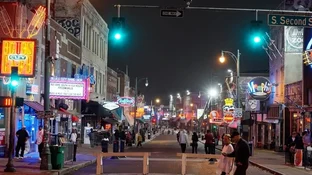
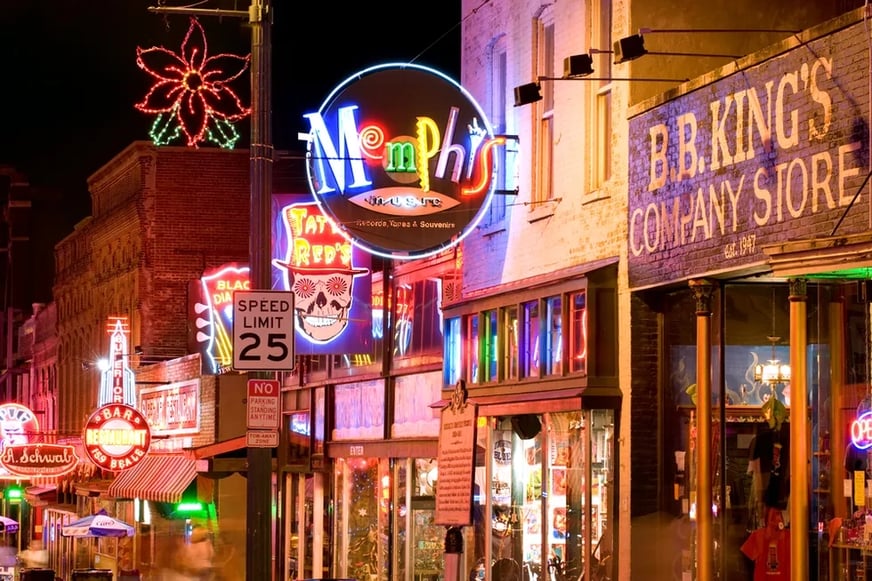
Civil Rights Movement -- In the years following the Civil War, freed slaves from around the South flocked to Memphis in search of jobs. Other African-American professionals, educated in the North, also came to Memphis to establish new businesses. The center for this growing community was Beale Street. With all manner of businesses, from lawyers' and doctors' offices to bars and houses of prostitution, Beale Street was a lively community. The music that played in the juke joints and honky-tonks began to take on a new sound that derived from the spirituals, field calls, and work songs of the Mississippi Delta cotton fields. By the first decade of the 20th century, this music had acquired a name -- the blues.

The music that expressed itself as the blues was the expression of more than a century of struggle and suffering by African Americans. By the middle of the 20th century, that long suffering had been given another voice -- the civil rights movement. One by one, school segregation and other discriminatory laws and practices of the South were challenged. Equal treatment and equal rights with whites was the goal of the civil rights movement, and the movement's greatest champion and spokesman was Dr. Martin Luther King, Jr., whose assassination in Memphis threw the city into the national limelight in April 1968.

In the early months of 1968, the sanitation workers of Memphis, most of whom were African Americans, went out on strike. In early April, Dr. King came to Memphis to lead a march by the striking workers; he stayed at the Lorraine Motel, just south of downtown. On April 4, the day the march was to be held, Dr. King stepped out onto the balcony of the motel and was gunned down by an assassin's bullet. Dr. King's murder did not, as perhaps had been hoped, end the civil rights movement. Today, the Lorraine Motel has become the National Civil Rights Museum. The museum preserves the room where Dr. King was staying the day he was assassinated and includes many evocative exhibits on the history of the civil rights movement. The museum recently received a major renovation and expansion.

By the time of Dr. King's murder, downtown Memphis was a classic example of urban decay. The city's more affluent citizens had moved to the suburbs in the post-World War II years, and the inner city had quickly become an area of abandoned buildings and empty storefronts. However, beginning in the 1970s, a growing desire to restore life to downtown Memphis saw renovation projects undertaken. By the 1980s, the renewal process was well under way, and the 1990s saw a continuation of this slow but steady revitalization of downtown.


Back to Top


Note: This information was accurate when it was published, but can change without notice. Please be sure to confirm all rates and details directly with the companies in question before planning your trip.


  Print This Article Print Get Frommer's RSS Feed RSS
Destination Guide
Destination Guide Destination Guide Destination Guide
Destination Guide Destination Guide Frommer's Nashville & Memphis, 8th Edition Destination Guide Frommer's Nashville & Memphis, 8th Edition

Author: Linda Romine
Pub Date: April 21, 2008
Price: $16.99

Add to Cart
Destination Guide Destination Guide Destination Guide Related Titles:
Frommer's Atlanta, 11th Edition
Destination Guide
Frommer's Maryland & Delaware, 8th Edition
Destination Guide
Frommer's New Orleans 2009
Destination Guide
Destination Guide Destination Guide
Destination Guide Destination Guide Destination Guide
Destination Guide
Destinations
Destinations