Home > Destinations > North America > USA > Tennessee > Memphis > In Depth > The Cradle of American Music
Bookstore Community Tips and Tools Book a Trip Deals and News Trip Ideas, Activities, Lifestyles Hotels Destinations Frommers.com Home
Frommer's - The best trips start here. Frommer's - The best trips start here.
Sign up for our FREE Newsletters! Win a FREE Trip
Most Recommended Articles
Most Commented Articles
  Print This Article Print Get Frommer's RSS Feed RSS

The Cradle of American Music

The blues, rock 'n' roll, and soul are sounds that defined Memphis music, and together these styles have made a name for Memphis all over the world. Never mind that the blues is no longer as popular as it once was, that Memphis long ago had its title of rock-'n'-roll capital usurped (by Cleveland, home of the Rock and Roll Hall of Fame), and that soul music evolved into other styles. Memphis continues to be important to music lovers as the city from which these sounds first emanated.

The blues, the first truly American musical style, developed from work songs and spirituals common in the Mississippi Delta in the late 19th and early 20th centuries. But the roots of the blues go back even farther, to traditional musical styles of Africa. During the 19th century, these musical traditions (brought to America by slaves) went through an interpretation and translation in the cotton fields and churches -- the only places where African Americans could gather at that time. By the 1890s, freed slaves had brought their music of hard work and hard times into the nightclubs of Memphis.

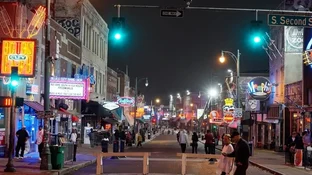
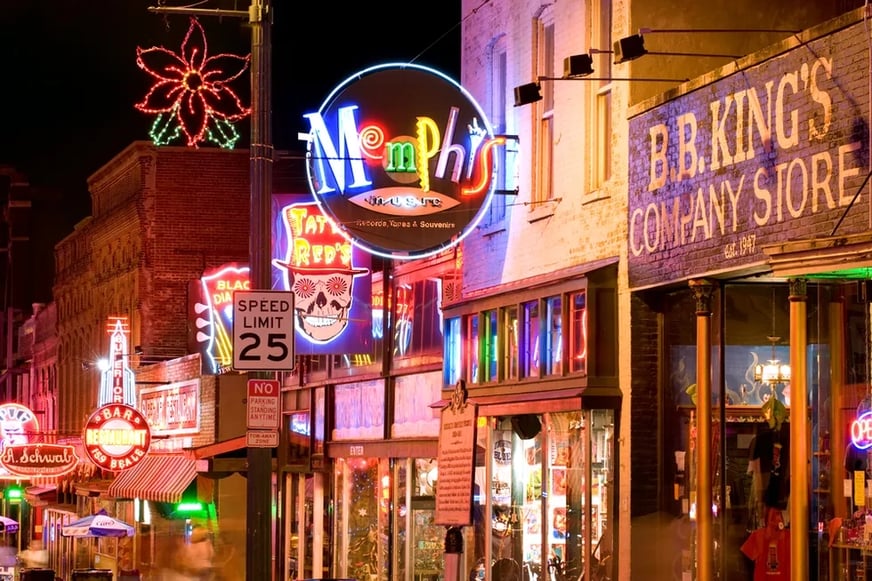
Beale Street -- It was here, on Beale Street, that black musicians began to fuse together the various aspects of the traditional music of the Mississippi Delta. In 1909, one of these musicians, a young bandleader named William Christopher Handy, was commissioned to write a campaign song for E. H. "Boss" Crump, who was running for mayor of Memphis. Crump won the election, and "Boss Crump's Blues" became a local hit. W. C. Handy later published his tune under the title "Memphis Blues." With the publication of this song, Handy started a musical revolution that continues to this day. The blues, which developed at about the same time that jazz was first being played down in New Orleans, would later give rise to both rock 'n' roll and soul music.

Beale Street became a center for musicians, who flocked to the area to learn the blues and showcase their own musical styles. Over the next 4 decades, Beale Street produced many of the country's most famous blues musicians. Among these was a young man named Riley King, who first won praise during an amateur music contest. In the 1940s, King became known as the Beale Street "Blues Boy," the initials of which he incorporated into his stage name when he began calling himself B.B. King. Today, B.B. King Blues Club is Beale Street's most popular nightclub. Several times a year, King performs at the club, and the rest of the year blues bands keep up the Beale Street tradition. Other musicians to develop their style and their first followings on Beale Street include Furry Lewis, Muddy Waters, Albert King, Bobby "Blue" Bland, Alberta Hunter, and Memphis Minnie McCoy.

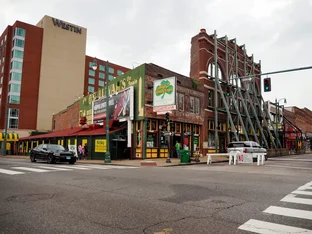
By the time B.B. King got his start on Beale Street, the area was beginning to lose its importance. The Great Depression shut down a lot of businesses on the street, and many never reopened. By the 1960s, there was talk of bulldozing the entire area to make way for an urban-renewal project. However, in the 1970s, an interest in restoring old Beale Street developed. Beginning in 1980, the city of Memphis, together with business investors, began renovating the old buildings between Second and Fourth streets. New clubs and restaurants opened, and Beale Street once again became Memphis's main entertainment district. Today true blues music is harder to find, however, as cover bands playing well-known Sun and Stax hits for tourists dominate the street.

Here Comes the King -- From the earliest days of Beale Street's musical popularity, whites visited the street's primarily black clubs. However, it wasn't until the late 1940s and early 1950s that a few adventurous white musicians began incorporating into their own music the earthy sounds and lyrics they heard on Beale Street. One of these musicians was a young man named Elvis Presley.

In the early 1950s, Sun Studio owner Sam Phillips began to record such Beale Street blues legends as B.B. King, Howlin' Wolf, Muddy Waters, and Little Milton, but his consumer market was limited to the African-American population. Phillips was searching for a way to take the blues to a mainstream (read: white) audience, and a new sound was what he needed. That new sound showed up at his door in 1954 in the form of a young delivery-truck driver named Elvis Presley, who, according to legend, had dropped in at Sun Studio to record a song as a birthday present for his mother. Phillips had already produced what many music scholars regard as the first rock-'n'-roll record when, in 1952, he recorded Jackie Brenston's "Rocket 88."

Two years later, when Elvis showed up at Sun Studio, Phillips knew that he had found what he was looking for. Within a few months of Elvis's visit to Sun Studio, three other musicians -- Carl Perkins, Jerry Lee Lewis, and Johnny Cash -- showed up independently of one another. Each brought his own interpretation of the crossover sound between the blues and country (or "hillbilly") music. The sounds these four musicians crafted soon became known as rockabilly music, the foundation of rock 'n' roll. Roy Orbison would also get his start here at Sun Studio.

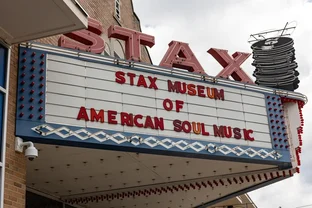
Rock-'n'-Roll, 'n' Soul Too -- In the early 1960s, Memphis once again entered the popular-music limelight when Stax/Volt Records gave the country its first soul music. Otis Redding, Isaac Hayes, Booker T and the MGs, and Carla Thomas were among the musicians who got their start at this Memphis recording studio.

Some 10 years after Sun Studio made musical history, British bands such as The Beatles and The Rolling Stones latched onto the blues and rockabilly music and began exporting their take on this American music back across the Atlantic. With the music usurped by the British invasion, the importance of Memphis was quickly forgotten. Today, Memphis is no longer the musical innovator it once was, though in late 2003 city planners began strategizing on a bold new initiative to promote Memphis as the independent record label capital of the industry. Until that comes to pass, however, there's still an abundance of good music to be heard in its clubs. Musicians both young and old are keeping alive the music that put the city on the map.


Back to Top


Note: This information was accurate when it was published, but can change without notice. Please be sure to confirm all rates and details directly with the companies in question before planning your trip.


  Print This Article Print Get Frommer's RSS Feed RSS
Frommer's Nashville & Memphis, 8th Edition Frommer's Nashville & Memphis, 8th Edition

Author: Linda Romine
Pub Date: April 21, 2008
Price: $16.99

Buy Now!
Related Titles:
Frommer's Atlanta, 10th Edition
Frommer's Maryland & Delaware, 8th Edition
Frommer's New Orleans 2008
Sponsored Links: What's This?
Museums on Us (r) , free admission from Bank of America
Add Frommers.com RSS Feed  Add Frommers.com RSS Feed (What's This?)
Add Frommers.com Deals & News to Your Web Site
Add to My Yahoo!     Add to My MSN     More RSS Readers
Add Frommers.com Podcast Add Frommers.com Podcast (What's This?)
Home > Destinations > North America > USA > Tennessee > Memphis > In Depth > The Cradle of American Music