|
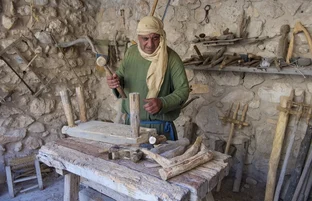
NazarethThere are four major things for tourists to do in Nazareth: Shop in the market, visit the holy Christian shrines, enjoy the many Arabic restaurants and sweet shops in the city, and visit the fascinating "Nazareth Village," a recreation of what life was like in the tiny hamlet of Nazareth at the time of Jesus. Christian Shrines -- The Basilica of the Annunciation is located on Casa Nova Street, on the spot where, according to Christian tradition, the angel Gabriel appeared before Mary, saying: "Behold, thou shalt conceive in thy womb, and bring forth a son, and shall call his name Jesus." The present Basilica of the Annunciation, a beautiful monument completed in 1966, was built over earlier structures dating from 1730 to 1877. The earliest church was built over the grotto in which Mary sat when Gabriel spoke to her. As you enter the basilica, you'll be on the ground (or grotto) level, which is in fact the church's crypt. After you've toured the crypt, walk back to the entrance and you'll see steps up to the nave. Unlike most Christian shrines in Israel, this basilica has a bold, modern design. Around the nave, on the walls, are murals that were created by artists from around the world. Note the Japanese mural of the Madonna and Child on the left (north) wall -- Mary's robe is made entirely of Japanese seed pearls. The mural from the United States, on the right (south) wall, at first seems discordant and excessive, but it works when viewed from the basilica's north-side door. Summer hours are daily from 8 to 11:45am and from 2 to 5:45pm; in winter it's open daily from 9 to 11:45am and from 2 to 4:45pm. (Many of the churches in Nazareth observe these same hours, closing for the "noontime siesta" during the middle of the day.) Walk out the north-side door to reach the other religious sites. The Church of Saint Joseph is 90m (295 ft.) away, constructed on the site believed to have been occupied by Joseph's carpentry workshop. From the sanctuary, stairways on either side go down to another floor below, where you can see old stone construction, an ancient water cistern, and a mosaic floor dating from the Byzantine period. Hours are the same as at the Basilica of the Annunciation, above. On the main street in the bazaar is the Greek Catholic "Synagogue" Church, believed to be the site of the ancient Nazareth synagogue that Jesus frequented: "And He came to Nazareth, where He had been brought up; and, as His custom was, He went into the synagogue on the Sabbath day, and stood up to read" (Luke 4:16). Farther along the road is the Franciscan Mensa Christi Church, believed to occupy the spot where Jesus ate with his disciples after the resurrection. Mary's Well, with its source inside the Greek Orthodox Church of the Annunciation, is another Christian holy site. The church was built at the end of the 17th century over the remains of three former churches. At the church entrance, on the archway above the stone staircase leading down to the well, there is a colorful mural showing the angel Gabriel coming to Mary and announcing in six languages, "Hail, thou that are highly favored, the Lord is with thee: blessed art thou among women." The ceiling is covered with brightly colored murals depicting scenes from the Bible. Proceed through the archway before you and you'll come to the well -- a small spring and a round stone well. The Basilica of Jesus the Adolescent, maintained by the French Salesian order, is one of the most beautiful churches in Nazareth. Built in 1918, the Gothic church contains pillars composed of clusters of slender columns that support the vaulted roof. There's a lovely marble statue of Jesus the Adolescent by the sculptor Bognio. It is a climb to get to the top of the hill north of the center of town, but it is worth the effort. Go down Casa Nova Street to Paul VI Street, turn left, go up 2 blocks, and go down the street to the left of the public fountain; the church is 1 short block up this street, straight ahead. It's open year-round daily from 8am to 5pm. Our Lady of Fright Chapel, sometimes called the Tremore, is built on a wooded hill south of the center opposite the Galilee Hotel. It is on the spot where Mary watched while the people of Nazareth attempted to throw Jesus over a cliff -- the Precipice, or Lord's Leap rock, .5km (1/4 mile) away. Although the majority of Nazareth's population was Christian before the 1950s, the city now has a Muslim majority, and is home to some lovely Islamic structures that are local landmarks (interiors are open only for Muslim prayer). Built between 1960 and 1965, the beautiful and modern Al-Salam Mosque is in the eastern quarter of town, a block away from Paul VI Street. In the southern part of the city is the new Al-Huda Mosque. Walking the Jesus Trail -- For millions of modern travelers, walking in the footsteps of Jesus has come to mean a few feet from a tour bus to the Church of the Annunciation or to the banks of the Jordan River. But in ancient times, people walked everywhere. Now a group of local Israelis has mapped out the routes Jesus would have taken as he crisscrossed the Galilee from Nazareth to Zippori, Kana, and down to the Sea of Galilee, passing olive groves, ancient springs, and historic sites and ruined places. A careful, 65km (40-mile) itinerary (mainly downhill from Nazareth) has been constructed, which can be hiked by independent walkers or done through tour operators and organized tours; included are places to camp, overnight lodgings, places to eat and buy supplies, always with an eye to authenticity and a close feeling for the land. An optional return route to Nazareth includes the ethereal Mount Tabor. For more information, go to www.jesustrail.com. Shopping in the Market -- The market streets, entered via Casa Nova, are narrow, crowded, and highly exotic. Remember that the deeper you get into the market, the smaller the shops become and the lower the prices. One of the first things to note is the trench running dead center of the street, and one of the first precautions is to stay out of it as much as possible -- it's the donkey trail. Snaking upward, the narrow roadway is lined with tin-roofed shops in which you'll see everything from plows and ram's horns to cakes, leather goods, chandeliers, plastic buckets, and fine jewelry. Daily necessities are displayed side by side with antiques from Turkish times that sell for thousands of shekels. You can buy a finjan coffee set here or a kefiya (the Arab headdress). One shop, deep in the market, carries narghilis (bubble pipes). If you're a coin collector, try the tiny shops where you'll find a variety of coins and prices. Whatever you buy, be sure to shop around, and whatever you do, bargain over everything. The old part of town is filled with fabulous stone mansions, many of which are now used as cafes and cultural centers. Check with the tourism office about walking tours being offered of this area.
Click the names below for more detailed information. Note: This information was accurate when it was published, but can change without notice. Please be sure to confirm all rates and details directly with the companies in question before planning your trip.
|
|
|||||||||||||||||||||||||||||||||||||||||||||||||||||||||||||||||||||||||||||||||||||||||||||||||||||||||||||||||||||||||||||||||||||||||||||||||||||||||||||||||||||||||||||||||||||||||||||||||||||||||||