Home > Destinations > Middle East and Africa > Jordan > Petra > Attractions
Bookstore Travel Talk - Our Message Boards Tips and Tools Book a Trip Deals and News Trip Ideas, Activities, Lifestyles Hotels Destinations Frommers.com Home
Frommer's - The best trips start here. Frommer's - The best trips start here.
Sign up for our FREE Newsletters! Win a FREE Trip
  Email This Article Email Print This Article Print Get Frommer's RSS Feed RSS

Attractions

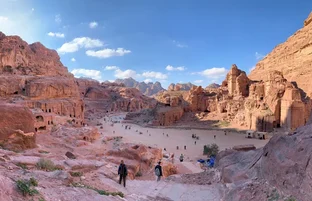
You enter Petra through the siq, a narrow crevice-canyon lined with niches that once held statues of gods and spirits that protected the city. The incredible siq winds its way through the rocks for almost a mile before opening to Petra's wonders of rock and light. Traditionally, visitors entered on horseback, or in special carts. Most visitors now walk from the entrance (beside the visitor center) through the siq. As you proceed through the siq, you feel as if you are in the prologue to a mysterious adventure. The siq's dreamlike, sculptural turnings are almost hallucinatory and separate Petra from the outside, real world. Indeed, Petra was chosen as the location for the climatic sequence of the film Indiana Jones and the Last Crusade for its atmosphere. If you walk through the shadowed siq at twilight, listen for the sound of the evening owl, once the symbol of the city.

The Nabataeans, who carved the elaborate palaces, temples, tombs, storerooms, and stables of their city into the solid rock of the cliffs, dominated the Trans-Jordan area from the 3rd century B.C. through Byzantine times. Little is known of the individual personalities who created Nabatean society. The Nabataeans, a Semitic people from northern Arabia, moved into the Negev and the southern portions of what is now Jordan in the 6th century B.C. They commanded the trade route from Damascus to Arabia; through here the great caravans passed, carrying spices, silk, jewels, gold, and slaves from as far away as Yemen and East Africa. As a trading people, the Nabataeans developed cosmopolitan tastes, and easily incorporated Hellenistic and Roman design into their architecture, and into their style of life. The fabulous facades carved into the rose sandstone cliffs of Petra are exotically Hellenistic rather than classical Greek or even Roman, and reflect the mixture of Western and Eastern, Semitic and European influences in which Nabatean civilization developed.

Nabatean religion was centered around two deities: Dushara, the god of strength and masculine attributes, and al-Uzza, also known as Atargatis, the goddess of water and fertility. Slowly, these deities took on the characteristics of Greek and Egyptian gods; al-Uzza, especially, became associated with elements of Aphrodite, the Greek goddess of love, Tyche, the goddess of fortune, and the Egyptian mother goddess, Isis.

In addition to their hidden capital at Petra, the Nabataeans developed lucrative trading and caravan cities at Avdat, Shivta, and Mamshit, in the Negev. Using careful methods of conserving dew and rainwater, and developing amazingly efficient methods of irrigation that are being studied by modern agronomists, the Nabataeans made the desert bloom and managed to sustain a population in the Negev and south Jordan far larger than the population of that region today.

Until the 1st century A.D., the mysterious Nabataeans skillfully maintained their independence from the Parthians, an Iranian people who ruled Mesopotamia to the east, as well as from the briefly successful Hasmonean Jewish Commonwealth (which lost its independence to Rome in 63 B.C.) and from the Hellenistic and Roman powers to the west. Nabatean neutrality and aloofness was legendary. In 40 B.C., the young Herod, who had recently been made governor of the Galilee and Judea by the Romans, was overthrown by Jewish insurgents. Desperate and pursued, Herod made his way with a small entourage across the desert to Petra to beg for sanctuary and reinforcements. Despite the fact that Herod's mother had been a Nabatean princess, the ever-cautious rulers of Petra denied him permission to enter the siq and the confines of the city (the indefatigable Herod eventually made his way to Rome, obtained reinforcements, put down the rebellion, and ruled as Rome's "King of the Jews" until his death in 4 B.C.). In A.D. 106, the Nabataeans were finally annexed into the Roman Empire. The emperor Hadrian (who put down the Jewish Bar Kochba Revolt of A.D. 132-35, and who built the defensive wall separating Britain from Scotland), visited Petra in A.D. 130. Thereafter the city was known as Petra Hadriane in his honor; it continued to be the center of a highly profitable trading route, with connections to all parts of the Roman Empire.

In the early 4th century, Christianity became the dominant religion of the Nabataeans. Important churches were built in every Nabatean community; the Bishops of Petra participated in ecumenical councils that helped shape the development of the early church. As the Roman Empire collapsed, and the amount of trade moving on the exotic desert routes through Petra shrank, the city's economy faltered. What trade there was tended to be shipped up the Red Sea to Egypt, bypassing the overland route through Nabatean territory. A series of earthquakes in late Byzantine times hastened the Nabataeans' decline. After Petra's conquest by the armies of the newly formed Muslim religion in A.D. 633, traditional trading routes changed, and the region became a forgotten backwater. Petra was briefly fortified by the crusaders, but after its surrender to Saladin in 1189, it sank into almost total oblivion. Not until 1812, when the Swiss explorer Johann Ludwig Burkhardt (who had carefully studied Islamic rituals in order to disguise himself as a Muslim) bribed Bedouin tribesmen to take him to Petra, was the ruined, uninhabited city restored to the knowledge of the world. Only since 1958 has a careful exploration of the site been undertaken.


Back to Top


Maps

Note: This information was accurate when it was published, but can change without notice. Please be sure to confirm all rates and details directly with the companies in question before planning your trip.


  Email This Article Email Print This Article Print Get Frommer's RSS Feed RSS
Frommer's Israel, 4th Edition Frommer's Israel, 4th Edition

Author: Robert Ullian
Pub Date: November 06, 2006
Price: $21.99

Buy Now!
Related Titles:
Frommer's Dubai, 1st Edition
Frommer's Egypt, 1st Edition
Frommer's Istanbul, 1st Edition
Add Frommers.com RSS Feed  Add Frommers.com RSS Feed (What's This?)
Add Frommers.com Deals & News to Your Web Site
Add to My Yahoo!     Add to My MSN     More RSS Readers
Add Frommers.com Podcast Add Frommers.com Podcast (What's This?)
Home > Destinations > Middle East and Africa > Jordan > Petra > Attractions