

| Home > Destinations > Europe > Spain > Traveler's Guide to Art & Architecture > Architecture |
|
|
||||||
![]() |
||||||
FREE Newsletters! |
Win a FREE Trip! |
|||||
|
|
||||||
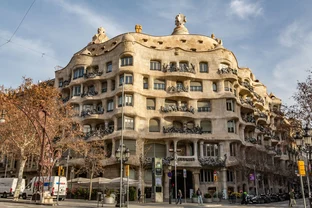
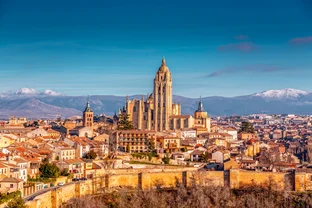
ArchitectureThere are a few points to keep in mind when considering a building's style, particularly for structures built before the 20th century. Very few buildings (especially churches) were actually built in only one style. Massive, expensive structures often took centuries to complete, during which time tastes would change and plans would be altered. While each architectural era has its distinctive features, some elements, general floor plans, and terms are common to many, or may appear near the end of one era and continue through later ones. From the Christian Romanesque period on, most churches consist either of a single wide aisle, or a wide central nave flanked by two narrow aisles. The aisles are separated from the nave by a row of columns, or by square stacks of masonry called piers, usually connected by arches. This main nave/aisle assemblage is usually crossed by a perpendicular corridor called a transept near the far, east end of the church so that the floor plan looks like a Latin cross (shaped like a crucifix). The shorter, east arm of the nave is the holiest area, called the chancel; it often houses the stalls of the choir and the altar. If the far end of the chancel is rounded off, we call it an apse. An ambulatory is a curving corridor outside the altar and choir area, separating it from the ring of smaller chapels radiating off the chancel and apse. Moorish & Mudejar (8th-15th C.) The Moors brought with them an Arabic architectural style that changed over the centuries but kept many features that give their remaining buildings, especially in Andalusia, a distinctly Eastern flair. The early Caliphate style of Córdoba lasted from the 8th to the 11th century, replaced when the Caliphate fell to the simpler, more austerely religious Almohad style in Seville in the 12th and 13th centuries. As the Moors were being driven from most of Spain, in the Arabs' last stronghold of Granada, they constructed the Alhambra in their most sophisticated and ornately decorated style, called Nasrid (13th-14th c.). After the Reconquest, Arab builders living under Christian rule developed the Mudéjar style, embellishing churches and palaces with Moorish elements. The Moors built three major structures: mosques, alcázares, and alcazabas. Mosques, Islamic religious buildings, were connected to minarets, tall towers from which the muezzin would call the people to prayer. Alcázares were palaces built with many small courtyards and gardens with fountains and greenery. (The Arabs started as a desert people, so their version of paradise has an abundance of water.) Alcazabas were fortresses built high atop hills and fortified as any defensive structure. Identifiable Moorish features, with the name of the period when the feature first appeared, include: Mezquita-Catedral de Córdoba is the best-preserved building in the Caliphate style. Of the Almohad period, the best remaining example is Seville's Giralda Tower, a minaret but little altered when its accompanying mosque was converted into a cathedral; the mosque and tower at Zaragosa's Palacio de la Aljafería have survived from the era as well. The crowning achievement of the Nasrid -- of all Spanish Moorish architecture -- is Granada's Alhambra palace and the adjacent Generalife gardens. Romanesque (8th-13th C.) As the Reconquest freed the north of Spain, a pilgrimage route sprang up along the coast to Santiago de Compostela. French and Italian pilgrims and Cistercian monks traveling the route brought the European Romanesque with them, sprinkling the way with many small churches and leaving a mighty cathedral at the trail's end. The Romanesque took its inspiration and rounded arches from ancient Rome (hence the name). Romanesque architects concentrated on building large churches with wide aisles to accommodate the pilgrims. But to support the weight of all that masonry, the walls had to be thick and solid with a few small windows and rest on huge piers, giving Romanesque churches a dark, somber, mysterious, and often oppressive feeling. Identifiable features of the Romanesque include: Although the great Catedral de Santiago de Compostela, the undisputed masterpiece of the style, has many baroque accretions, the floor plan is solidly Romanesque. Other good examples include Sanguesa's Iglesia de Santa María and Iglesia de Santiago. Gothic (13th-16th C.) By the late 12th century, engineering developments freed church architecture from the heavy, thick walls of Romanesque structures and allowed ceilings to soar, walls to thin, and windows to proliferate. Spain imported the style (and often the masons and architects) from its birthplace in France. Instead of dark, somber, relatively unadorned Romanesque interiors that forced the eyes of the faithful toward the altar, the Gothic interior enticed the churchgoers' gazes upward to high ceilings filled with light. The priests still conducted Mass in Latin, but now peasants could "read" the Gothic comic books of stained-glass windows. The French style eventually developed into a genuine Spanish idiom, the elaborate, late-15th-century Isabelline style, named after the Catholic queen. Identifiable features of the Gothic include: The French style of Gothic was energetically pursued in Spain in the early to mid-13th century, first in adapting the Romanesque Catedral de Santa María in Burgos, then in Catedral de Toledo and Catedral de León, the most ornate. Fourteenth- and fifteenth-century Gothic cathedrals include those at Avila, Segovia, Pamplona, Barcelona, and Girona. (The last is a peculiar, aisleless Catalán plan, although the interior is now baroque.) The best of the Isabelline style can be seen in Valladolid in the facades of Iglesia de San Pablo and Colegio San Gregorio. Renaissance (16th C.) As in painting, the rules of Renaissance architecture stressed proportion, order, classical inspiration, and mathematical precision to create unified, balanced structures based on Italian models. The earliest -- and most Spanish -- Renaissance style (really a transitional form from Gothic) was marked by facades done in an almost Moorish intricacy and was called Plateresque, for it was said to resemble the work of silversmiths (plateros). Some identifiable Renaissance features include: The best of the Plateresque decorates the facades of Salamanca's Convento de San Estebán and Universidad. Charles V's Summer Palace built in the middle of Granada's Moorish Alhambra is the greatest High Renaissance building in Spain. The most monumentally classical of Renaissance structures was Phillip II's El Escorial monastery outside Madrid, designed by Juan de Herrera (1530-97), who also started Valladolid's Cathedral in 1580, although the exterior was later finished in flamboyant baroque style. Baroque (17th-18th C.) The overall effect of the baroque is to lighten the appearance of structures and add movement of line and vibrancy to the static look of the classical Renaissance. At the beginning of this period, however, the classicism of Juan de Herrera continued to dominate, making the Spanish baroque more austere and simple than contemporary European versions. But soon the Churriguera family of architects and their contemporaries gave rise to the overly ornate, sumptuously decorated Churriguesque style. Identifiable features include: Madrid's Plaza Mayor is the classic example of the restrained Herrera-style early baroque. Churriguesque masterpieces include Granada's Monasterio Cartuja and Salamanca's Plaza Mayor. The baroque was largely used to embellish existing buildings, such as the fine, ornate facade on Santiago de Compostela's Cathedral. Neoclassical (18th-19th C.) As a backlash against the excesses of the baroque, by the middle of the 18th century, Bourbon architects began turning to the austere simplicity and grandeur of the Classical Age and inaugurated the neoclassical style. Their work was inspired by the rediscovery of Italy's Pompeii and other ancient sites. Identifiable neoclassical features include: The primary neoclassical architect, Ventura Rodríguez (1717-85), designed the facade of Pamplona's Cathedral and Madrid's grand boulevard of the Paseo del Prado. On that boulevard is one of Spain's best neoclassical buildings, the Museo del Prado. Modernisme & Modern (20th C.) In Barcelona, architects such as Lluis Doménech i Montaner (1850-1923) and the great master Antoni Gaudí (1852-1926) developed one of the most appealing, idiosyncratic forms of Art Nouveau, called modernisme. This Catalán variant took a playful stab at building with undulating lines and colorful, broken-tile mosaics. During the long Franco years, architecture languished as utilitarian and bland, but in the late 1990s American Frank Gehry (b. 1929) gave a wake-up call to Spanish architecture with his curvaceous, gleaming silver Guggenheim Museum in Bilbao. Identifiable features of modernisme include: The best of modernisme is in Barcelona, including Gaudí's apartment buildings along Passeig de Gràcia, and his massive unfinished cathedral, La Sagrada Família.
Note: This information was accurate when it was published, but can change without notice. Please be sure to confirm all rates and details directly with the companies in question before planning your trip.
|
|||||||||||||||||||||||||||||||||||||||||||||||||||||||||||||||||||||||||||||||||||||||||||||||||||||||||||||||||||||||||||||||||||||||||||||||||||||||||||||||||||||||||||||||
| Home | Destinations | Hotels | Trip Ideas | Deals & News | Book a Trip | Tips & Tools | Travel Talk | Bookstore | ||||||||||||||||||||||||
| About Frommer's | FAQ | Contact Us | Help | Site Map | Privacy Policy | Advertise With Us | ||||||||||||||||||||||||
|
||||||||||||||||||||||||
| © 2000-2008 by Wiley Publishing, Inc. All rights reserved. | ||||||||||||||||||||||||
| Home > Destinations > Europe > Spain > Traveler's Guide to Art & Architecture > Architecture |