Lynne Neuman
Things To Do in Amelia Island
Bookstore

Available as paperback
and as e-book.
Amelia Island Attractions
There’s a bit of Confederate history in these parts, but not taught in most Florida schools is the fact that during the Jim Crow era, there was a haven for Black people in this area called American Beach, most of which today has been sadly razed by developers who put up pricey vacation homes. Founded by African-American businessman A.L. Lewis, the area was home to restaurants, hotels, night clubs, shops and more, and thrived until 1964, when Hurricane Dora devastated the area. Coast One Tours (tel. 904/635-9081) conducts Black historical tours that will take you to the beach area where NaNa dune—the tallest in all of Florida still exists, as well as to the A. L. Lewis Museum to learn more about the man who found triumph over segregation and disenfranchisement.
Another informative and entertaining way to tour the historic district are 30-minute guided tours on an electric carriage with Jeffers Carriages (tel. 904738-1519). Carriages pick up passengers at the corner of Front and Center streets in Fernandina Beach. Tours start at $40 per person.
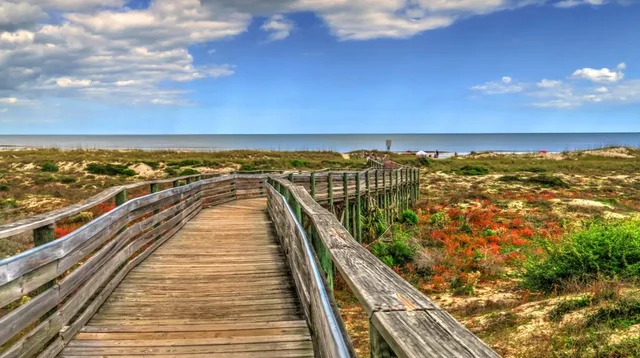
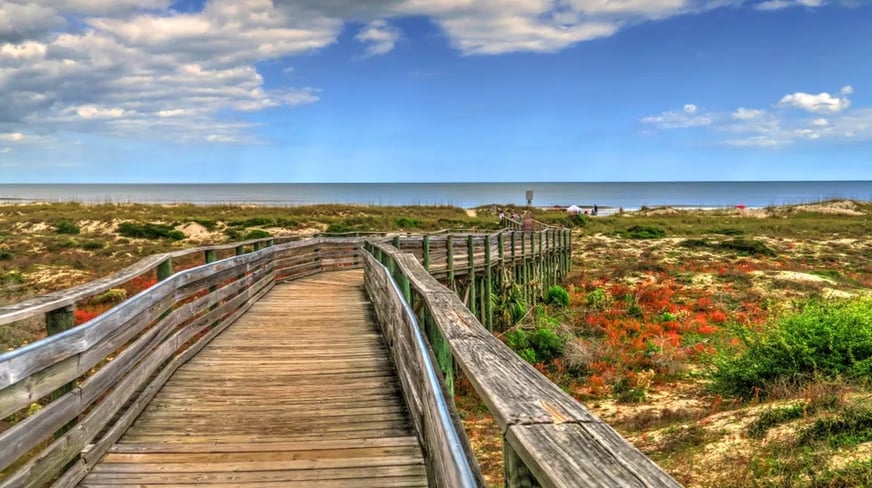
The beach at Fort Clinch State Park (tel. 904/277-7274), which wraps around the island’s heavily forested northern end, is backed by rolling dunes and is filled with shells and driftwood. It’s popular for swimming and surfing, but visitors do so at their own risk, as the beach has no lifeguards. A jetty and pier jutting into Cumberland Sound are popular with anglers. There are showers and changing rooms at the pier. Elsewhere in the park, you might see an alligator—and certainly some of the 170 species of birds that live here—by hiking the Willow Pond nature trail, which is one of the first stops on the Great Florida Birding and Wildlife Trail. Rangers lead nature tours on the trail, usually beginning at 10:30am on Saturday. There are also 3.3 miles of paved roads for biking and 6 miles of off-road bike trails here. See below for information about the historic fort at the park. The park entrance is on Atlantic Avenue near the beach. Entrance fees are $6 per vehicle with up to eight occupants, $2 per pedestrian or bicyclist. The park is open daily from 8am to sunset.
Pets on leashes are allowed on all of the island’s public beaches and in Fort Clinch State Park.
Another informative and entertaining way to tour the historic district are 30-minute guided tours on an electric carriage with Jeffers Carriages (tel. 904738-1519). Carriages pick up passengers at the corner of Front and Center streets in Fernandina Beach. Tours start at $40 per person.
Hitting the Beach on Amelia Island
Thanks to a reclamation project, the widest beaches on island are at the exclusive enclave on the island’s southern third. Even if you aren’t staying at one of the swanky resorts, you can enjoy this section of beach at Peters Point Beach Front Park, on A1A, north of the Ritz-Carlton. The park has picnic shelters and restrooms. North of the resort, the beach has public-access points with free parking every quarter-mile or so. Like Daytona Beach, they allow driving on the sand here, but you must be a resident to do so. The center of activity is Main Beach, at the ocean end of Atlantic Avenue (A1A), with good swimming, restrooms, picnic shelters, showers, a food concession, a playground, and lots of free parking. This area is popular with families.The beach at Fort Clinch State Park (tel. 904/277-7274), which wraps around the island’s heavily forested northern end, is backed by rolling dunes and is filled with shells and driftwood. It’s popular for swimming and surfing, but visitors do so at their own risk, as the beach has no lifeguards. A jetty and pier jutting into Cumberland Sound are popular with anglers. There are showers and changing rooms at the pier. Elsewhere in the park, you might see an alligator—and certainly some of the 170 species of birds that live here—by hiking the Willow Pond nature trail, which is one of the first stops on the Great Florida Birding and Wildlife Trail. Rangers lead nature tours on the trail, usually beginning at 10:30am on Saturday. There are also 3.3 miles of paved roads for biking and 6 miles of off-road bike trails here. See below for information about the historic fort at the park. The park entrance is on Atlantic Avenue near the beach. Entrance fees are $6 per vehicle with up to eight occupants, $2 per pedestrian or bicyclist. The park is open daily from 8am to sunset.
Pets on leashes are allowed on all of the island’s public beaches and in Fort Clinch State Park.
- Museum
A.L. Lewis Museum at American Beach, FLA
Opened in 2014, this fascinating museum was the dream of MaVynee Oshun Betsch, aka “The Beach Lady,” who died in 2005, but happened to have been the great granddaughter of A.L. Lewis, President of the Afro-American Life Insurance Company and a self-made millionaire, who created an… - Museum
Amelia Island Museum of History
Housed in the old Nassau County jail, built of brick in 1878, this award-winning local museum explains Amelia Island’s history, from Timucuan Indian times through its possession by France, Spain, Great Britain, the United States, and the Confederacy. Only an upstairs photo gallery is… - Historic Site
Fort Clinch
Construction on the remarkably well-preserved Fort Clinch began in 1847 on the northern tip of the island and was still underway when Union troops occupied it in 1862. The fort was abandoned shortly after the Civil War, except for a brief reactivation in 1898 during the…