Château d’Angers

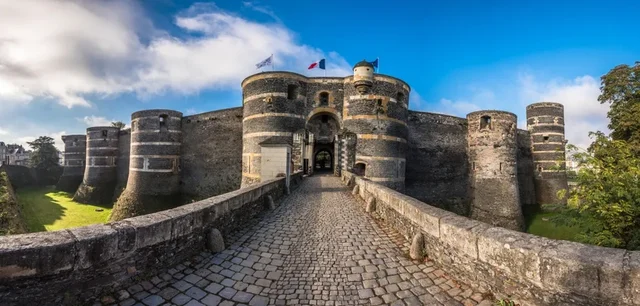
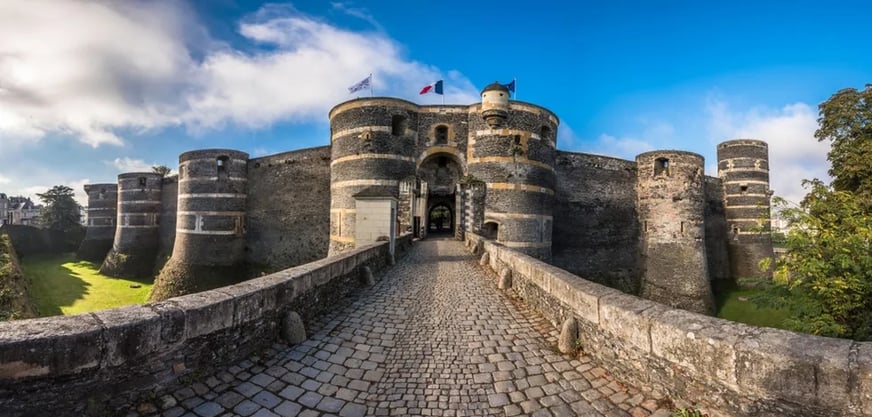
The château, dating from the 9th century, was the base of the comtes d’Anjou. At the end of the 11th century the notorious Black Falcon, Foulques III d’Anjou, who conquered much of the Western Loire, lived here, and in time, the Plantagenets took up residence. From 1230 to 1238, the outer walls and 17 enormous towers were built, creating a fortress. King René favored the château, and during his reign, a brilliant court life flourished until he was forced to surrender to Louis XI. Louis XIV turned the château into a prison. In World War II, the Nazis used it as a munitions depot, and the Allies bombed it in 1944.
Visit the castle to see the Apocalypse Tapestries. They weren’t always so highly regarded—they once served as a canopy to protect orange trees and were also used to cover the damaged walls of a church. Woven in Paris by Nicolas Bataille from cartoons by Jean de Bruges around 1375 for Louis I of Anjou, they were purchased for a nominal sum in the 19th century. The series of 77 sections, illustrating the Book of St. John, stretches 100m (328 ft.).
A full visit should also include the ramparts, windmill tower, and 15th-century chapel. Once you’ve paid the entrance fee, you can take an hour-long guided tour focusing on the architecture and history of the château, or a tour devoted to the Apocalypse Tapestries. Both are available only in French; a self-guided tour with audio guide is available in English.
The château, dating from the 9th century, was the base of the comtes d’Anjou. At the end of the 11th century the notorious Black Falcon, Foulques III d’Anjou, who conquered much of the Western Loire, lived here, and in time, the Plantagenets took up residence. From 1230 to 1238, the outer walls and 17 enormous towers were built, creating a fortress. King René favored the château, and during his reign, a brilliant court life flourished until he was forced to surrender to Louis XI. Louis XIV turned the château into a prison. In World War II, the Nazis used it as a munitions depot, and the Allies bombed it in 1944.
Visit the castle to see the Apocalypse Tapestries. They weren’t always so highly regarded—they once served as a canopy to protect orange trees and were also used to cover the damaged walls of a church. Woven in Paris by Nicolas Bataille from cartoons by Jean de Bruges around 1375 for Louis I of Anjou, they were purchased for a nominal sum in the 19th century. The series of 77 sections, illustrating the Book of St. John, stretches 100m (328 ft.).
A full visit should also include the ramparts, windmill tower, and 15th-century chapel. Once you’ve paid the entrance fee, you can take an hour-long guided tour focusing on the architecture and history of the château, or a tour devoted to the Apocalypse Tapestries. Both are available only in French; a self-guided tour with audio guide is available in English.
Details
Bookstore

Available as paperback
and as e-book.