Basilica de la Sagrada Familia

Architect Antoni Gaudí (1852–1926) was a profoundly religious man, and from 1912 forward he made the design of this soaring basilica his life’s work. If it is not the grandest church in all of Spain, it is certainly the grandest constructed within living memory.
The church was begun in 1882 as a Neo-Gothic cathedral for the poor, but the original architect was soon fired and Gaudí was put in charge aged just 31. He quickly drew up far more ambitious plans and would dedicate the next 40 years of his life to the project, the last 14 exclusively. He even lived on-site.
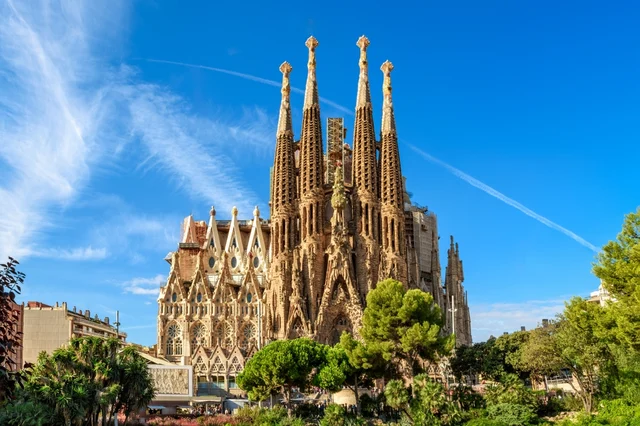
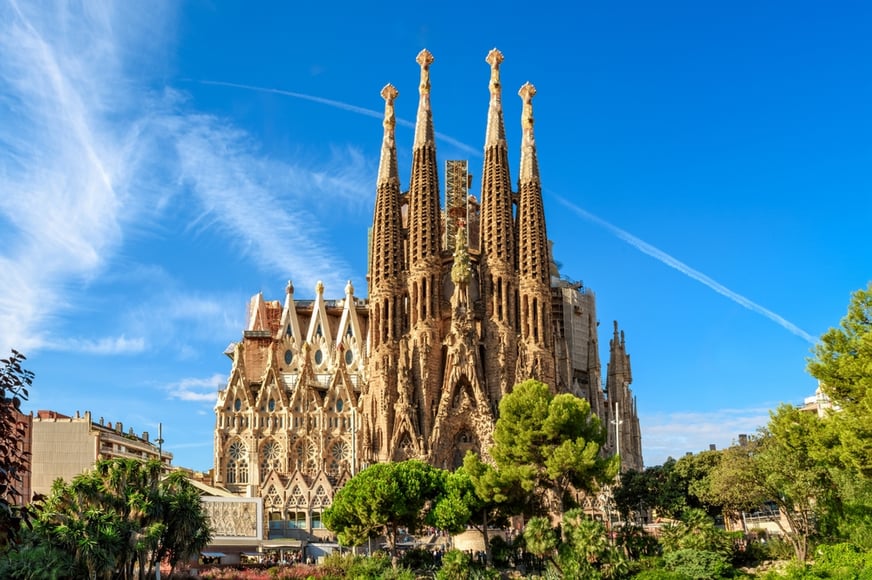
The building showcases both his trial-and-error approach using natural forms and his extreme devotion to God. The church’s original towers on the Nativity Façade look like vast growing vegetables, but every surface is encrusted with carvings depicting stories from the birth and childhood of Christ. Fruits of the seasons surround another set of spires, dragons and gargoyles hang off corners, an entire Noah’s ark of animals is carved in stone.
And that’s just the outside. Gaudí conceived the interior as a vast forest in which the columns seem to grow from the floor with powerful fronds holding the roof aloft. Stained glass creates a magical kaleidoscope of color. “The sun is the best painter,” said the architect.
The soaring interior really seems like a place of worship now, after decades as a construction site that stood open to the elements; the roof finally went on a few years ago, and the target date for completion—2026 originally, now 2032 for all the work—seems within reach.
The building work has always been slow and controversial. When Gaudí died in 1926, after being knocked down by a tram, only one tower had been completed. Work continued using plans and models left by the architect, but when anti-clerical anarchists set fire to the basilica in 1936, many were destroyed. The project languished for decades until, aided by technology to divine Gaudí’s intent, construction moved ahead in the 1980s under the direction of the sculptor Josep Maria Subirachs (1927-2014).
The later work divides opinion. Its skeletal forms and spiky geometric edges seem at odds with Gaudí’s organic vision. The western Passion Façade is especially jarring, with a chunky white pediment that resembles giant Lego blocks. The east façade (of the Nativity), where you will enter, is more in the spirit of Gaudí’s pious Christian view of the New Testament stories, although they appear to have been carved out of volcanic stone, cobwebs, and bat droppings. Dragons and gargoyles hang off corners, and an entire Noah’s ark of preposterous animals (rhinos! elephants!) are carved in stone. Gaudí is buried in a chapel beneath the main church.
Advice for visiting: This UNESCO-listed wonder is worth several hours of your time, spent both inside and out, and the steep admission fee supports the ongoing construction. The cost of the elevator ride up the towers, where the true magnificence of Gaudí’s creation is most visible, is absolutely worth the extra euros. Buying tickets online in advance has become essential, in order to avoid the wait of an hour or more to get inside.
Architect Antoni Gaudí (1852–1926) was a profoundly religious man, and from 1912 forward he made the design of this soaring basilica his life’s work. If it is not the grandest church in all of Spain, it is certainly the grandest constructed within living memory.
The church was begun in 1882 as a Neo-Gothic cathedral for the poor, but the original architect was soon fired and Gaudí was put in charge aged just 31. He quickly drew up far more ambitious plans and would dedicate the next 40 years of his life to the project, the last 14 exclusively. He even lived on-site.
The building showcases both his trial-and-error approach using natural forms and his extreme devotion to God. The church’s original towers on the Nativity Façade look like vast growing vegetables, but every surface is encrusted with carvings depicting stories from the birth and childhood of Christ. Fruits of the seasons surround another set of spires, dragons and gargoyles hang off corners, an entire Noah’s ark of animals is carved in stone.
And that’s just the outside. Gaudí conceived the interior as a vast forest in which the columns seem to grow from the floor with powerful fronds holding the roof aloft. Stained glass creates a magical kaleidoscope of color. “The sun is the best painter,” said the architect.
The soaring interior really seems like a place of worship now, after decades as a construction site that stood open to the elements; the roof finally went on a few years ago, and the target date for completion—2026 originally, now 2032 for all the work—seems within reach.
The building work has always been slow and controversial. When Gaudí died in 1926, after being knocked down by a tram, only one tower had been completed. Work continued using plans and models left by the architect, but when anti-clerical anarchists set fire to the basilica in 1936, many were destroyed. The project languished for decades until, aided by technology to divine Gaudí’s intent, construction moved ahead in the 1980s under the direction of the sculptor Josep Maria Subirachs (1927-2014).
The later work divides opinion. Its skeletal forms and spiky geometric edges seem at odds with Gaudí’s organic vision. The western Passion Façade is especially jarring, with a chunky white pediment that resembles giant Lego blocks. The east façade (of the Nativity), where you will enter, is more in the spirit of Gaudí’s pious Christian view of the New Testament stories, although they appear to have been carved out of volcanic stone, cobwebs, and bat droppings. Dragons and gargoyles hang off corners, and an entire Noah’s ark of preposterous animals (rhinos! elephants!) are carved in stone. Gaudí is buried in a chapel beneath the main church.
Advice for visiting: This UNESCO-listed wonder is worth several hours of your time, spent both inside and out, and the steep admission fee supports the ongoing construction. The cost of the elevator ride up the towers, where the true magnificence of Gaudí’s creation is most visible, is absolutely worth the extra euros. Buying tickets online in advance has become essential, in order to avoid the wait of an hour or more to get inside.
Details
Bookstore
Available as paperback
and as e-book.