La Pedrera (Casa Milà)

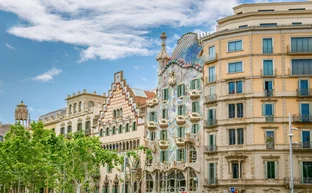
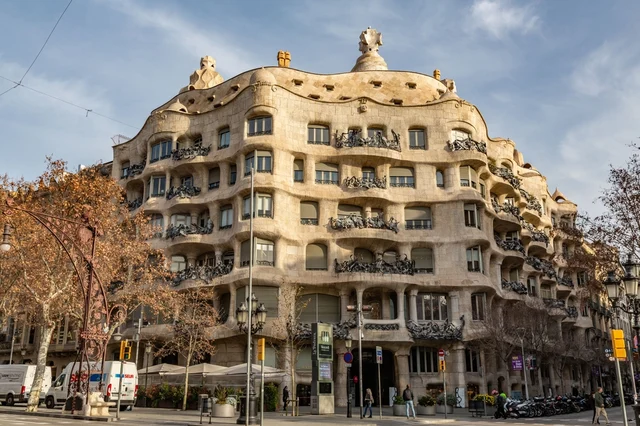
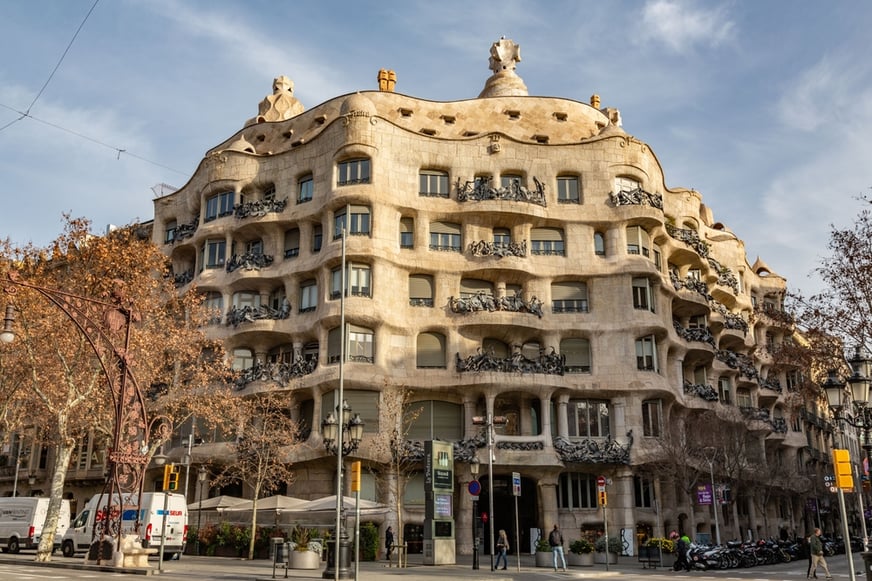
When Gaudí’s last secular commission, Casa Milà, was finished in 1912, the neighbors took one look at the undulating lines of its rough-hewn limestone and dubbed it La Pedrera (“The Quarry”). The nickname has stuck as a term of endearment. With its broad, rippling façade and seemingly windblown wrought iron balconies, it is one of the most beloved of Gaudí’s works, and another spot where buying an advance ticket online will save you time and money.
The standard tour includes a visit to the Tenants’ Apartment, which recreates how a bourgeois Barcelona family would have lived when the building was new, complete with Gaudí-designed fixtures and fittings. Substitute a modern music system for the Edison phonograph, and most visitors would be ready to sign a lease on the spot. (A couple of the building’s apartments are still privately occupied). Above, in the brick-vaulted Whale Attic, photographs, drawings, and models help you to get inside the architect’s mind. (He calculated, for instance, the loads an arch could bear by hanging weights on knotted cord to get the shapes he wanted, then extrapolating to life size.)
Gaudí saved his grandest gestures for the Warrior Rooftop, transforming functional chimneys into a sculpture garden of swirling mosaic forms and ominous hooded warriors. It makes a magical setting for jazz concerts on summer evenings. Amid the chimneys, a parabolic arch frames the steeples of Gaudí’s other masterpiece, La Sagrada Família. Lots of different—and expensive—packages are available. The Night Experience, including a rooftop lightshow and a glass of cava, is not worth the additional outlay, and doesn’t include the apartment visit.
When Gaudí’s last secular commission, Casa Milà, was finished in 1912, the neighbors took one look at the undulating lines of its rough-hewn limestone and dubbed it La Pedrera (“The Quarry”). The nickname has stuck as a term of endearment. With its broad, rippling façade and seemingly windblown wrought iron balconies, it is one of the most beloved of Gaudí’s works, and another spot where buying an advance ticket online will save you time and money.
The standard tour includes a visit to the Tenants’ Apartment, which recreates how a bourgeois Barcelona family would have lived when the building was new, complete with Gaudí-designed fixtures and fittings. Substitute a modern music system for the Edison phonograph, and most visitors would be ready to sign a lease on the spot. (A couple of the building’s apartments are still privately occupied). Above, in the brick-vaulted Whale Attic, photographs, drawings, and models help you to get inside the architect’s mind. (He calculated, for instance, the loads an arch could bear by hanging weights on knotted cord to get the shapes he wanted, then extrapolating to life size.)
Gaudí saved his grandest gestures for the Warrior Rooftop, transforming functional chimneys into a sculpture garden of swirling mosaic forms and ominous hooded warriors. It makes a magical setting for jazz concerts on summer evenings. Amid the chimneys, a parabolic arch frames the steeples of Gaudí’s other masterpiece, La Sagrada Família. Lots of different—and expensive—packages are available. The Night Experience, including a rooftop lightshow and a glass of cava, is not worth the additional outlay, and doesn’t include the apartment visit.
Details
Bookstore
Available as paperback
and as e-book.