Casa Amatller

Three of the greatest residential Modernista buildings in Barcelona stand along the block of Passeig de Gràcia between Carrer del Consell de Cent and Carrer d’ Aragó. Labeled by tourism promoters as the Quadrat D’Or, or Golden Quarter, it’s also referred to with a wink as the Mançana de la Discòrdia (Block of Discord), a name alluding to the mythical Judgment of Paris, in which an apple was the prize in a contentious beauty contest among three goddesses (in Catalan, “apple” is the same word as “city block”).
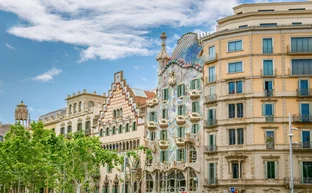
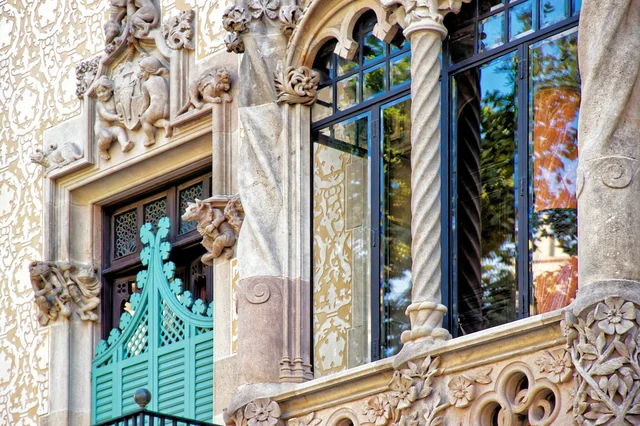
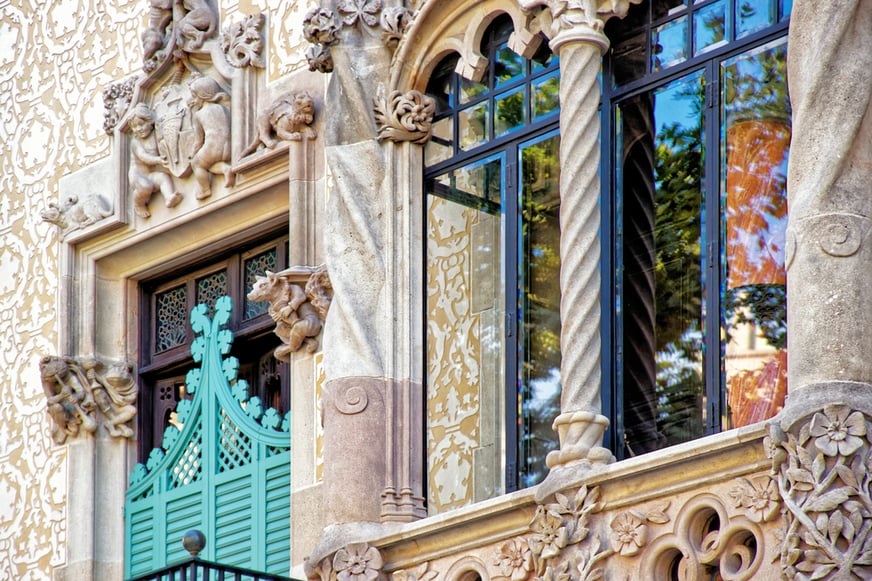
Casa Amatller, completed by Josep Puig i Cadafalch in 1900, has been painstakingly restored to how it looked when the wealthy chocolatier Antoní Amatller lived here with his only daughter Teresa. There is a whiff of Willy Wonka-esque wonder and melancholy about this extraordinary gingerbread palace. The chocolate mogul commissioned Cadafalch to rework an existing townhouse as a Neo-Gothic fantasy, drawing on the era’s fascination with northern European style and a nostalgia for Catalan history. Its flat, stepped façade is coated with sgraffito (patterned stucco) and colored ceramic tiles. It stands in striking contrast to its next-door neighbor, Gaudí’s Casa Batlló. Puig i Cadafalch made extensive use of ceramics, wrought iron, and fanciful sculptures to achieve this gingerbread creation.
An informative audio guided tour includes, appropriately, a cup of hot chocolate at the end, and the adjoining shop and café sell irresistible treats, beautifully packaged in Modernista style.
Three of the greatest residential Modernista buildings in Barcelona stand along the block of Passeig de Gràcia between Carrer del Consell de Cent and Carrer d’ Aragó. Labeled by tourism promoters as the Quadrat D’Or, or Golden Quarter, it’s also referred to with a wink as the Mançana de la Discòrdia (Block of Discord), a name alluding to the mythical Judgment of Paris, in which an apple was the prize in a contentious beauty contest among three goddesses (in Catalan, “apple” is the same word as “city block”).
Casa Amatller, completed by Josep Puig i Cadafalch in 1900, has been painstakingly restored to how it looked when the wealthy chocolatier Antoní Amatller lived here with his only daughter Teresa. There is a whiff of Willy Wonka-esque wonder and melancholy about this extraordinary gingerbread palace. The chocolate mogul commissioned Cadafalch to rework an existing townhouse as a Neo-Gothic fantasy, drawing on the era’s fascination with northern European style and a nostalgia for Catalan history. Its flat, stepped façade is coated with sgraffito (patterned stucco) and colored ceramic tiles. It stands in striking contrast to its next-door neighbor, Gaudí’s Casa Batlló. Puig i Cadafalch made extensive use of ceramics, wrought iron, and fanciful sculptures to achieve this gingerbread creation.
An informative audio guided tour includes, appropriately, a cup of hot chocolate at the end, and the adjoining shop and café sell irresistible treats, beautifully packaged in Modernista style.
Details
Bookstore

Available as paperback
and as e-book.