Fundació Joan Miró

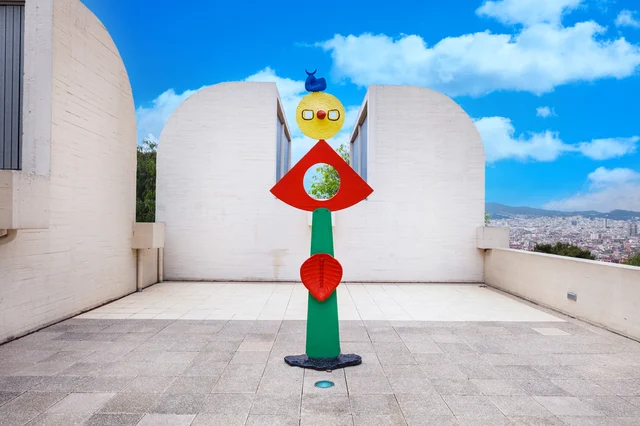
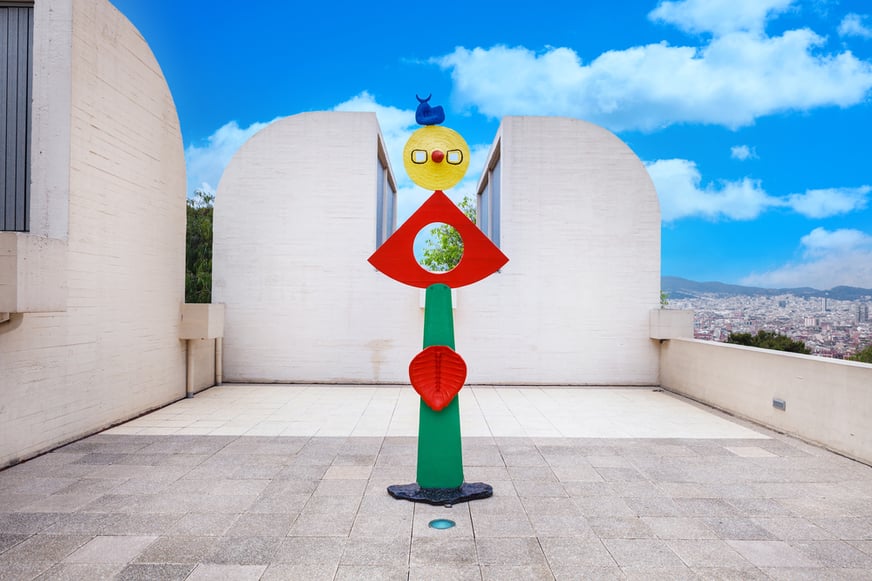
This comes close to art museum perfection. Even if you don’t care about the work of Catalan artist Joan Miró (1893–1983), the hilltop location of the Foundation has an inspiring panoramic view, with whimsical painted metal sculptures on its easily accessible roof, and the gleaming white building (by Miró's friend, architect Josep Lluís Sert) is a marvel in itself.
The Barcelona native (there is a small plaque on his birthplace in the Passatge de Crédit in the Gothic Quarter) achieved fame as part of the surrealist movement in Paris in the early 20th century, but his boldly abstracted graphic style and vibrant palette are rigorously Spanish/Catalan. The Foundation was created by Miró himself in 1975 with donations from his private collection. The permanent collection of around 400 paintings, sculptures, ceramics, and textiles—and thousands of drawings—is beautifully arranged in generous white spaces, showing Miró’s development from the figurative and Fauvist to the surreal and symbolic. Additional galleries house work by other artists in homage to Miró, including Antoni Tàpies and Eduardo Chillida, and regular touring exhibitions. An indoor-outdoor café serves reasonably priced Mediterranean dishes and the gift shop has oodles of Miró-related merchandise.
This comes close to art museum perfection. Even if you don’t care about the work of Catalan artist Joan Miró (1893–1983), the hilltop location of the Foundation has an inspiring panoramic view, with whimsical painted metal sculptures on its easily accessible roof, and the gleaming white building (by Miró's friend, architect Josep Lluís Sert) is a marvel in itself.
The Barcelona native (there is a small plaque on his birthplace in the Passatge de Crédit in the Gothic Quarter) achieved fame as part of the surrealist movement in Paris in the early 20th century, but his boldly abstracted graphic style and vibrant palette are rigorously Spanish/Catalan. The Foundation was created by Miró himself in 1975 with donations from his private collection. The permanent collection of around 400 paintings, sculptures, ceramics, and textiles—and thousands of drawings—is beautifully arranged in generous white spaces, showing Miró’s development from the figurative and Fauvist to the surreal and symbolic. Additional galleries house work by other artists in homage to Miró, including Antoni Tàpies and Eduardo Chillida, and regular touring exhibitions. An indoor-outdoor café serves reasonably priced Mediterranean dishes and the gift shop has oodles of Miró-related merchandise.
Details
Bookstore
Available as paperback
and as e-book.