Palau Güell

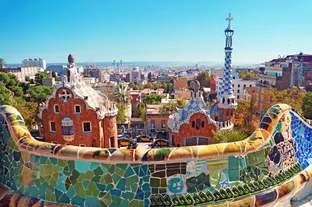
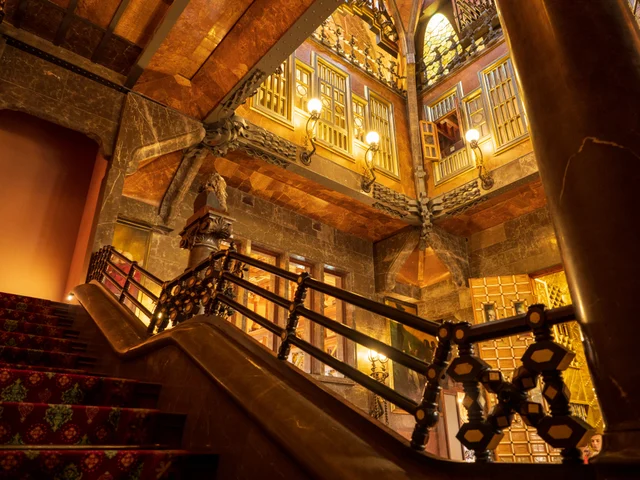
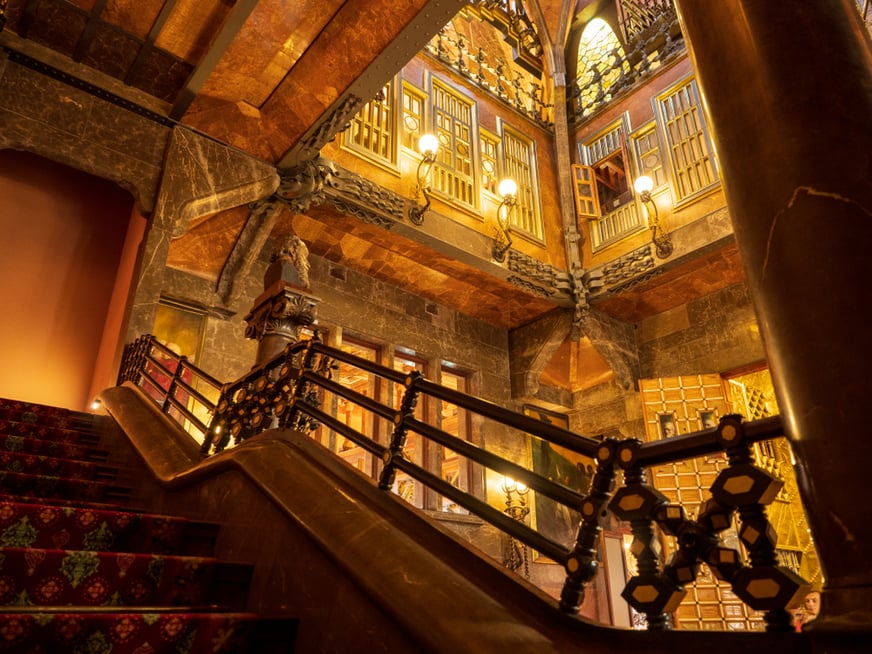
Constructed between 1886 and 1890 for aristocrat and industrialist Eusebi Güell, this was Antoni Gaudí’s second commission—and yet the architect’s prodigious talent was such that it already looks almost as if it were grown rather than built. The exterior is severe, in stone and wrought iron, and the family quarters hardly look comfortable. But this bourgeois palace was created more for show than comfort. The highlight is the central concert hall, complete with a choir gallery and a magnificent pipe organ, on which Güell’s daughter Isabel would give recitals. (You might hear it being played). The hall is crowned with a light-pierced dome and Gaudí’s trademark parabolic arches, and above and below are more hints of things to come. The underground forest of brick columns and vaults in 10 musty cellars creates a honeycomb of stables and servants’ quarters, and functions as much as a root system as a foundation. The rooftop is even more startling: Gaudí wrapped the chimneys with swirling abstract sculptures. Not only are they embedded with mosaics of broken pottery, they also employ artistic symbols from ancient Catalan tradition, an idea he would use again on a grand scale on his patron’s next commission—Parc Güell. The tour is accompanied by an informative audio guide.
Constructed between 1886 and 1890 for aristocrat and industrialist Eusebi Güell, this was Antoni Gaudí’s second commission—and yet the architect’s prodigious talent was such that it already looks almost as if it were grown rather than built. The exterior is severe, in stone and wrought iron, and the family quarters hardly look comfortable. But this bourgeois palace was created more for show than comfort. The highlight is the central concert hall, complete with a choir gallery and a magnificent pipe organ, on which Güell’s daughter Isabel would give recitals. (You might hear it being played). The hall is crowned with a light-pierced dome and Gaudí’s trademark parabolic arches, and above and below are more hints of things to come. The underground forest of brick columns and vaults in 10 musty cellars creates a honeycomb of stables and servants’ quarters, and functions as much as a root system as a foundation. The rooftop is even more startling: Gaudí wrapped the chimneys with swirling abstract sculptures. Not only are they embedded with mosaics of broken pottery, they also employ artistic symbols from ancient Catalan tradition, an idea he would use again on a grand scale on his patron’s next commission—Parc Güell. The tour is accompanied by an informative audio guide.
Details
Bookstore
Available as paperback
and as e-book.