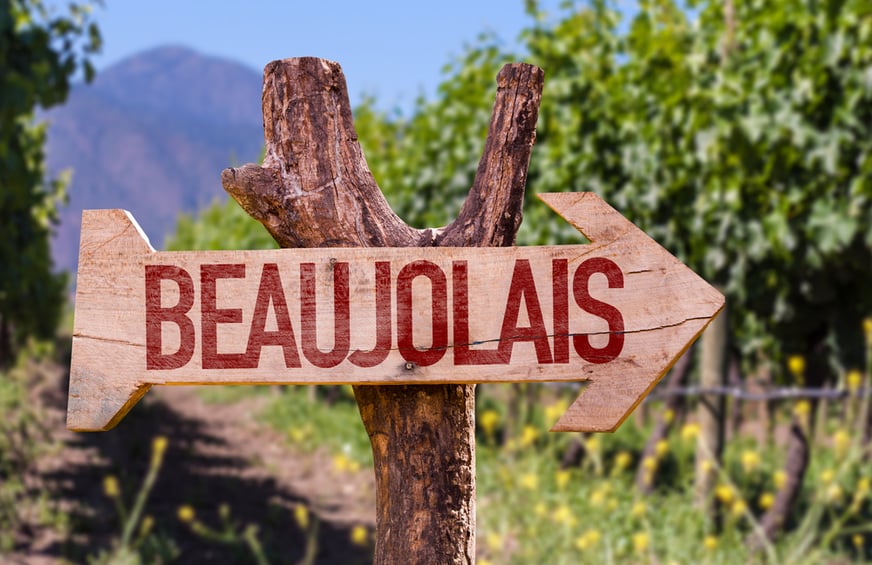
Things To Do in Beaujolais Country
Bookstore

Available as paperback
and as e-book.
Beaujolais Country Attractions
Exploring Southern Beaujolais
With its warm-hued stone architecture, Southern Beaujolais has been dubbed “Land of the Golden Stones”. It’s the most attractive place to use as a base for exploring both Northern and Southern Beaujolais. Capital of Beaujolais, Villefranche-sur-Saône is a businesslike base to start, but you’ll probably want to stay in one of the 39 villages dorés.
Go to Villefranche-sur-Saône tourist office, not far from the marketplace for a booklet on Beaujolais country. It includes a map, itineraries, and lists the wine-tasting cellars open to the public. It also lists and details some 30 villages.
Any tour of Southern Beaujolais should include the pedestrianized, medieval village of Oingt—officially designated as one of the most beautiful villages in France. Only the tower remains of the medieval castle, but it’s worth climbing for the panoramic views over Beaujolais. A good place to stock up on local Beaujolais wine is Terroir des Pierres Dorées (tel. 04-78-15-91-07), at 76 place de Presberg on the edge of the pedestrianized center.
Another pretty village is St-Julien-Sous-Montmelas, 11km (6.75 miles) northwest of Villefranche (take D35). Claude Bernard, the father of physiology, was born here in 1813. His small stone house—the Musée Claude-Bernard (414 route du Musée; tel. 04-74-67-51-44)—exhibits the scholar’s mementos, instruments, and books. The museum is open from April to October, Wednesday to Sunday 10am to 12:30pm and 2 to 6pm; admission is 5 euro or free for children 12 and under.
If you like fairy-tale castles, you should visit Château de Montmelas (tel. 07-64-62-01-74) in Montmelas-Saint-Sorlin. Known locally as Sleeping Beauty castle, it has been home to the same aristocratic family since the Middle Ages. From this hilltop castle, you’ll find breathtaking views towards the distant Mont Blanc. You can telephone in advance for a 90-minute wine tasting (from 12€) in the cellars with Delphine, the charming Countess of Harcourt. Award-winning red and white table wines, and even sparkling wines, are produced by the Comte himself. If you’d like to stay, two brightly furnished gîtes are available. For a princely sum, you can even hire out the entire castle. From St. Julien, take the D19 west and then the D44 towards the castle.
Visiting Northern Beaujolais
Wine connoisseurs head straight to Northern Beaujolais where the serious Cru appellation wines are grown. Most of the 10 Beaujolais Crus (certified as the region’s best wines that are more nuanced in flavor and capable of aging longer) are within a short drive of Belleville, the largest town in Northern Rhône. From Lyon or Villefranche-sur-Saône, drive north on the A6.
- Winery
Caveau du Cru Morgon
A good place to start exploring Northern Beaujolais is at this cellar in the basement of the 18th-century Château de Fontcrenne, next to the Hôtel de Ville. Here you can taste red wines from the well-regarded Beaujolais Cru Morgon. Caveau du Cru Morgon produces and bottles wines…Villié-Morgon
- Winery
Château de la Chaize
This is a fairy-tale setting to taste the sought-after wines of Brouilly. Lived in by the Marquise de Roussy de Sales, this 17th-century castle produces some of the most prestigious Beaujolais Cru Brouilly wines. Grapes are picked by hand and seven wine-growing families living on the… - Museum/Winery/Theme Park
Hameau DuBoeuf
Families and wine virgins will enjoy a trip to Europe’s premier wine adventure park run by the godfather of Beaujolais wine, George Duboeuf. The wine museum takes you through 2,000 years of wine history, while the original town train station has been converted into a wine transport…Romanèche-Thorins