Things To Do in Bilbao
Bookstore
Available as paperback
and as e-book.
Bilbao Attractions
Cargo ships no longer sail up the Nervión river into the once-smoggy center of Bilbao, a former industrial center once nicknamed the “botxo,” or “hole.” Foundries, shipyards, and factories are long gone, with only one crane remaining as a reminder. Now a walk along the riverbank gives insight into the renaissance of Bilbao: a modern soccer stadium, cutting-edge skyscrapers, a designer footbridge, the Guggenheim itself.
Under a master plan by Argentinian architect Cesar Pelli (1926-2019), the waterfront was reshaped as a green, human-scale place. The elegant footbridge over the river near the Guggenheim, the Pasarela Zubizuri, summarizes the spirit of the new Bilbao. Designed by Santiago Calatrava, it is sinuous and monumental, and exclusively for pedestrians.
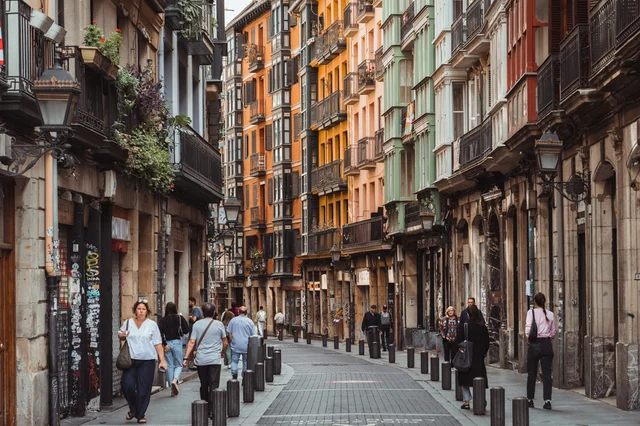
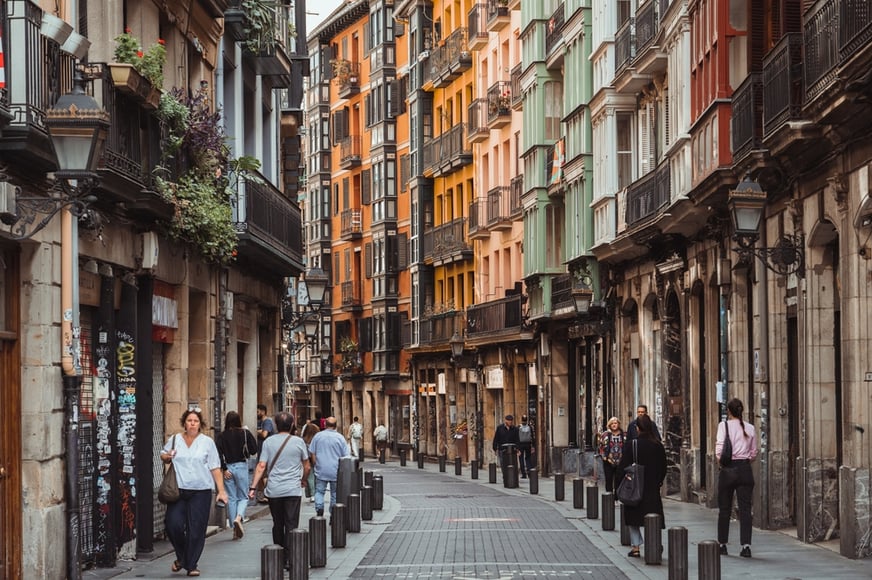
The magnificent arrow-straight Gran Via boulevard cuts a swath across the city, its Parisian-style splendor dotted with designer shopping outlets. At its eastern end, across another bend of the river, you’ll find the Casco Viejo, the atmospheric old town centered around seven original streets.
Even though Bilbao was established around 1300, it has few medieval monuments. However, the Old Quarter of Bilbao—connected by four bridges to the more modern city areas across the Nervión—has been declared a national landmark and buzzes with life. To reach the pedestrianized Old Quarter on foot (the only way to explore it), take the Puente del Arenal bridge from the Gran Vía, Bilbao’s main boulevard. From the Guggenheim Museum Bilbao, hop on the Tranvía to Pio Baroja, or the Metro to Casco Viejo—or enjoy the walk down the riverfront promenade.
Start exploring in Plaza Nueva, also called the Plaza de los Mártires, enclosed by 64 graceful arches, completed in 1826. At night, and indeed during much of the day, this compact square becomes a lively place to drink (a small glass of wine is called a chiquiteo) and snack on pintxos. From there it’s a 5-minute walk down Posta Kalea to the Catedral de Santiago, Plaza Santiago, built in the 15th century and dedicated to Bilbao’s patron saint St. James. The church is an important pilgrimage site, and its neo-Gothic tower is said to demonstrate the “good taste of the cultured population of Bilbao.” It’s open Monday to Saturday 10am‒6:30pm, Sunday 1-8pm). Tickets cost 8€ adults, 7€ seniors, 6.50€ students and children 13 and over.
Make your way up Gurutze Kalea to Plaza Miguel de Unamuno, climb 300 steps, and do a 10-minute walk to reach the hilltop Basilica de Begoña, Calle Virgen de Begoña, 8 (tel. 94-412-70-91), built largely in the early 1500s. (You can also follow a tunnel from the plaza to the Casa Viejo Metro station, where there’s an elevator up the hill.) Inside, the dimly lit church features a brightly illuminated depiction of the Virgen de Begoña, patron saint of Bizkaia, dressed in long flowing robes. Many boats are named for the Virgin, and a long-standing custom calls for sailors returning to port to sing the “Salve Regina” when they spot the church tower. It’s open Monday to Saturday 10:30am‒1:30pm and 5:30‒8;30pm, Sunday during mass.
- Cultural complex
Alhóndiga Bilbao
French furniture and product designer Philippe Starck made his public debut as an architect by remaking this one-time Modernisme white elephant as Bilbao’s cultural and sporting center. Opened in 1909 as a wine storage facility, the building was devastated by fire 10 years later. The… - Museum
Euskal Itsas Museoa
You know that an industry is really finished when the city builds a museum about it. Bilbao was a great shipbuilding center on Spain’s north coast from the beginning of the Industrial Revolution. Now it’s a city about information and information technology, so this excellent maritime… - Museum
Guggenheim Museum
Skeptics said Bilbao would get a temporary bump in tourism as curious people came to see what Frank O. Gehry had wrought on the once-industrial waterfront. Nearly 3 decades later, some 1.3 million people now visit the museum each year, and the flow shows no sign of abating. Truly,… - Museum
Museo Arqueologica de Bizkaia
When academics points out that the Basque language is unlike any other in Europe, Basque archaeologists counter that the Basques were living in northern Spain long before the Neolithic people who spoke proto-Indo-European ever set foot in Europe. This striking facility uses… - Museum
Museo de Bellas Artes
It’s tempting to feel sorry for this fine arts museum, since the Guggenheim gets all the attention. But it’s worth visiting for two reasons: First, its tidy linear organization by art historical category seems a reassuring return to order after the disorienting galleries of the…
Bilbao Shopping
Many visitors can’t resist buying a beret in the Basque Country. The best selection is at Sombrería Gorostiaga, Calle Victor, 9 (tel. 94-416-12-76), a family-owned business since 1857. It opens Monday to Friday 10am‒1:30pm and 4‒8pm, Saturday 10am‒1:30pm and 4:30‒7:45pm. Elosegui is the authentic brand to buy.
Even if you are not a foodie, check out the literally ship-shaped Mercado de la Ribera, Calle Ribera, 20. A marvel of decorative tile, brick, and glass, the 1929 Art Deco–style building sits on the site of markets dating back to the 14th century. A huge, buzzy space is dedicated to cafes heaving with pintxos and people. It claims rather inconvincingly to be the largest covered market in Europe but it’s certainly worth a visit and opens Monday 8am to 2:30pm, Tuesday to Friday 8am‒2:30pm and 5‒8pm, Saturday 8:00am‒3pm (mid-June to mid-Sept, the afternoon openings are Fri only).
On most Sundays, a compact flea market starts at 8am on the riverbank in the Arenal bridge area of the Old Quarter; there is an adjacent flower market on the same day, while the same venue hosts a lively farmers market on Saturdays.
Bilbao Nightlife
For locals, going out for drinks and pintxos is the principal mode of evening entertainment. There is a good concentration of bars on Calle Licenciado Poza, between Alameda del Doctor Areilza and Calle Iparraguirre, in the Ensanche neighborhood, and for those staying near the Guggenheim, the Abando district to the museum’s southeast has more than enough bars to fill several evenings. The Café Iruña can be found there, but also walk along streets such as Henao, Ledesma, and Juan de Ajuriaguerra to find plenty more places to drink, nibble, and dine.
In the Casco Viejo, the super-lively Plaza Nueva with its 22 bars (and one pharmacy!) is the best choice for people-watching and barhopping. Among the plaza’s options, Gure Toki is a must-visit and Café Bar Bilbao, Plaza Nueva, 6 (bilbao-cafebar.com; 📞 94-415-16-71), has a hundred years of history and a suitably classic look. Its house specials include fresh anchovies wrapped around green olives.
If you’d rather dance and mingle than eat, one of the most popular spots is Cotton Club, Calle Gregorio de la Revilla, 25 (tel. 689-230-910), with plenty of live music of every genre: pop, rock, folk, and indie. A DJ spins the latest tunes for a crowd in their 20s and 30s. It opens on Thursday from 8:30pm until 4.30am, but the club is most frenzied on Friday and Saturday when it’s open 8:30pm‒6:00am.
The Teatro Arriaga Antzokia, Plaza Arriaga, 1 (tel. 94-479-20-36), on the banks of the Nervión, is the setting for world-class opera, classical music, theater, ballet, and even zarzuelas (comic operas). The schedule is on the website. Details of other festivals and cultural events are available via the tourist office website.