Things To Do in Caceres
Bookstore
Available as paperback
and as e-book.
Caceres Attractions
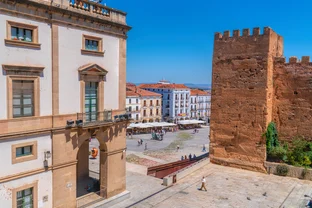
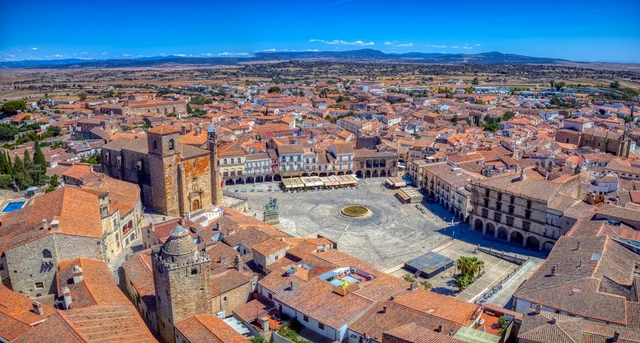
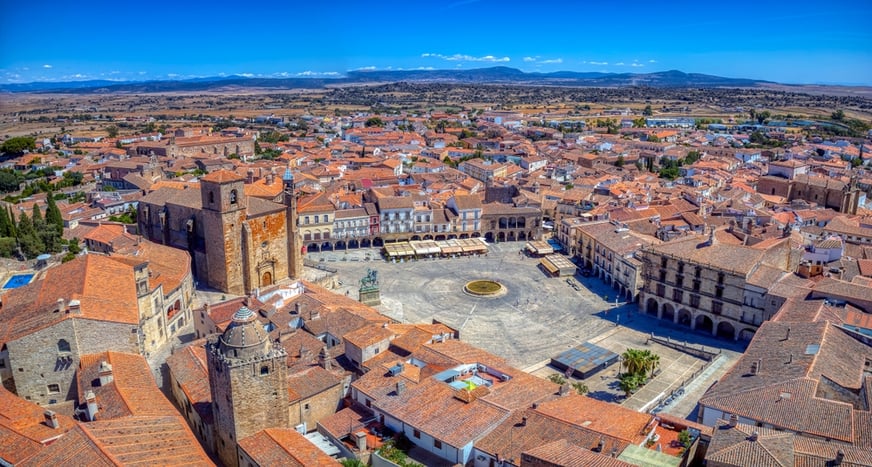
The first place you’re likely to reach in old Cáceres is Plaza Mayor (see above), which lies at the gateway to the walled city. It’s a vast, oblong square, developed in the 15th century for fairs and gatherings, and it plays much the same role today, accommodating the annual WOMAD world music festival among many other events. It’s a lovely place to relax on a café terrace and contemplate the uncluttered façades. Yet it’s only the hors d’oeuvre to the old town proper, revealed through the oddly angled Arco de la Estrella (The Arch of the Star). Designed by Manuel Churriguera in 1726, the arch was commissioned by the nobleman Bernardino de Carvajal Moctezuma, who ordered the oblique shape to allow carriages access to his palace next to Torre de Bujaco.
The barrio antiguo, Cáceres Viejo is enclosed by massive ramparts. The heart of the Old City lies between Plaza de Santa María and, a few blocks to the south, Plaza San Mateo. Plaza de Santa María is an irregularly shaped, rather elongated square. On each of its sides are the honey-brown facades of buildings once inhabited by the local nobility. On a casual stroll through the city's cobblestone streets, your attention will surely be drawn to the walls that enclose the old upper town. These are a mixture of Roman and Arab engineering, and they are outstandingly preserved. About 30 towers remain from the city's medieval walls, all of them heavily restored. Originally much taller, the towers reflected the pride and independence of their builders; when Queen Isabella took control, however, she ordered them cut down to size. Only the Casa de las Cigüeñas (House of the Storks) in Plaza de San Mateo was allowed to keep its stature, demonstrating the value of loyalty to the queen. To its right you'll see the Torre del Horno, a mud-brick adobe structure left from the Moorish occupation.
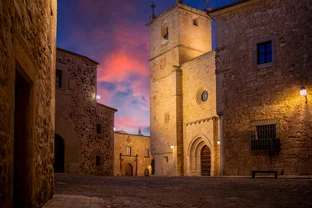
On the far side of Plaza de Santa María rises the Catedral de Santa María, basically Gothic in style although many Renaissance embellishments have been added. Completed sometime in the 1500s, this is the cathedral of Cáceres and contains the remains of many conquistadors. We have a complete review of the cathedral here.
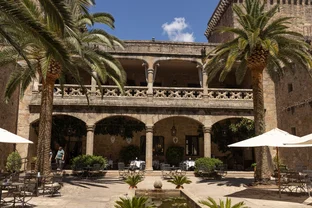
La Casa de los Toledo-Montezuma was built by Juan Cano de Saavedra with money from the dowry of his wife, the daughter of Montezuma. The house is set into the northern corner of the medieval ramparts, about a block to the north of Plaza de Santa María. See our full review of that here.
Cuesta de la Compañía leads to Plaza San Mateo and the 14th-century Iglesia de San Mateo, which has a Plateresque portal and a rather plain nave -- except for the Plateresque tombs, which add a decorative touch.
Two adjoining plazuelas near here embody the flavor of old Cáceres. The first of them, Plaza de las Veletas, on the site of the old Alcázar, has a wonderful archaeological museum (see our full review here).
The Church of Santiago was begun in the 12th century and restored in the 16th century. It has a reredos carved in 1557 by Alonso de Berruguete and a 15th-century figure of Christ. The church is outside the ramparts, about a block to the north of Arco de Socorro. To reach it, exit the gate, enter Plaza Socorro, and then walk down Calle Godoy. It is on your right.
Look up, and the chances are you’ll see a stork (cigüeña) alighting on a huge, untidy nest built on a rooftop or bell tower. The city is one of the most important stork-breeding sites in Europe, hosting scores of pairs. In the nearby town of Malpartida de Cáceres, the birds are celebrated every spring with a festival called the Week of the Stork, including photography competitions and ornithological trails. Nowadays, you’ll see storks throughout the year as fewer are migrating across the Straits of Gibraltar to winter in Africa, preferring the rich pickings here. In some parts of the region, notably the Parque Nacional de Monfragüe, you can observe the much rarer black stork.
If you have time, it’s worth exploring the old town twice. By day, climb the winding, cobbled streets and peek into its many magnificent palaces and churches. By night, when the buildings and squares are beautifully lit and the air is cool, take a guided tour. Historiadores (tel. 68-436-47-76) offer tours in English led by local historians from 10€ per person. The city’s stories and legends are a real-life game of thrones.
- Historic Building
Casa de los Toledo-Moctezuma
Just north of the cathedral in the old town, this domed palace bears the name of Isabel de Moctezuma, daughter of the Aztec emperor, Moctezuma II. It was built by the conquistador Juan Cano de Saavedra with riches from her dowry following their wedding in 1532. Isabel led an… - Art museum
Centro de Artes Visuales, Fundación Helga de Alvear
Just outside the old town, this Modernist stone palace houses the collection of the German/Spanish collector Helga de Alvear, who died in 2025. She established a nonprofit foundation here in 2006, in partnership with the council of Extremadura, to share and promote contemporary… - Museum
Museo de Cáceres y Aljibe
The municipal museum at the top of the old town is a low-key gem. It occupies two historic houses, Palacio de las Veletas and Casa de los Caballos, built on the remains of the Moorish fortress, or alcazaba. The tour begins with archaeological and ethnographic collections illustrating… - Historic home/museum
Palacio de los Golfines de Abajo
Perhaps the most magnificent of all the palaces in Cáceres, the heavily restored home of the Golfin family glitters with artistic treasures spanning 600 years. The Catholic Monarchs Isabel and Fernando stayed here—you can see a signed letter from them asking the Golfines for military… - Landmark
Plaza de Santa María
As you climb Calle Arco de la Estrella, the first old town square you’ll reach—and one of the most picturesque—is Plaza de Santa María. Framed by the honeyed façades of noble palaces, it is dominated by the Concatedral de Santa María, the city’s cathedral—a Gothic hulk to which…
Caceres Shopping
Some of the most appealing shops in Cáceres are on the streets radiating from the Plaza Mayor, with a particularly good selection of artifacts along either side of Calle Pintores. If you want to see a more modern face of the region, and shop for housewares and fashion while you're at it, drive 15 minutes west of the town center to the Centro Comercial Ruta de la Plata, Carretera Portugal, where you'll find a scattering of boutiques, plus a number of simple snack bars and cafes.