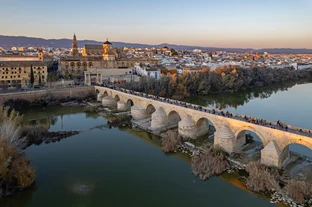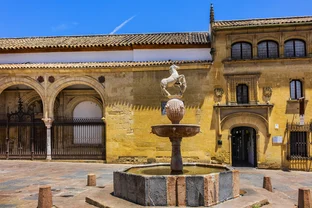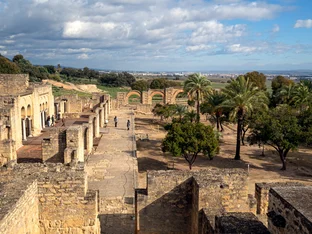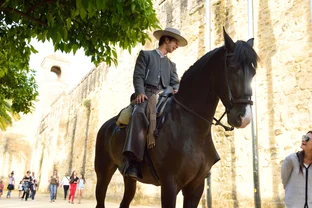
Mezquita Catedral de Córdoba

No visitor to Córdoba should miss its mosque, one of the world’s great architectural achievements.
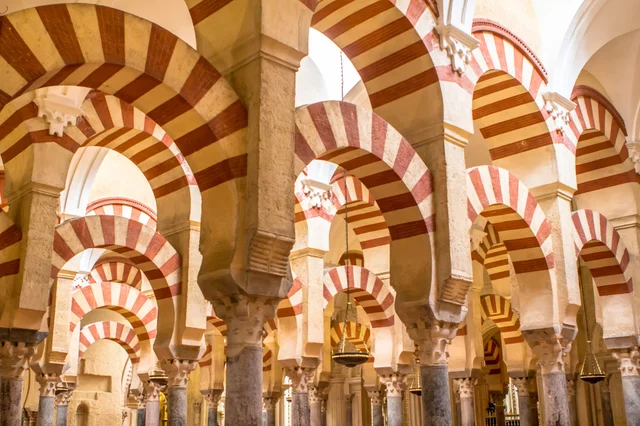
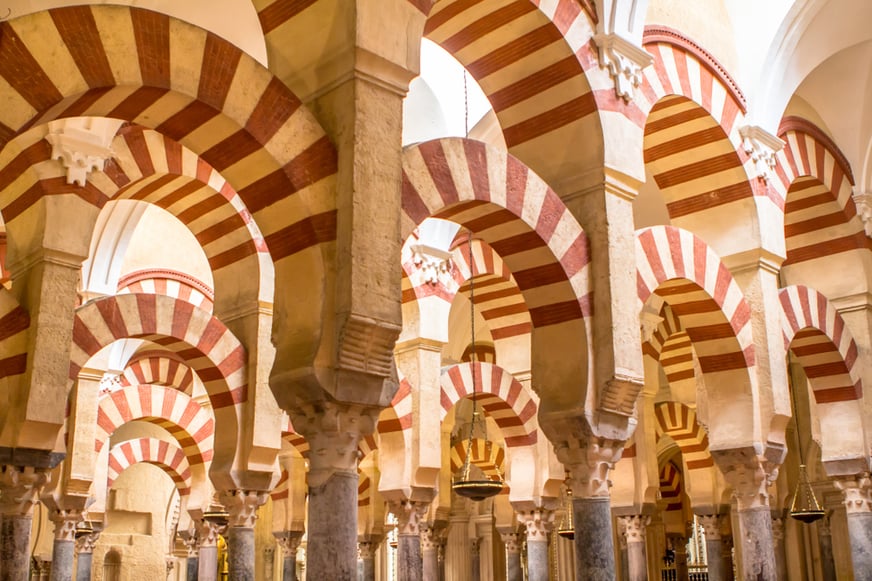
It was begun in 785 by the founder of the Emirate of Córdoba, Abd al-Rahman I, and extended by succeeding rulers. Its mesmerizing forest of identical columns and red and white arches seems to go on forever—until rudely interrupted by the Christian cathedral built in its midst in the 16th century. Emperor Carlos V, who also ordered controversial alterations at the Alhambra in Granada, gave the go-ahead for the cathedral in 1523, ignoring pleas from the town council. Later, he is said to have regretted the decision, telling the church: “You have built what you or others might have built anywhere, but you have destroyed something that was unique in the world.”
It is certainly unique, but far from destroyed. Restoration began in earnest in the 19th century and continues today. Spain’s Muslim community has repeatedly appealed to the Catholic Church to be allowed to pray here, but so far that has been denied, and although everyone refers to it as the Mezquita (mosque), it remains in constant use as Córdoba’s cathedral.
Maqsurah & Mihrab
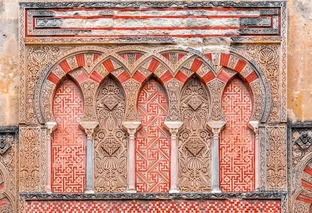
In the 960s, Al-Hakam II ordered extensions of extraordinary intricacy that became the blueprint for Islamic architecture for centuries. The Maqsurah was the private enclosure where the Caliph and his retinue would worship, protected from the masses. Its multi-lobed arches and spectacular skylit dome show how Córdoba led the way in both art and engineering in the 10th century. It faces the glittering Mihrab, the religious focus of the mosque. Al-Hakam asked the Byzantine emperor Nicephorus to send craftsmen capable of equaling the decoration of the great mosque of Damascus. The Christian emperor not only agreed but threw in a consignment of golden tesserae (mosaic pieces) for good measure. The wonderful mosaics and inscriptions on the horseshoe-arched prayer niche survived because it was bricked up at the time of the Reconquista and remained hidden until the 19th century.
Capilla Real & Capilla Villaviciosa
Following the Christian reconquest of Córdoba in 1236, the mosque became the city’s cathedral, but the complex remained largely unchanged for more than a century. In 1371, Enrique II of Castile completed the Capilla Real as a pantheon for the kings of Castile and León. The chapel is in Mudéjar style, closely following the Islamic architectural tradition. In the late 15th century, with the support of Isabel I of Castile, the Capilla Villaviciosa was added—an ingenious marriage of Islamic multi-lobed arches and Gothic vaulting.
Capilla Mayor
The big and controversial change came in 1523 when a large section of pillars was cleared to make way for the Capilla Mayor, a full-scale Renaissance cathedral that took more than 250 years to complete. Incongruous as it is against the calm symmetry of the mosque’s arches, it is nonetheless an impressive architectural feat, especially the indulgent Mannerist dome, completed by Juan de Ochoa in 1600.
Torre Campanario
The 54m (177ft) bell tower was built on the site of the mosque’s original minaret and rebuilt in 1589 following an earthquake. It remains the tallest building in Córdoba’s old town, and you can climb it for views across the city. Entry, separate to the mosque visit, costs 3€.
Patio de los Naranjos
After contemplating the mosque, linger in the peace of the Patio de los Naranjos, with its neat rows of orange trees, palms, and fountains, where worshippers once performed ablutions before prayer. Despite the heavy tourism beyond the walls of the mosque, the whole experience still feels refreshingly uncommercial.
Tip: A range of options to visit the Mezquita is available, from early morning free entry to a night-time sound and light tour and guided visits. You might want to visit more than once during your stay.
Calle Cardenal Herrero, 1. mezquita-catedraldecordoba.es. 📞 95-785-00-30.
No visitor to Córdoba should miss its mosque, one of the world’s great architectural achievements.
It was begun in 785 by the founder of the Emirate of Córdoba, Abd al-Rahman I, and extended by succeeding rulers. Its mesmerizing forest of identical columns and red and white arches seems to go on forever—until rudely interrupted by the Christian cathedral built in its midst in the 16th century. Emperor Carlos V, who also ordered controversial alterations at the Alhambra in Granada, gave the go-ahead for the cathedral in 1523, ignoring pleas from the town council. Later, he is said to have regretted the decision, telling the church: “You have built what you or others might have built anywhere, but you have destroyed something that was unique in the world.”
It is certainly unique, but far from destroyed. Restoration began in earnest in the 19th century and continues today. Spain’s Muslim community has repeatedly appealed to the Catholic Church to be allowed to pray here, but so far that has been denied, and although everyone refers to it as the Mezquita (mosque), it remains in constant use as Córdoba’s cathedral.
Maqsurah & Mihrab
In the 960s, Al-Hakam II ordered extensions of extraordinary intricacy that became the blueprint for Islamic architecture for centuries. The Maqsurah was the private enclosure where the Caliph and his retinue would worship, protected from the masses. Its multi-lobed arches and spectacular skylit dome show how Córdoba led the way in both art and engineering in the 10th century. It faces the glittering Mihrab, the religious focus of the mosque. Al-Hakam asked the Byzantine emperor Nicephorus to send craftsmen capable of equaling the decoration of the great mosque of Damascus. The Christian emperor not only agreed but threw in a consignment of golden tesserae (mosaic pieces) for good measure. The wonderful mosaics and inscriptions on the horseshoe-arched prayer niche survived because it was bricked up at the time of the Reconquista and remained hidden until the 19th century.
Capilla Real & Capilla Villaviciosa
Following the Christian reconquest of Córdoba in 1236, the mosque became the city’s cathedral, but the complex remained largely unchanged for more than a century. In 1371, Enrique II of Castile completed the Capilla Real as a pantheon for the kings of Castile and León. The chapel is in Mudéjar style, closely following the Islamic architectural tradition. In the late 15th century, with the support of Isabel I of Castile, the Capilla Villaviciosa was added—an ingenious marriage of Islamic multi-lobed arches and Gothic vaulting.
Capilla Mayor
The big and controversial change came in 1523 when a large section of pillars was cleared to make way for the Capilla Mayor, a full-scale Renaissance cathedral that took more than 250 years to complete. Incongruous as it is against the calm symmetry of the mosque’s arches, it is nonetheless an impressive architectural feat, especially the indulgent Mannerist dome, completed by Juan de Ochoa in 1600.
Torre Campanario
The 54m (177ft) bell tower was built on the site of the mosque’s original minaret and rebuilt in 1589 following an earthquake. It remains the tallest building in Córdoba’s old town, and you can climb it for views across the city. Entry, separate to the mosque visit, costs 3€.
Patio de los Naranjos
After contemplating the mosque, linger in the peace of the Patio de los Naranjos, with its neat rows of orange trees, palms, and fountains, where worshippers once performed ablutions before prayer. Despite the heavy tourism beyond the walls of the mosque, the whole experience still feels refreshingly uncommercial.
Tip: A range of options to visit the Mezquita is available, from early morning free entry to a night-time sound and light tour and guided visits. You might want to visit more than once during your stay.
Calle Cardenal Herrero, 1. mezquita-catedraldecordoba.es. 📞 95-785-00-30.
Details
Bookstore
Available as paperback
and as e-book.