Things To Do in Cuenca
Bookstore
Available as paperback
and as e-book.
Cuenca Attractions
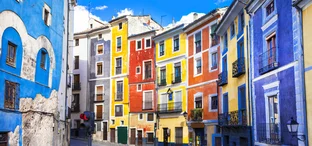
The new city that spreads out at the base of Cuenca is lively, but it’s of limited interest to sightseers. Plan to stay up the hill in the old city and take plenty of time to stand and stare—Cuenca itself is the star. Plaza Mayor is the social center of the old town, flanked by the Baroque arch of the city hall on one side and the cathedral on the other. A palette of pastel and earth colors on the tall house fronts provides a lovely backdrop to the outdoor cafes.
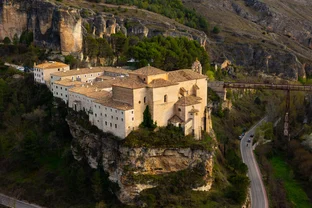
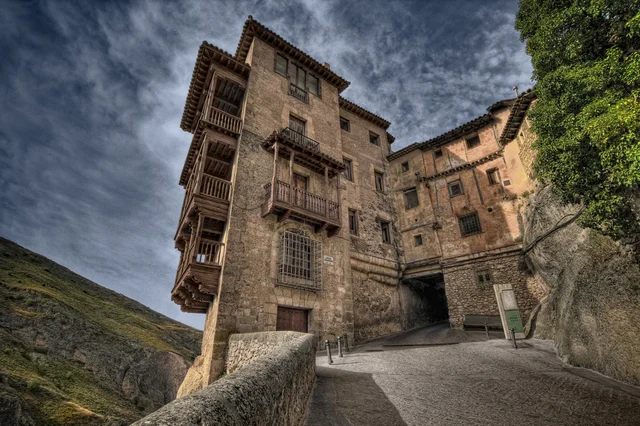
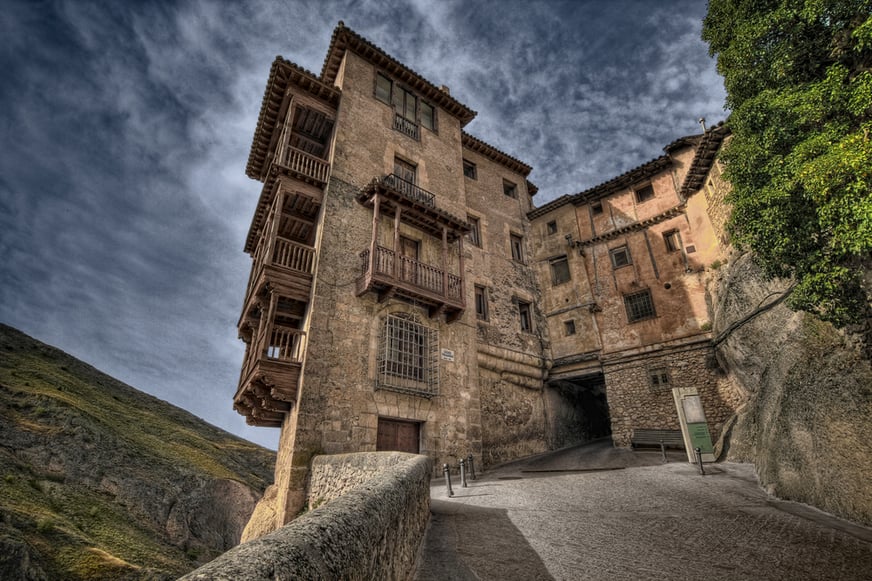
All the main sights are close at hand. Just west of Plaza Mayor, the Mirador de San Miguel overlooks the green hillsides of the Júcar valley. Climb (or take bus L2) along Calle San Pedro past the gate of Arco de Bezudo for wonderful vistas across the craggy gorge. East of Plaza Mayor is the dramatic Puente de San Pablo, an iron and wood footbridge that spans the 60m-deep (200-ft.) Huécar gorge between the old city and the parador. Unless you’re prone to vertigo, cross the bridge for exhilarating views of Cuenca’s casas colgadas (hanging houses, one is pictured at the top of the page). The A footbridge is suspended over a 60m (197-ft.) drop.
Speaking of the hanging houses, these extraordinary structures were built into the sheer rock, and date back some 600 years. They were originally constructed as private residences for wealthy Cuencan families—you can still see a noble crest, attributed to the 15th-century clergyman Obispo Valero, on one façade. A panorama of the city painted in 1565 shows that there were once many more of them, but most were demolished in the early 20th century. The best preserved and most celebrated examples are on Calle Canónigos, perched high above the Huécar gorge.
Over the centuries they have undergone many changes, adding features such as the cantilevered wooden balconies that jut out dramatically. In the 1960s, the abstract artist and art patron Fernando Zóbel was looking for a suitable site to house his collection. He leased them from the city, had them restored by local architects, and launched the next chapter in their history. Two of them form the Museo de Arte Abstracto Español while the third has been transformed into a fine dining restaurant.
Cuenca's streets are narrow and steep, often cobbled, and even the most athletic visitor will tire quickly. But you shouldn't miss it, even if you have to stop and rest periodically.

9 Results
- Cathedral
Catedral de Cuenca
As soon as Alfonso VIII conquered Cuenca, he commissioned this Anglo-Norman cathedral to please his homesick wife, Eleanor Plantagenet (daughter of England’s Henry II and Eleanor of Aquitaine). The masons he brought from Normandy constructed it in the same style as the cathedral at… - Museum
Fundación Antonio Pérez
The Sigüenza-born artist, collector, and poet Antonio Pérez established his foundation in this rambling former convent overlooking the Huécar gorge in 1998. Follow the arrows through his collection of contemporary Spanish art, including rooms devoted to striking work by Millares,… - Museum
Fundación Antonio Saura
Of all the artists inspired by the improbable beauty of Cuenca, Antonio Saura (1930–98) had the most personal connection to the city. He had tuberculosis as a teenager and began coming to Cuenca for his health at age 18. He became fascinated by the view from his sickbed window and it… - Art museum
Museo Casa Zavala
Cuenca’s third contemporary art space opened as the Fundación Antonio Saura in 2008, 10 years after the death of the Abstract Expressionist painter. Of all the artists inspired by Cuenca, Saura had the most personal connection. Suffering tuberculosis as a teenager, he began coming… - Museum
Museo Diocesano
Occupying the episcopal palace just around the corner from the cathedral, this is its Treasury museum, and after all that abstract art it’s worth a look. Its best-known pieces are a couple of paintings by El Greco’s workshop commissioned for local churches in the 16th century, but… - Museum
Museo Paleontológico de Castilla-La Mancha
It’s worth stepping away from the old town to experience more than 500 million years of natural history at the regional museum of paleontology. Life-size model dinosaurs roam the grounds in front of a contemporary structure that resembles huge shipping containers—from which the giant… - Museum
Museo de Arte Abstracto Español
You are in for a double treat here. Cuenca’s first major contemporary art museum, established by the visionary artist Fernando Zóbel in 1966, occupies two of its casas colgadas (hanging houses). It’s hard to know where to look first—at the details of this extraordinary building, out… - Museum
Museo de Cuenca
The regional history museum takes the long view, all the way back to Neolithic funeral idols. Cuenca was once important for lead and silver mining, and Iron Age exhibits show how Carthaginian, Greek, and Phoenician artifacts found their way here through trade with the coast. The… - Landmark
Plaza Mayor
This square is the social center of the old city. It is flanked by the Ayuntamiento (City Hall) on one side and the cathedral on the other. Only local traffic is permitted in the plaza during most of the day, making it safer for walking around. Cafes spill out into the plaza at…
Cuenca Nightlife
The bars around Plaza Mayor not only have a spectacular setting, they’re friendly and good for tapas too. If you order a drink at Mesón Plaza Mayor, you may get a free portion of delicious garlic fried potatoes. At the Mirador de San Miguel nearby, La Plazería, Bajada San Miguel (tel. 69-692-74-73) has a perfectly placed terrace to watch the sunset and also does good food. As the evening wears on, Taberna Jovi, Calle Colmillo, 10 (tel. 96-921-42-84) is where the locals gather for cocktails and free tapas at its gentleman’s club-like bar. For late drinks, La Edad de Oro, Calle Severo Catalina, 7; tel. 96-922-10-82) offers a huge range of gins and plays non-stop golden-age rock ‘n’ roll. La Grotte del Huécar, Paseo de Huécar, 2 (tel. 60-835-56-84) has a lively terrace built into the rocks above the river.
Tip: In summer, the intense heat of the day dissipates suddenly at night, and the streets of Cuenca become so cool that you’ll need a sweater or jacket.