Things To Do in Dijon
Bookstore

Available as paperback
and as e-book.
Dijon Attractions
Dijon was a backwater when the French Revolution occurred, a happy twist of fate because it meant that its churches, palaces, and mansions were largely undisturbed at a time when marauding masses were damaging and destroying historic structures in other French cities. And you’ll learn a lot about the fascinating history of the city by looking at these buildings—which range from medieval half-timbered houses to palaces—if you have the right interpreter. A gent who goes by the name of Bertrand on Airbandb/Experiences is an excellent tour guide (at $17/person); or you can pick up the surprisingly engaging audio walking tour from the Tourist Board (see above; 10€).
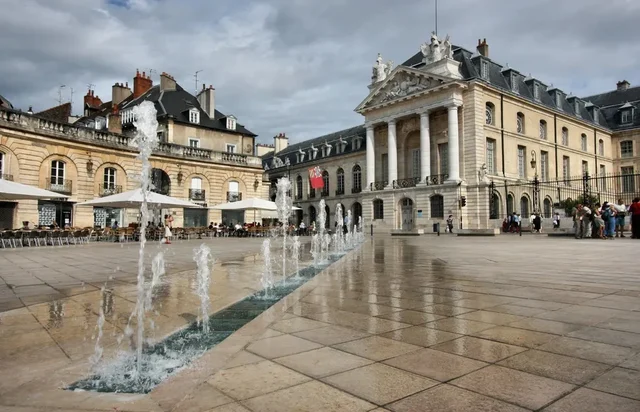
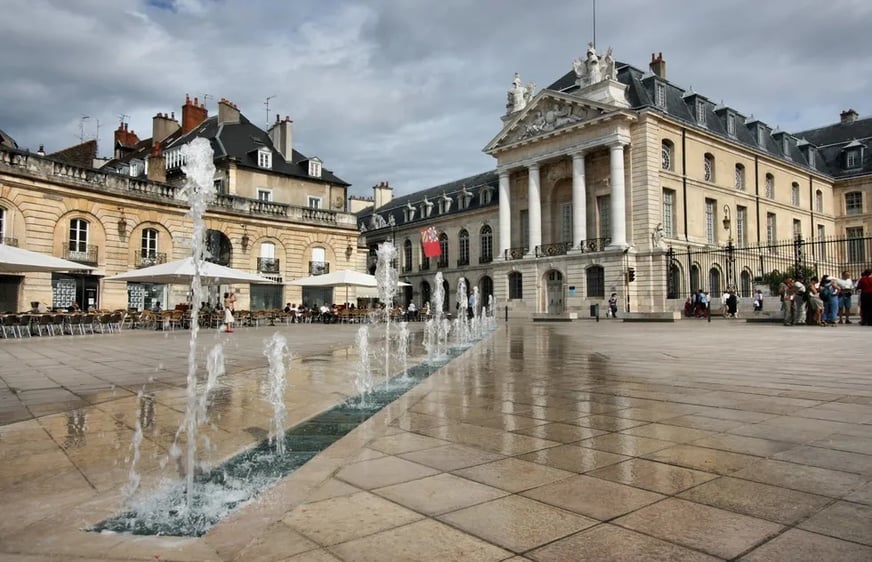
On either tour, you’ll definitely spend time at the grand Palais des Ducs et des États de Bourgogne, which was once seat of government for an empire that stretched all the way into today’s Holland and Belgium. Its oldest section was constructed in the 14th and 15th centuries. Today the complex, set around two courtyards, is capped with mansard roofs (gray-tile gambrel roofs, popular in the 17th-century, like those you see in parts of the Louvre and on chateaux across France). The newer section is the Palais des États de Bourgogne, constructed in the 17th and 18th centuries for the Burgundian parliament; check out the Chapelle des Élus (free access via the tourist office), which dates from 1738 and was designed by Jacques Gabriel, Louis XV’s architect. Today the palace is la mairie (the town hall); all of its newer section and much of its older section are reserved for the municipal government and not open to the public. However, fabulous views can be had from the top of Tour Philippe le Bon (316 steps; 5€ adults; days and times vary; check with the tourist office; http://destinationdijon.com/visites/la-montee-de-la-tour-philippe-le-bon).
Walking tours also always head into Dijon’s Medieval Quarter to see the extravagant 16th and 17th century hôtels particuliers (private mansions), some of which have colorful, geometrically-patterned roof tiles, a practice that dates back to the 14th century and is found throughout the region. Gothic cathedral Notre-Dame de Dijon is always a stop, too, mostly so that participants can rub an owl gargoyle on the side of the church for luck (on Rue de la Chouette). Just across from the owl (which looks like just a lump today from all the rubbing) is Maison Milliere, a perfectly preserved half-timbered cottage from 1483 that had a starring role in Gerard Depardieu's film version of Cyrano de Bergerac (1990).
The Musée Archéologique, 5 rue du Docteur Maret (https://archeologie.dijon.fr; tel. 03-80-48-83-70), housed in a medieval abbey, contains finds from the area, including the abbey itself. Admission is free, and it’s open Wednesday to Monday 9am to 12:30pm and 2 to 6pm; from November to March, the museum is open Wednesday, Saturday, and Sunday. It can be skipped if you’re short on time.
A medieval nunnery, Monastère des Bernardines, 15–17 rue Ste-Anne (📞 03-80-48-80-90), is home to two museums. The chapel holds the Musée d’Arts Sacrés (https://art-sacre.dijon.fr), devoted to art from regional churches, and the cloister contains the Musée de la Vie Bourguignonne (https://vie-bourgignonne.dijon.fr), which exhibits folkloric costumes, farm implements, and some 19th- and early-20th-century storefronts from Dijon’s center. Admission is free to both museums (Wed–Mon 9:30am–12:30pm and 2–6pm).
The Musée Archéologique, 5 rue du Docteur Maret (https://archeologie.dijon.fr; tel. 03-80-48-83-70), housed in a medieval abbey, contains finds from the area, including the abbey itself. Admission is free, and it’s open Wednesday to Monday 9am to 12:30pm and 2 to 6pm; from November to March, the museum is open Wednesday, Saturday, and Sunday.
A medieval nunnery, L’Ancien Couvent des Bernardines, 17 rue Ste-Anne (tel. 03-80-48-80-90), is home to two museums. The chapel holds the Musée d’Arts Sacrés (https://art-sacre.dijon.fr), devoted to art from regional churches, and the cloister contains the Musée de la Vie Bourguignonne (https://vie-bourguignonne.dijon.fr), which exhibits folkloric costumes, farm implements, and some 19th- and early-20th-century storefronts from Dijon’s center. Admission is free to both museums (Wed–Mon 9:30am–12:30pm and 2–6pm).
- Religious Site
Chartreuse de Champmol
Although the fancy tombs of the dukes of Burgundy are in what is now the Musée des Beaux-Arts, their bodies are actually buried in this charterhouse at the western edge of Dijon. Now a psychiatric hospital, it’s still possible to visit: The main sights are the church portal and… - Museum
Musée Magnin
Housed in a handsome 17th-century hôtel particulier, this museum boasts an impressive collection of around 2,000 artworks by lesser-known French, Italian, and Flemish artists from the 14th to the 19th centuries. Some of the paintings, like the Italian landscapes by Anne-Louis Girodet…Around Town
- Museum
Musée des Beaux-Arts & Musée Rude
One part of the ducal palace houses one of France's most important national art collections, showcasing exceptional sculpture, ducal kitchens from the mid-1400s (with great chimney pieces) and a collection of European paintings and sculptures from the 14th to the 21st centuries. Take…Around Town
Dijon Shopping
Your shopping list may include regional wines, mustard, antiques, pain d’épices (spiced bread), and the blackcurrant liqueur, Crème de Cassis. The best shopping streets are rue de la Liberté, rue du Bourg, rue Bossuet, Place Grangier for designer shops and rue Verrerie for antiques. The market at Les Halles, rue Odebert, sells fruit, vegetables, and foodstuffs on Tuesday, Thursday, and Friday on Tuesday, and Thursday to Saturday 7:30am to 1pm.
Dijon has several great fromageries (cheese shops) including Le Chalet Comtois, 28 rue Musette (tel. 03-80-30-48-61); look out for the regionally made semi-soft Cîteaux, made by monks in the abbey of the same name, and pungent, unctuous Époisses.
For wine, we like Dr. Wine, 5 rue Musette (www.drwine.fr; tel. 03-80-53-35-16) a hybrid shop, restaurant and wine club; you can have a full-blown meal or nibble delicious platters of ham and cheese. Les Clos Vivants, 1 rue Musette (lesclosvivants.fr; tel. 03-80-30-45-01), is another brilliant wine shop that runs tastings.
You won’t be able to pass Jonathan Pautet, 2 rue de la Chouette (jonathanpautet.fr; tel. 03-80-67-17-88) without going in to buy some cakes or chocolates (the chocolate snails, filled with ganache, marzipan and praline are a must).
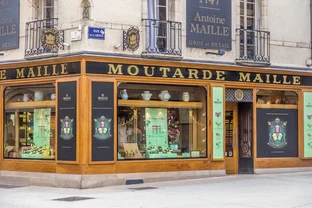
At La Boutique Maille, 32 rue de la Liberté (maille.com; tel. 03-80-30-41-02), you can purchase many varieties of the world-famous mustard while Mulot et Petitjean (their ornately paneled flagship store is at 13 pl. Bossuet; www.mulotpetitjean.fr; tel. 03-80-30-07-10) is the place to go for homemade pain d’épices. You can find out how the product is made at their factory at 6 bd. de l’Ouest (tel. 03-80-53-17-10; Tues–Sat 10am–12:30pm and 2–6:30pm; 8€ adults).
For antiques and interiors, head to the half-timbered streets around rue Verrerie. Southeast of the city center, Le Consortium, 37 rue de Longvic (www.leconsortium.fr; tel. 03-80-68-45-55), is Dijon’s most interesting modern-art gallery.
For the last 40 years, Le Baldaquin, 13 rue Verrerie (www.le-baldaquin-dijon.fr; tel. 03-80-33-95-40 has been a children’s treasure trove of wooden toys and mobiles.
Dijon Nightlife
Popular with the young crowd, Bam Jam, 43 rue Auguste Comté (tel. 03-80-73-30-64) is another small but lively music bar, with bands and DJs playing everything from Jazz to rap to techno. Opposite the Halles food market, Gobleterie, 1 rue Bannelier (tel. 07-88-41-18-02), is open Monday and Wednesday to Saturday 6pm to 2am (and 11am-3pm Saturday) and provides an intimate setting for delicious cocktails.
To try some of the region’s rarest wines, as well as surprising vintages from around the rest of France, descend into the 16th-century vaulted basement of Caveau de Saulx, 80 rue J-J Rousseau (ecaveaudesaulx.fr; tel. 07-63-51-17-50; Wed–Sun 6–midnight; until 2am Fri-Sat, and until 11pm Sun). You can order from the long list of wines, or opt for a blind tasting–the lot accompanied by copious patés, hams, snails and cheeses.
The opera season (www.opera-dijon.fr; tel. 03-80-48-82-82)in Dijon stretches from October to May. Operas, dance recitals, and concerts are held in two venues: Grand Théâtre de Dijon, place du Théâtre (where you can pop along anytime Tues–Sat from 11am–6pm to buy tickets) and L’Auditorium, pl. Jean Bouhey (that opens just 1 hr. before each performance). Although it’s a good idea to buy tickets in advance online.
Several cinemas show films in their original version including Eldorado, 21 rue Alfred de Musset (https://cinemaeldorado.wordpress.com; tel. 03-80-66-51-89), and Cinéma Olympia, 16 AV. Maréchal Foch (Tram line 1 or 2, stop Foch-Gare) (www.cines-dijon.com; tel. 03-80-43-55-99).