Exploring the Golf de Rose
Bookstore

Available as paperback
and as e-book.
Golf de Roses Attractions
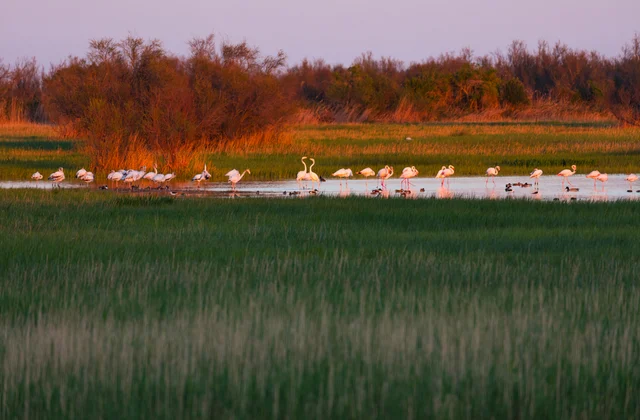
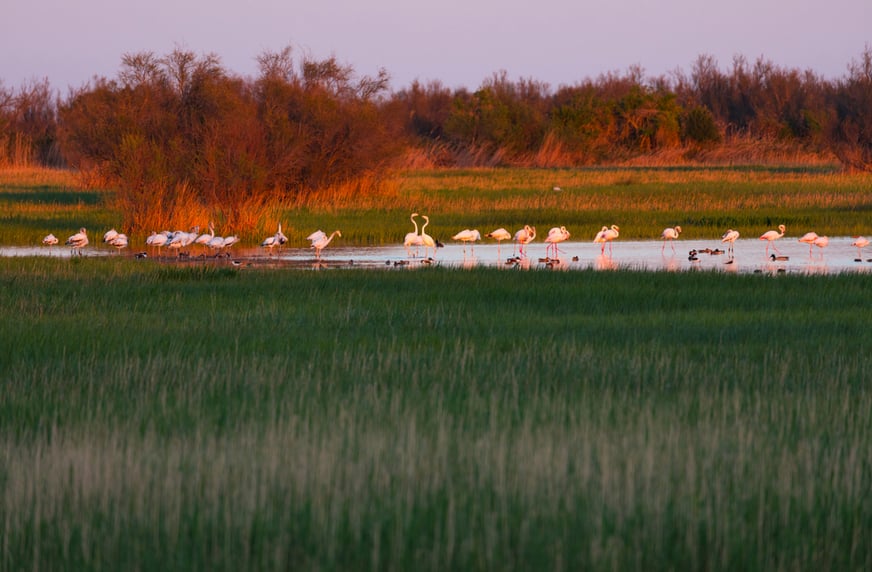
A short distance south of Roses, past the extraordinary 1970s marina development of Empuriabrava, lie the wetlands of the Parc Natural dels Aiguamolls de l’Empordà (pictured above). Situated at the mouth of Riu Fluvià, the ecological preserve provides an important habitat for migratory birds—329 species have been cited here. The park’s website has plenty of information about itineraries for exploring the park, including by bicycle and for those with mobility issues. There’s an information center signposted on the highway between Castelló d’Empúries and St. Pere Pescador (tel. 97-245-42-22). Numerous camping sites surround the park, most offering inexpensive bungalows for hire. Some, like Las Palmeras, 17470 Sant Pere Pescador (tel. 97-720-80-81) emphasize the tranquil environment, others like La Ballena Alegre, (17470 Sant Pere Pescador; tel. 97-252-03-02) cater more for beach life and watersports.
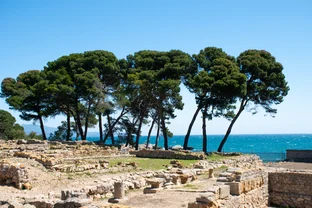
The vast Greek and Roman archaeological site at Empúries is a wonder, with layer upon layer of history. Located just north of the village of L’Escala, it been under excavation since 1908 and digging continues. The Greeks founded it in 575 b.c. as an emporion, or “trading port”. Then, in 218 b.c, the Roman General Scipio Africanus landed here in a bid to oust the Carthaginians from the Iberian Peninsula. When the Carthaginians had gone, a Roman settlement flourished, with a forum, basilica, and grand villas decorated with mosaics. Few complete structures survive, but the scale of the ancient urban layout is thrilling. Within the site, the Museu d’Arqueologia de Catalunya interprets the history of both settlements through a rich collection of archaeological treasures, of which the most impressive is the Greek sculpture of Asclepios (God of Medicine). A replica stands where it discovered in the early 20th century. Tip: head directly to the museum first, then stroll among the ruins. Understanding the exhibits helps bring the ancient stones to life. The museum is on Carrer Puig i Cadafalch, s/n (tel. 97-277-02-08). Admission is 6€ adults, 4€ students and seniors, free for children under 16. It is open daily 10am‒6pm, until 8pm June to September. In winter it closes at 5pm and is also closed on Mondays.
You can stay next to the archaeological site at Hostal Empúries, Platja de Portitxol, s/n; (tel. 97-277-02-07), an idyllic beach hotel offering spa treatments and gastronomic cuisine. In low season, doubles start at just 100€, but you’ll need to book well in advance for summer, when prices rise to more than 300€, with a minimum two-night stay.