Alhambra and Generalife

Qalat al-Hamra (the Red Castle) is perhaps the most beautiful fortress ever built. Originally constructed for defensive purposes on a rocky hilltop above the Darro River, it was converted into a palace by the first Nasrid emir Ibn al-Ahmar in 1238 and extended by succeeding rulers over the next couple of centuries. Islamic architecture in Spain reached its dizzying apogee in the 14th century when Yusuf I and Muhammad V ordered the construction of the Palacios Nazaríes and the Patio de los Leones respectively. Although magnificent from a distance, its unadorned exterior may surprise you when you first see it up close. The astonishing ornamentation lies within.
Enter the complex via the uninspiring concrete pavilion on Paseo de la Sabica. From there, it’s a 10-minute walk to the Nasrid Palaces.
Most visitors won’t need an expensive guide, or even an audio guide. Many of the Arabic inscriptions translate to “Only Allah is conqueror.”It’s best simply to immerse yourself in the Alhambra and its gardens and try—as Washington Irving suggested—to shut your eyes to everyday life.
Carlos V’s Palace
As you wait for your slot at the Nasrid Palaces, take a look at the Palacio de Carlos V. The Holy Roman Emperor —who also allowed a cathedral to be built in the middle of the great mosque in Córdoba—didn’t think the Alhambra was grand enough. So, in 1526 he ordered Pedro Machuca, a student of Michelangelo, to design a fitting royal residence. To add insult to injury, Carlos financed his Renaissance pile by levying a tax on the Muslims.
Stunningly innovative in its day, the square exterior opens to reveal a huge circular courtyard with two arcaded stories, open to the sky. But the emperor never lived here, and the palace remained unfinished until the 20th century.
Inside are two smallish museums. Museo de la Alhambra (tel. 95-802-79-29; free admission; Wed–Sat 8:30am–6pm, until 8pm in summer; Tues and Sun 8am–2:30pm) displays artifacts excavated at the site, including fragments of sculpture, ceramics, and even perfume burners used in the harem. The most outstanding objects are the richly decorated Nasrid amphorae and the Pila de Almanzor, a 10th-century ablution basin adorned with lions, stags, and ibex. The Museo de Bellas Artes (tel. 95-856-35-08; admission 1.50€, free for EU citizens; Tues–Sat 9am–6pm, until 8pm in summer; Sun 9am–3pm) has a modest collection of Christian religious paintings and sculpture from the 15th to the 20th century, including a marvelous still life by Sánchez Cotán. But you can’t help feeling the museum—like the palace itself—is in the wrong place.
Mexuar
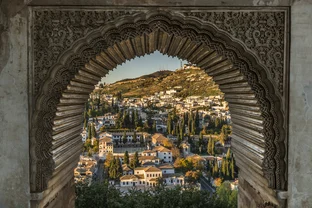
When your time slot arrives, you’ll be ushered on a strictly controlled tour of the Palacios Nazaríes, starting in the Mexuar. The first, modestly decorated hall was a reception area where the emir and his ministers heard appeals from members of the public. It was converted to a Catholic chapel in the 16th century—note the emperor’s motto Plus Ultra (Further Beyond) on the tiled walls. At the back are the oratory and mihrab, which look out onto the Albaicín below (the views are magnificent). They were heavily restored in the 20th century following a gunpowder mishap in 1590.
Pass through the Cuarto Dorado (Gilded Room), so-called because of its embellished ceiling added by the Christian kings. Constructed in 1365, this is where the emir sat on giant cushions and listened to the petitions of his subjects, or met privately with his chief ministers. The windows here are surrounded by panels and richly decorated with tiles and stucco. Next you’ll find yourself in the small but beautiful Patio del Mexuar. The façade here is highly elaborate as it was the doorway to the Serallo, or inner court. The public wouldn’t have been allowed past this point. Inscriptions in stucco repeat the Arabic phrase “there is no conqueror but Allah.”
Serallo
The Serallo, built during the reign of Yusuf I in the 14th century, is arranged around the Patio de los Arrayanes (Court of the Myrtles), which contains a narrow reflecting pool hedged by myrtle bushes. Note the decorative tiles, among the finest in the Alhambra. At the northern end is the antechamber known as the Sala de la Barca. Its magnificent wooden ceiling suggests the hull of a boat, or barca, but the name probably comes from the Arabic baraka, or blessing, a word repeated again and again in the plasterwork.
Beyond, in the Palacio de Comares, is the Salón de Embajadores (Hall of the Ambassadors), the palace’s largest and grandest room, built between 1334 and 1354. This is where the Nasrid rulers carried out their diplomatic business. Perfectly square, it contained the sultan’s throne. Its crowning cedar dome evokes the seven heavens of the Islamic cosmos. It was in this room that the ill-starred Boabdil signed the terms of his surrender to the Catholic Monarchs.
Harem
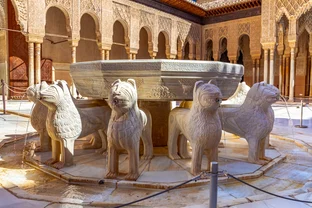
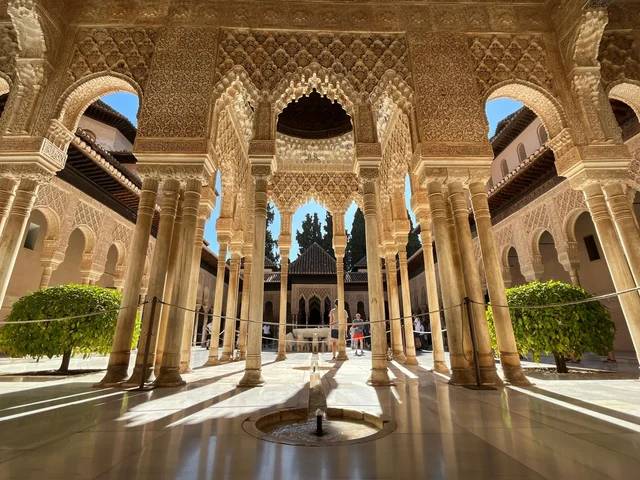
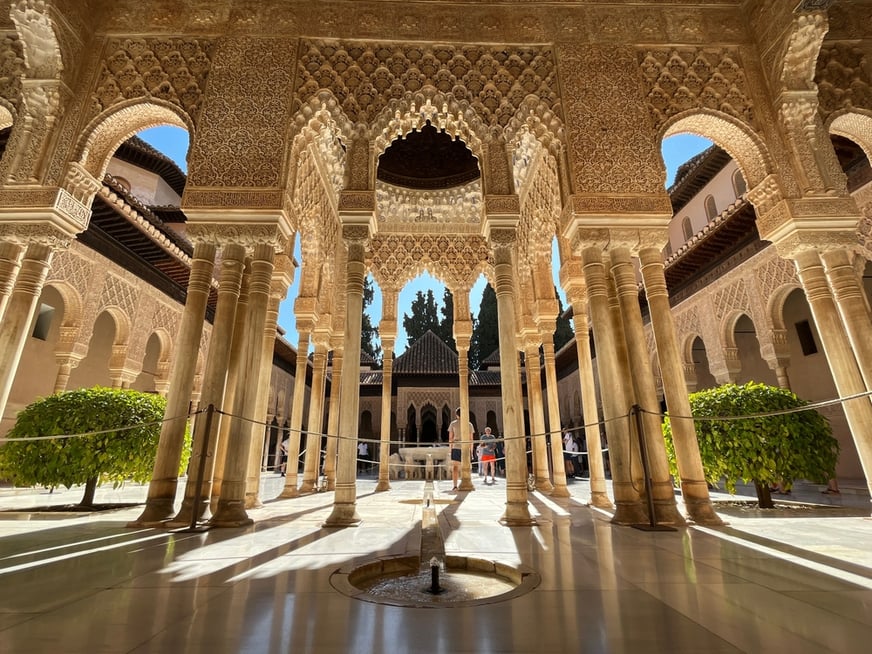
An opening off the Court of the Myrtles leads to the greatest architectural achievement of the Alhambra—the Patio de los Leones (Court of the Lions, see top of page), constructed for Muhammad V in the 1360s. This was the heart of the palace, the private quarters where the sultan and his family would retreat.
The court is an architectural representation of paradise and shows Christian influences in its cloister, lined with arcades supported by 124 slender marble columns. At its center is Andalucía’s most famous fountain, resting on 12 marble lions. The lions represent the hours of the day, the months of the year, and maybe even the tribes of Israel. To one side is the Sala de los Abencerrajes. It is said that during a banquet here, Boabdil’s father, Muley Hacén, slaughtered 16 members of the Abencerraj family because their chief was sleeping with his favorite wife, Zoraya.
Two further rooms open onto the Court of the Lions. The Sala de los Reyes (Hall of the Kings), the Alhambra’s great banquet hall, features 14th-century ceiling paintings on leather, attributed to Christian artists. The Sala de las Dos Hermanas (Hall of the Two Sisters), named for the two identical marble slabs in the pavement, has stunning honeycomb vaulting known as muqarnas that hang from its dome. Next to it, the Sala de las Ajimeces (Hall of the Balconies) leads to the exquisitely framed Mirador de Daraxa, looking out on a leafy patio below.
From here, a gallery leads down to the Patio de la Reja (Court of the Window Grille). This is where Washington Irving lived in the emperor’s chambers in 1829, and where he began to write his famous book Tales of the Alhambra.
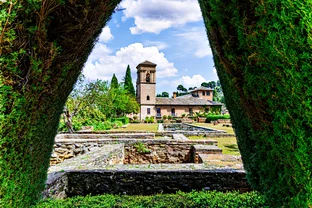
As you leave the Nasrid palace and walk through the gardens towards the Generalife, you’ll reach the Torre de las Infantas (Tower of the Princesses), scene of one of Irving’s most famous stories. Three beautiful princesses, Zayda, Zorayda, and Zorahayda, fell in love with three captive Christian soldiers. To cut a long story short, two sisters got their man, but the third, Zorahayda, couldn’t betray her father and died broken-hearted, locked in the tower. The story goes that she is buried in these gardens, where a single rosebush grows.
(Irving credits the French with saving the Alhambra for posterity, but in fact they were responsible for blowing up seven of the towers in 1812, and it was a Spanish soldier who cut the fuse before more damage could be done. When the Duke of Wellington arrived a few years later, he chased out the chickens, the Gypsies, and the transient beggars who were squatting in the Alhambra and set up housekeeping here himself.)
Generalife
Cross the bridge at Torre del Agua and you’ll soon reach the gardens and the main building of the Generalife. Set in 30 lush hectares (74 acres), it was built in the 13th century as a sultan’s escape from the scorching summer heat and palace intrigues. Its name means garden of the architect. Don’t expect an Alhambra in miniature—its open windows, arcades, and white painted walls were designed for comfort rather than splendor.
The gardens, on the other hand, are magnificent, although they have been much altered over the centuries. Highlights include the Patio de Polo, where visitors on horseback would dismount; the Escalera del Agua, a gently flowing water staircase; and the Patio de la Acequía, an enclosed oriental garden with rows of water jets making graceful arches above it. The Patio de la Sultana is said to have been the secret rendezvous point for Zoraya, wife of Sultan Muley Hacén, and her lover, chief of the unlucky Abencerrajes. So much for escaping palace intrigue. The gardens of the Generalife provide an unsurpassable setting for Granada’s International Festival of Music and Dance, which takes place over two weeks in early summer.
Alcazaba
At the beginning or end of your visit, plan to see the Alcazaba, the rugged 9th-century fortress that is the oldest part of the complex. For spectacular views, climb the Torre de la Vela watchtower. From here, you can get a great sense of the Alhambra and Generalife, and the whole city and province of Granada are laid out before you, stretching towards the snowcapped mountains of the Sierra Nevada. It was on this parapet in January 1492 that the cross was again raised over Granada, after nearly 800 years of Islamic rule.
Advice on ticket purchases
The Alhambra is so popular—millions visit every year—that the numbers who can enter each day is strictly controlled. Tickets often sell out weeks and even months in advance, so book them online well before you travel. Lots of sites offer tickets and tours, but the only official one is tickets.alhambra-patronato.es; tel. 95-802-79-71.
Take care too when choosing which ticket to buy. There are several options and not all give access to the Palacios Nazaríes (the Nasrid Palaces), which you don’t want to miss. The Alhambra General ticket (19.09€) includes access to all the public areas within the complex. You can select when to visit the Nasrid Palaces, but you must show up at the time specified on your ticket. Warning: If you miss it, you won’t be allowed in.
The rest of the complex, including the Generalife and Alcazaba, can be visited at any time from 8.30am until closing time. You can show the QR code on your phone or collect your ticket at a vending machine at the entrance. Don’t forget your passport or ID card—you’ll need to show it to get in.
Allow 3–4 hours to visit the palaces and gardens.
Walking to the Alhambra
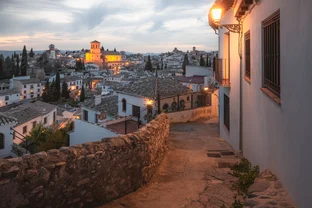
Most visitors opt to take a taxi or bus from the city center to the Alhambra, but some hardy souls enjoy the uphill climb from Plaza Nueva. Start on Cuesta Gomérez and follow the signs indicating the zigzagging road that leads to the top. The wooded walk takes about 30 minutes. A shorter but steeper ascent on Cuesta del Rey Chico starts from Paseo de los Tristes. For those staying at the parador or other hotels near the Alhambra, walking into town and catching a bus or taxi back up the hill might be a happy compromise.
Qalat al-Hamra (the Red Castle) is perhaps the most beautiful fortress ever built. Originally constructed for defensive purposes on a rocky hilltop above the Darro River, it was converted into a palace by the first Nasrid emir Ibn al-Ahmar in 1238 and extended by succeeding rulers over the next couple of centuries. Islamic architecture in Spain reached its dizzying apogee in the 14th century when Yusuf I and Muhammad V ordered the construction of the Palacios Nazaríes and the Patio de los Leones respectively. Although magnificent from a distance, its unadorned exterior may surprise you when you first see it up close. The astonishing ornamentation lies within.
Enter the complex via the uninspiring concrete pavilion on Paseo de la Sabica. From there, it’s a 10-minute walk to the Nasrid Palaces.
Most visitors won’t need an expensive guide, or even an audio guide. Many of the Arabic inscriptions translate to “Only Allah is conqueror.”It’s best simply to immerse yourself in the Alhambra and its gardens and try—as Washington Irving suggested—to shut your eyes to everyday life.
Carlos V’s Palace
As you wait for your slot at the Nasrid Palaces, take a look at the Palacio de Carlos V. The Holy Roman Emperor —who also allowed a cathedral to be built in the middle of the great mosque in Córdoba—didn’t think the Alhambra was grand enough. So, in 1526 he ordered Pedro Machuca, a student of Michelangelo, to design a fitting royal residence. To add insult to injury, Carlos financed his Renaissance pile by levying a tax on the Muslims.
Stunningly innovative in its day, the square exterior opens to reveal a huge circular courtyard with two arcaded stories, open to the sky. But the emperor never lived here, and the palace remained unfinished until the 20th century.
Inside are two smallish museums. Museo de la Alhambra (tel. 95-802-79-29; free admission; Wed–Sat 8:30am–6pm, until 8pm in summer; Tues and Sun 8am–2:30pm) displays artifacts excavated at the site, including fragments of sculpture, ceramics, and even perfume burners used in the harem. The most outstanding objects are the richly decorated Nasrid amphorae and the Pila de Almanzor, a 10th-century ablution basin adorned with lions, stags, and ibex. The Museo de Bellas Artes (tel. 95-856-35-08; admission 1.50€, free for EU citizens; Tues–Sat 9am–6pm, until 8pm in summer; Sun 9am–3pm) has a modest collection of Christian religious paintings and sculpture from the 15th to the 20th century, including a marvelous still life by Sánchez Cotán. But you can’t help feeling the museum—like the palace itself—is in the wrong place.
Mexuar
When your time slot arrives, you’ll be ushered on a strictly controlled tour of the Palacios Nazaríes, starting in the Mexuar. The first, modestly decorated hall was a reception area where the emir and his ministers heard appeals from members of the public. It was converted to a Catholic chapel in the 16th century—note the emperor’s motto Plus Ultra (Further Beyond) on the tiled walls. At the back are the oratory and mihrab, which look out onto the Albaicín below (the views are magnificent). They were heavily restored in the 20th century following a gunpowder mishap in 1590.
Pass through the Cuarto Dorado (Gilded Room), so-called because of its embellished ceiling added by the Christian kings. Constructed in 1365, this is where the emir sat on giant cushions and listened to the petitions of his subjects, or met privately with his chief ministers. The windows here are surrounded by panels and richly decorated with tiles and stucco. Next you’ll find yourself in the small but beautiful Patio del Mexuar. The façade here is highly elaborate as it was the doorway to the Serallo, or inner court. The public wouldn’t have been allowed past this point. Inscriptions in stucco repeat the Arabic phrase “there is no conqueror but Allah.”
Serallo
The Serallo, built during the reign of Yusuf I in the 14th century, is arranged around the Patio de los Arrayanes (Court of the Myrtles), which contains a narrow reflecting pool hedged by myrtle bushes. Note the decorative tiles, among the finest in the Alhambra. At the northern end is the antechamber known as the Sala de la Barca. Its magnificent wooden ceiling suggests the hull of a boat, or barca, but the name probably comes from the Arabic baraka, or blessing, a word repeated again and again in the plasterwork.
Beyond, in the Palacio de Comares, is the Salón de Embajadores (Hall of the Ambassadors), the palace’s largest and grandest room, built between 1334 and 1354. This is where the Nasrid rulers carried out their diplomatic business. Perfectly square, it contained the sultan’s throne. Its crowning cedar dome evokes the seven heavens of the Islamic cosmos. It was in this room that the ill-starred Boabdil signed the terms of his surrender to the Catholic Monarchs.
Harem
An opening off the Court of the Myrtles leads to the greatest architectural achievement of the Alhambra—the Patio de los Leones (Court of the Lions, see top of page), constructed for Muhammad V in the 1360s. This was the heart of the palace, the private quarters where the sultan and his family would retreat.
The court is an architectural representation of paradise and shows Christian influences in its cloister, lined with arcades supported by 124 slender marble columns. At its center is Andalucía’s most famous fountain, resting on 12 marble lions. The lions represent the hours of the day, the months of the year, and maybe even the tribes of Israel. To one side is the Sala de los Abencerrajes. It is said that during a banquet here, Boabdil’s father, Muley Hacén, slaughtered 16 members of the Abencerraj family because their chief was sleeping with his favorite wife, Zoraya.
Two further rooms open onto the Court of the Lions. The Sala de los Reyes (Hall of the Kings), the Alhambra’s great banquet hall, features 14th-century ceiling paintings on leather, attributed to Christian artists. The Sala de las Dos Hermanas (Hall of the Two Sisters), named for the two identical marble slabs in the pavement, has stunning honeycomb vaulting known as muqarnas that hang from its dome. Next to it, the Sala de las Ajimeces (Hall of the Balconies) leads to the exquisitely framed Mirador de Daraxa, looking out on a leafy patio below.
From here, a gallery leads down to the Patio de la Reja (Court of the Window Grille). This is where Washington Irving lived in the emperor’s chambers in 1829, and where he began to write his famous book Tales of the Alhambra.
As you leave the Nasrid palace and walk through the gardens towards the Generalife, you’ll reach the Torre de las Infantas (Tower of the Princesses), scene of one of Irving’s most famous stories. Three beautiful princesses, Zayda, Zorayda, and Zorahayda, fell in love with three captive Christian soldiers. To cut a long story short, two sisters got their man, but the third, Zorahayda, couldn’t betray her father and died broken-hearted, locked in the tower. The story goes that she is buried in these gardens, where a single rosebush grows.
(Irving credits the French with saving the Alhambra for posterity, but in fact they were responsible for blowing up seven of the towers in 1812, and it was a Spanish soldier who cut the fuse before more damage could be done. When the Duke of Wellington arrived a few years later, he chased out the chickens, the Gypsies, and the transient beggars who were squatting in the Alhambra and set up housekeeping here himself.)
Generalife
Cross the bridge at Torre del Agua and you’ll soon reach the gardens and the main building of the Generalife. Set in 30 lush hectares (74 acres), it was built in the 13th century as a sultan’s escape from the scorching summer heat and palace intrigues. Its name means garden of the architect. Don’t expect an Alhambra in miniature—its open windows, arcades, and white painted walls were designed for comfort rather than splendor.
The gardens, on the other hand, are magnificent, although they have been much altered over the centuries. Highlights include the Patio de Polo, where visitors on horseback would dismount; the Escalera del Agua, a gently flowing water staircase; and the Patio de la Acequía, an enclosed oriental garden with rows of water jets making graceful arches above it. The Patio de la Sultana is said to have been the secret rendezvous point for Zoraya, wife of Sultan Muley Hacén, and her lover, chief of the unlucky Abencerrajes. So much for escaping palace intrigue. The gardens of the Generalife provide an unsurpassable setting for Granada’s International Festival of Music and Dance, which takes place over two weeks in early summer.
Alcazaba
At the beginning or end of your visit, plan to see the Alcazaba, the rugged 9th-century fortress that is the oldest part of the complex. For spectacular views, climb the Torre de la Vela watchtower. From here, you can get a great sense of the Alhambra and Generalife, and the whole city and province of Granada are laid out before you, stretching towards the snowcapped mountains of the Sierra Nevada. It was on this parapet in January 1492 that the cross was again raised over Granada, after nearly 800 years of Islamic rule.
Advice on ticket purchases
The Alhambra is so popular—millions visit every year—that the numbers who can enter each day is strictly controlled. Tickets often sell out weeks and even months in advance, so book them online well before you travel. Lots of sites offer tickets and tours, but the only official one is tickets.alhambra-patronato.es; tel. 95-802-79-71.
Take care too when choosing which ticket to buy. There are several options and not all give access to the Palacios Nazaríes (the Nasrid Palaces), which you don’t want to miss. The Alhambra General ticket (19.09€) includes access to all the public areas within the complex. You can select when to visit the Nasrid Palaces, but you must show up at the time specified on your ticket. Warning: If you miss it, you won’t be allowed in.
The rest of the complex, including the Generalife and Alcazaba, can be visited at any time from 8.30am until closing time. You can show the QR code on your phone or collect your ticket at a vending machine at the entrance. Don’t forget your passport or ID card—you’ll need to show it to get in.
Allow 3–4 hours to visit the palaces and gardens.
Walking to the Alhambra
Most visitors opt to take a taxi or bus from the city center to the Alhambra, but some hardy souls enjoy the uphill climb from Plaza Nueva. Start on Cuesta Gomérez and follow the signs indicating the zigzagging road that leads to the top. The wooded walk takes about 30 minutes. A shorter but steeper ascent on Cuesta del Rey Chico starts from Paseo de los Tristes. For those staying at the parador or other hotels near the Alhambra, walking into town and catching a bus or taxi back up the hill might be a happy compromise.
Details
Bookstore

Available as paperback
and as e-book.