Things To Do in La Rochelle
Bookstore
Available as paperback
and as e-book.
La Rochelle Attractions
La Rochelle has two sides: the old and unspoiled town inside the Vauban defenses and the modern and industrial suburbs. The city’s fortifications have a circuit of 5.5km (3.5 miles), with a total of seven gates. It’s an easy city to walk around, or you can rent the yellow bicycles (or electric cars) called Yélo (https://yelo.agglo-larochelle.fr) from stations around the city. There are even solar-powered boats that chug across the harbor. These cross the La Rochelle channel from Cours des Dames to La Médiathèque and are called by pressing on a button on the quay side. A 10-trip ticket is 11€, or a single ride is 1.30€, and is also valid on the city's buses. You can also buy a 24-hr. unlimited ticket for 4.50€.
The town, with its arch-covered streets, is great for strolling. The port is a fishing harbor and one of Europe’s major sailing centers. If you are here during the summer, try to schedule a visit in time to attend a fish auction (called La Criée aux Poissons) at the Marché Central de la Rochelle, starting at 5am every Thursday from mid-June to mid-September (7€ per person booked through the tourist office, see above). You can even learn how to lift the nets like a professional fisherman at the Lycée Maritime de la Rochelle during the summer when the full-time students are not around. For information on these 2-hr. introductions, see www.lycee-maritime-larochelle.com or again go through the tourist office. The best streets for strolling, each with a 17th-century arcade, are rue du Palais, la Rue du Temple, rue Chaudrier, and rue des Merciers, the latter with its ancient wooden houses (seek out the ones at nos. 3, 5, 8, and 17).
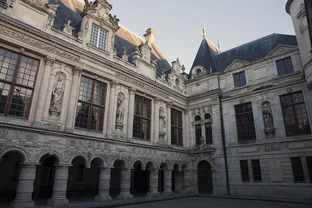
The town’s 14th-century showcase Hôtel de Ville (City Hall) is built in flamboyant Gothic style with battlements. It was heavily damaged in a 2013 fire, but many of its treasures were saved and the building reopened in 2019 after extensive restoration. Step inside for a look at its wonderfully ornate public rooms. Open Monday to Friday 8am–6pm and Saturday 10am–12:30pm and 1:30–6pm.
Important: If you plan to do a lot of sightseeing, you can buy a La Rochelle Océan Pass (larochelleoceanpass.com), which gives you admission to more than 30 attractions plus public transport (but not Yélo bicycles). It’s valid over 48 hours, 72 hours and 7 days, and includes admission to sites in La Rochelle as well as the Charente-Maritime region. Sites include La Rochelle’s towers, Musée Maritime, Musée du Nouveau-Monde, Musée d’Histoire Naturelle, boat rides, a trip to Ile-de-Ré and a boat ride to Fort Boyard, among others. A 48-hour pass costs 44€, adults, 22€, for children 12–17 and 11€, for children 6–11 (free for children under 6).
If you think you'll just be seeing the towns major historic towers, you can purchase a three-tower ticket for 9.50€ adults or 5.50€ ages 18 to 25. It allows you to visit all three tours (though usually after two towers, only the most die-hard tower devotees press on). If you wanted to combine the towers with a museum visit, a ticket costing 13€ gets you into the three towers as well as one of the following: Musée du Nouveau-Monde, Musée Maritime and Muséum d’Histoire Naturelle.
Tracing Your Roots
During the French Wars of Religion that raged off and on for much of the 17th century, a large number of both Huguenots and Catholics emigrated from La Rochelle to north America, especially Canada. It is thought that as many as 14,000 emigrants landed in New France (the term referred to French colonies across North America including Québec, Newfoundland, Nova Scotia, and parts of the Great Lakes) in the century up to 1760. Besides the Musée du Nouveau-Monde, you will also see a sculpture in the Vieux-Port called Globe de la Francophonie by artist Bruce Krebs, celebrating this global spread of French culture and language. If you are tracing your own roots here, you could start with the Unicaen Project run by Caen university (no longer funded, but the information gathered in a research project from 2001 to 2006 is searchable on www.unicaen.fr/mrsh/prefen/index.php). Open by request only, the Musée Rochelais d’Histoire Protestante on 2 Rue Saint-Michel (www.protestantisme-museelarochelle.fr; tel. 05-46-50-88-03; 4€ adults, 2€ students and visitors 24–18, free for children 17 and under) has some potentially useful archives.
Sailing the Ports of La Rochelle
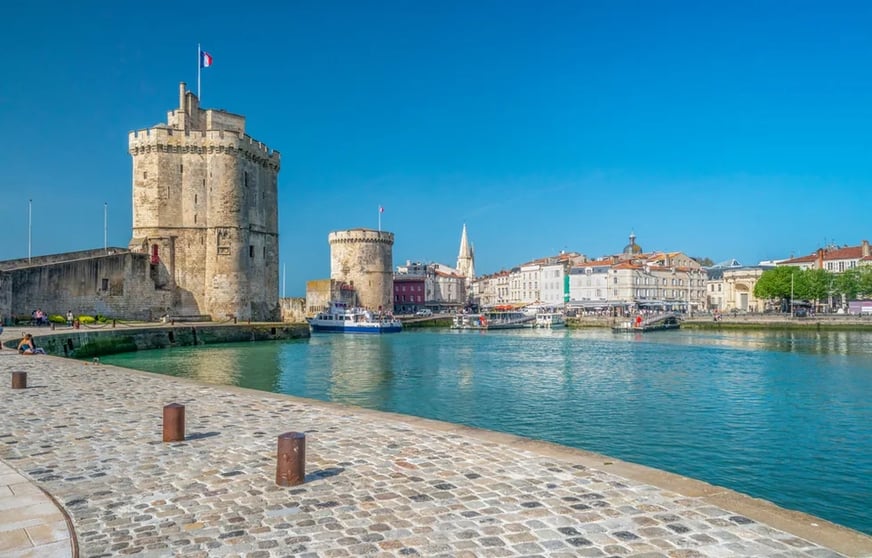
La Rochelle has always earned its living from the sea and the ships that make its harbor their home. Four distinct harbors have grown up over the centuries, each a world unto itself, rich with local nuance and lore. They include the historic Vieux-Port, the Port de Plaisance (a modern yacht marina), the Port de Pêche (the fishing port), and the Port de Commerce, mostly used by large container ships.
The best way to appreciate them is to take a boat tour. Visit the tourist office (or its website), which acts as a clearinghouse for the major tour companies. Tours combine a look at the modern facilities with a waterside view of the historic ramparts—which, despite their girth and height, did not protect the city’s 17th-century Protestants from starvation and eventual annihilation.
The company with the most frequent departures is the Croisières Inter-Iles (www.inter-iles.com; tel. 05-46-50-55-54). Every day from April to October, about a half-dozen cruises glide into each of the six ports. In winter, they’re offered less frequently, usually only on school vacations. Tours last 70 to 180 min. each, are conducted in French, and average 20€.
Another excellent waterborne outing—but only during the warmer months—involves taking a ferry from the Vieux-Port of La Rochelle to Ile de Ré. The island, 26km (16 miles) off the coast of La Rochelle and ringed with 69km (43 miles) of sandy beaches, holds nature preserves crisscrossed with biking and hiking paths, and a number of excellent restaurants in the island’s main town, St-Martin-de-Ré. Croisières Inter-Iles (see above) serves the island. If you want to get here during July or August, and if you don’t have a car, we recommend taking the ferry for a round-trip fare of 22€. It’s worth spending a few days on the island if you have time, joining the many Parisians who escape here during the summer months. The island has many bike rental shops and over 100km (62 miles) of excellent bike paths. Since the island is fairly flat (the highest point only 19m/62 ft.), you can easily do the trip without a car.
You can also drive your car across the bridge that connects the Ile de Ré to the French mainland. It’s accessible from a point 3km (1.75 miles) south of La Rochelle. The toll is 16€ in summer, 8€ in winter. The local bus company, Transports Nouvelle Aquitaine (transports.nouvelle-aquitaine.fr; tel. 09-70-87-08-87), offers up to 15 round-trips per day year-round (line 3), and charges 2.30€ one-way or 4.10€ round-trip from La Rochelle to several stops along the island.

9 Results
- Zoo/Aquarium
Aquarium de La Rochelle
La Rochelle’s blockbuster crowd pleaser, this is one of the biggest aquariums in Europe and has just benefitted from an upgrade, reopening in February 2018. It rises from a portside position near the Port des Minimes, north of the old city. Inside are guided walkways stretching over…Around Town
- Landmark
Hôtel de Ville (City Hall)
The town's 14th-century showcase is built in flamboyant Gothic style with battlements. Inside you can admire the Henry II staircase with canopies and the marble desk of the heroic Jean Guiton. You must visit as part of a guided tour (in French only); advance reservations are not… - Museum
Musée Maritime
This museum is comprised of eight permanently docked boats, two of which can be visited: a weather ship that was used in the North Atlantic until the 1980s, and an antique chalutier de peche (fishing trawler). The vintage yachts evoke the grand days of La Rochelle as a maritime power…Around Town - Museum
Musée des Beaux-Arts
This museum is in an Episcopal palace built in the mid–17th century. The 900-strong art collection spans the 15th to the 20th centuries but focuses mainly on 19th century art with works by Gustave Doré, Brossard de Beaulieu, Camille Corot, and Paul Huet, as well as local artists…Around Town - Museum
Musée du Nouveau-Monde
In an 18th-century town house named after the Fleuriau family who lived there from 1772 to 1974, this is one of La Rochelle’s most intriguing museums. It’s rich with evidence of the city’s prominent role in the colonization of Canada, as La Rochelle was the primary port in France for…Around Town - Museum
Muséum d’Histoire Naturelle
One of the hidden treasures of La Rochelle, this lovely museum is set within an enormous (2,500 sq. m/26,910 sq. ft.) mansion in the heart of town and surrounded by lovely botanical gardens. This is truly a museum to get lost in. Expect an array of taxidermied animals, African masks,…Around Town - Historic Site
Tour St-Nicolas
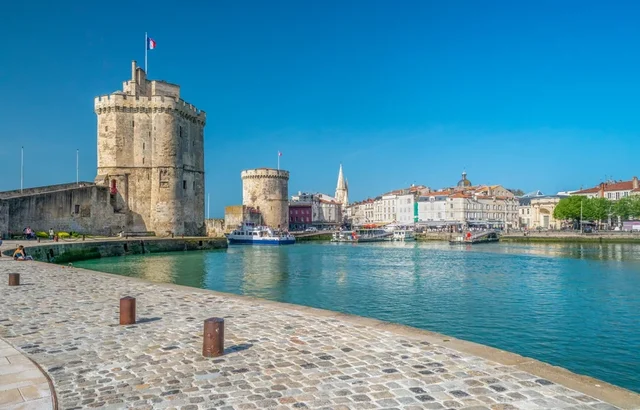
The oldest tower in La Rochelle, Tour St-Nicolas was built between 1371 and 1382. It originally guarded the town against surprise attacks. From its second floor, you can enjoy a view of the town and harbor; from the top, you can see only the old town and Ile d’Oléron.Around Town - Historic Site
Tour de la Chaîne
During the 1300s, this tower was built as an anchor piece for the large forged-iron chain that stretched across the harbor, closing it against hostile warships. The exhibits focus on the history of the first migration to Canada. - Historic Site
Tour de la Lanterne
Built between 1445 and 1476, this was once a lighthouse but was used mainly as a jail as late as the 19th century. A low rampart connects the cylindrical tower to the Tour de la Chaîne. During the Wars of Religion, 13 priests were tossed from its summit. You climb 162 steps to the…Around Town
La Rochelle Nightlife
From July to September, head for quai Duperré, cours des Dames, and cours des Templiers. Once the sun starts to set, this becomes one big pedestrian zone peppered with street performers. It’s a fun, almost magical area that sets the tone for the rest of the night. Your early evening should include a stop at La Guignette, 8 rue Sainte Nicolas (https://la-guignette.fr; tel. 05-56-41-05-75), which looks pretty much unchanged since it opened in the 1930s and has on tap la guignette, a blend of white wine, sparkling water, and syrup rarely found outside of La Rochelle (and possibly this bar).