Things To Do in Lunenburg
Bookstore

Available as paperback
and as e-book.
Lunenburg Attractions
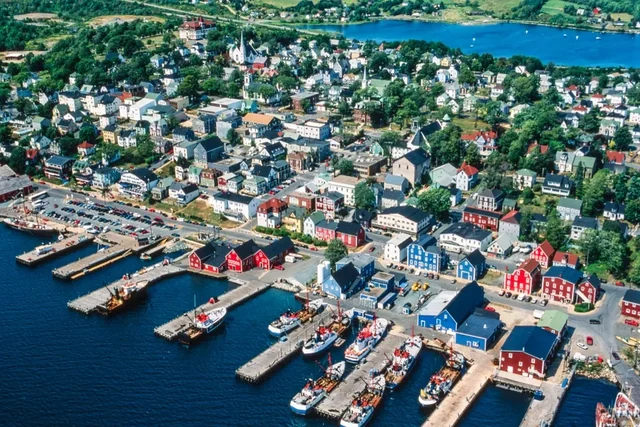
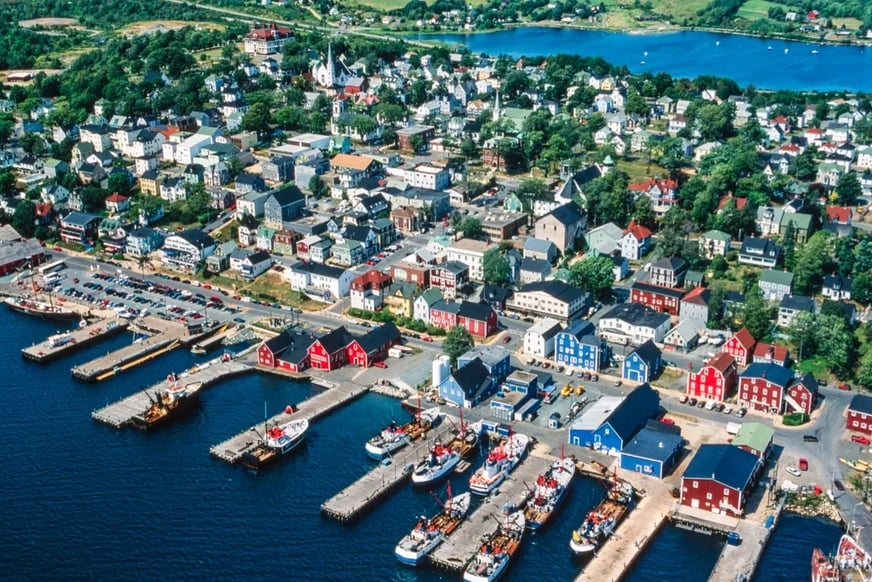
While exploring the steep streets of the town, note the architectural influence of its European settlers—especially the Germans. Some local folks made their fortunes from the sea, but serious money was also made by carpenters who specialized in the elaborate ornamental brackets that adorn dozens of homes here. Many homes feature a distinctive architectural element known as the “Lunenburg bump,” a five-sided dormer-and-bay-window combo installed directly over an extended front door. (Other homes feature the simpler, more common Scottish dormer.) Also look for double or triple roofs on some projecting dormers, which serve absolutely no function other than to give them the vague appearance of a wedding cake.
St. John’s Anglican Church (tel. 902/634-4994) at the corner of Duke and Cumberland streets is one of the most impressive architectural sights in all of Eastern Canada—even though it’s a reconstruction. The original structure was built in 1754 of oak timbers shipped from Boston in simple New England meetinghouse style. Between 1840 and 1880, the church went through a number of additions and was overlaid with ornamentation and shingles to create an amazing example of the “carpenter Gothic” style. All this changed on Halloween night of 2001: A fire nearly razed the place, gutting its precious interior and much of the ornate exterior. In 2005, the church reopened after a painstaking 4-year restoration project using new materials but the old design. It’s a must-see, and free to enter.
A contrasting stop is the Ironworks Distillery at 2 Kempt St. (tel. 902/640-2424), a craft micro-distillery and retail outlet in a former marine blacksmith’s, shop built in 1893, that supplied ironworks for the once-booming shipbuilding trade. These days, they’re making vodka from apples grown in the Annapolis Valley. In addition, they also make liqueurs from locally sourced berries—their blueberry and cranberry flavors are so intense (without being sweet) that they give the sensation of devouring a handful of berries fresh from the field. As Lunenburg is a rum-running town, they also make rum distilled straight from Crosby’s molasses, a company that began in Yarmouth in 1879.
Several boat tours operate from the waterfront, most tied up near the Fisheries Museum. Lunenburg Whale Watching Tours (tel. 902/527-7175), the longest-operating business on the South Shore, sails in pursuit of several species of whales, along with dolphins, seals, sea turtles, and seabirds on 3-hour excursions. There are four departures daily from May through October, with reservations recommended (and all bookings must be confirmed 24 hr. in advance with a phone call). Cost is C$75 per adult, C$40 for children under 14, and infants free. If you have less time, Star Charters (tel. 877/386-3535 or 902/634-3535) takes visitors aboard a 48-foot wooden ketch on shorter, mellow 90-minute tours of Lunenburg’s inner harbor five times daily from June through October. These tours cost C$55 adults, C$40 students 16 or older, C$25 children, and C$127-C$135 family. There are three departures daily. Sunset cruises are the same price and depart at 6:30pm.
The Dauntless Bluenose
Take an old Canadian dime -- one minted before 2001 -- out of your pocket and have a close look. That graceful schooner on one side? That's the Bluenose, Canada's most recognized and most storied ship. The Bluenose was built in Lunenburg in 1921 as a fishing schooner. But it wasn't just any schooner. It was an exceptionally fast schooner. U.S. and Canadian fishing fleets had raced informally for years. Starting in 1920, the Halifax Herald sponsored the International Fisherman's Trophy, which was captured that first year by Americans sailing out of Massachusetts. Peeved, the Nova Scotians set about taking it back. And did they ever. The Bluenose retained the trophy for 18 years running, despite the best efforts of Americans to recapture it. The race was shelved as World War II loomed; in the years after the war, fishing schooners were displaced by long-haul, steel-hulled fishing ships, and the schooners sailed into the footnotes of history. The Bluenose was sold in 1942 to labor as a freighter in the West Indies. Four years later it foundered and sank off Haiti. What made the Bluenose so unbeatable? Several theories exist. Some said it was because of last-minute hull design changes. Some said it was frost "setting" the timbers as the ship was being built. Still others claim it was blessed with an unusually talented captain and crew. The replica Bluenose II was built in 1963 from the same plans as the original, in the same shipyard, and even by some of the same workers. It has been owned by the province since 1971, and sails throughout Canada and beyond as Nova Scotia's seafaring ambassador. The Bluenose’s location varies from year to year, and it schedules visits to ports in Canada and the United States. In midsummer, it typically alternates between Lunenburg and Halifax, during which time visitors can sign up for 2-hour harbor sailings. Find each summer’s sailing schedule online at https://bluenose.novascotia.ca.
Lunenburg Shopping
- Books
Block Shop Books
Crammed with books of every kind—including lots of local work—Block Shop is a warren of stacks with quiet corners where reading is encouraged. From the stone foundation, a ledge or two sticks out, doubling as a shelf or a seat. Author readings and book club meetings are held… - Linens
Laurie Swim Gallery
Laurie Swim has taken quilt making to a fine art form. Her pieces could be mistaken at a distance for photographs or paintings, they are so exquisitely and painstakingly rendered. While some of her work captures the innocence of childhood or a moment in a quiet cove, other work is…