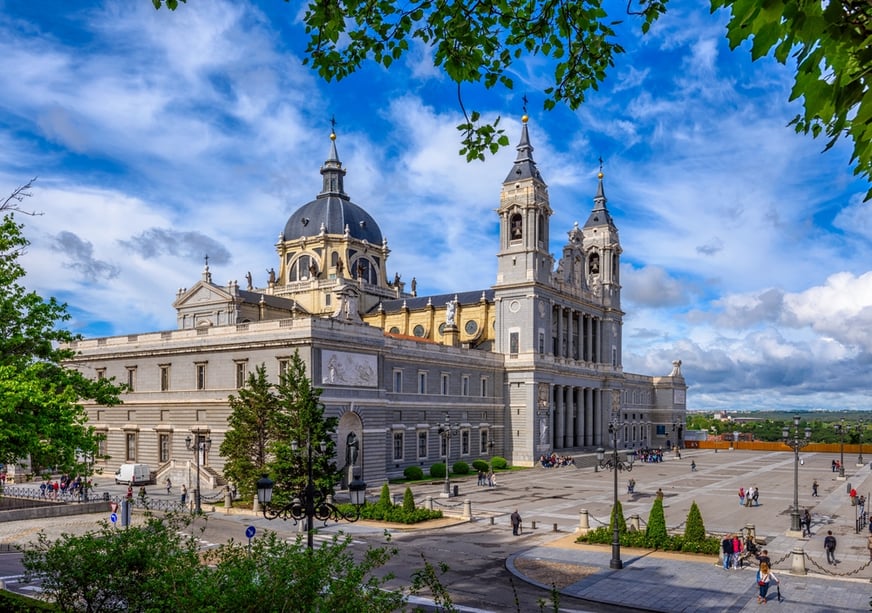
Catedral de la Almudena

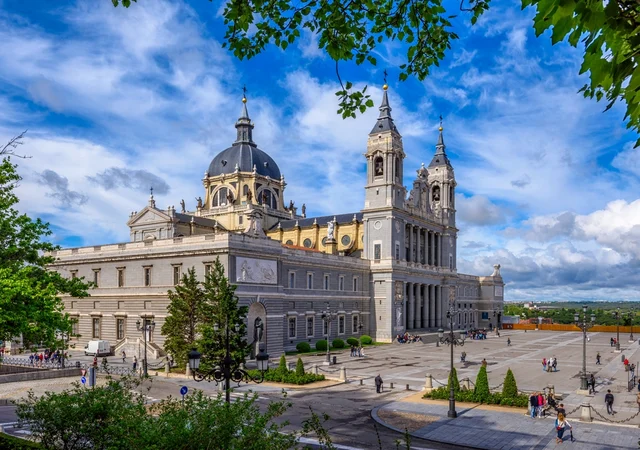
Wars, rebellions, political chaos, and a lack of cash delayed the completion of Madrid’s cathedral for 110 years after ground was broken in 1883. In keeping with Spanish tradition, it was built on the site of Madrid’s chief mosque under Moorish rule. It was named for the Virgen de la Almudena, whose icon was found on the site when Alfonso VI re-conquered the city under the sign of the cross in 1085. The cathedral was originally designed as a neo-Gothic building but when architect Fernando Chueca took over the construction, he altered the plans to make it neoclassical—a better fit with the adjacent Palacio Real. Inside, highlights include contemporary stained glass and ceiling paintings by Kiko Argüello; a Mudéjar chest dating from the 13th century said to have contained the relics of San Isidro, Madrid’s patron saint; and Spain’s largest crypt, featuring some 500 granite columns.
Wars, rebellions, political chaos, and a lack of cash delayed the completion of Madrid’s cathedral for 110 years after ground was broken in 1883. In keeping with Spanish tradition, it was built on the site of Madrid’s chief mosque under Moorish rule. It was named for the Virgen de la Almudena, whose icon was found on the site when Alfonso VI re-conquered the city under the sign of the cross in 1085. The cathedral was originally designed as a neo-Gothic building but when architect Fernando Chueca took over the construction, he altered the plans to make it neoclassical—a better fit with the adjacent Palacio Real. Inside, highlights include contemporary stained glass and ceiling paintings by Kiko Argüello; a Mudéjar chest dating from the 13th century said to have contained the relics of San Isidro, Madrid’s patron saint; and Spain’s largest crypt, featuring some 500 granite columns.
Details
Bookstore
Available as paperback
and as e-book.