Plaza de Cibeles

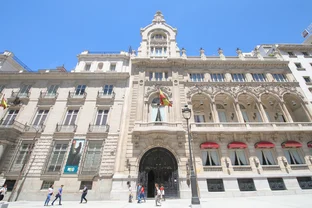
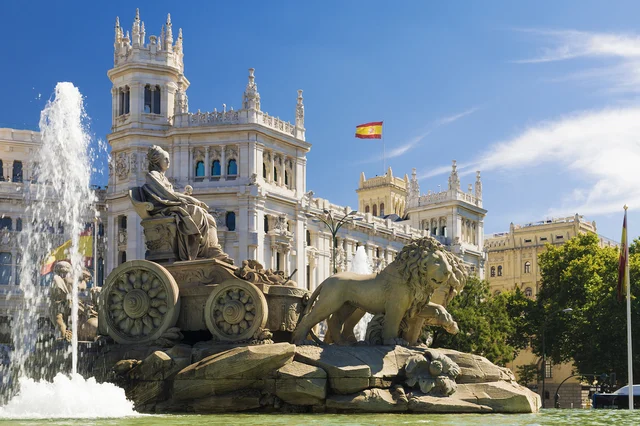
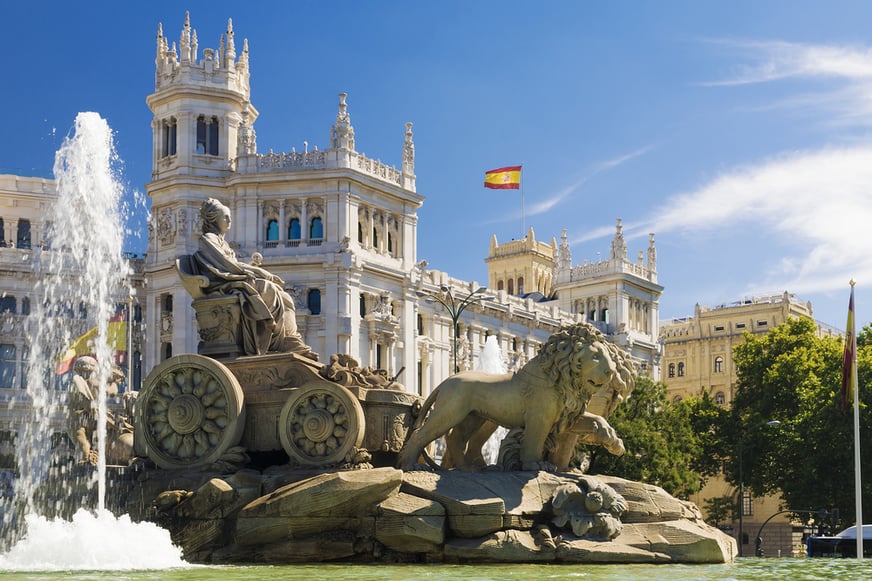
One of Madrid’s most emblematic landmarks—and a bus dropping off point—this busy traffic circle is dominated by the grandiose former Palacio de Comunicaciones (CentroCentro) and by the famous Neoclassical fountain, Fuente de Cibeles. It was conceived in 1782 by the great Enlightenment architect Ventura Rodríguez. It depicts the Roman goddess of fertility and agriculture on a sturdy chariot drawn by two lions. Originally it had a practical function with standpipes providing water for madrileños and their horses. In recent times it has become best known as the spot where Real Madrid soccer fans gather to celebrate their team’s many triumphs, when the team captain places a scarf around the neck of the goddess. The Fuente de Neptuno, just along the Paseo del Prado, serves the same purpose for fans of Real’s archrivals, Atlético Madrid.
One of Madrid’s most emblematic landmarks—and a bus dropping off point—this busy traffic circle is dominated by the grandiose former Palacio de Comunicaciones (CentroCentro) and by the famous Neoclassical fountain, Fuente de Cibeles. It was conceived in 1782 by the great Enlightenment architect Ventura Rodríguez. It depicts the Roman goddess of fertility and agriculture on a sturdy chariot drawn by two lions. Originally it had a practical function with standpipes providing water for madrileños and their horses. In recent times it has become best known as the spot where Real Madrid soccer fans gather to celebrate their team’s many triumphs, when the team captain places a scarf around the neck of the goddess. The Fuente de Neptuno, just along the Paseo del Prado, serves the same purpose for fans of Real’s archrivals, Atlético Madrid.
Details
Bookstore

Available as paperback
and as e-book.