Puente Romano

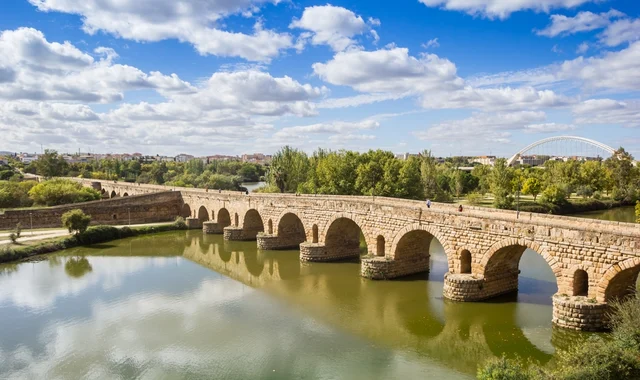
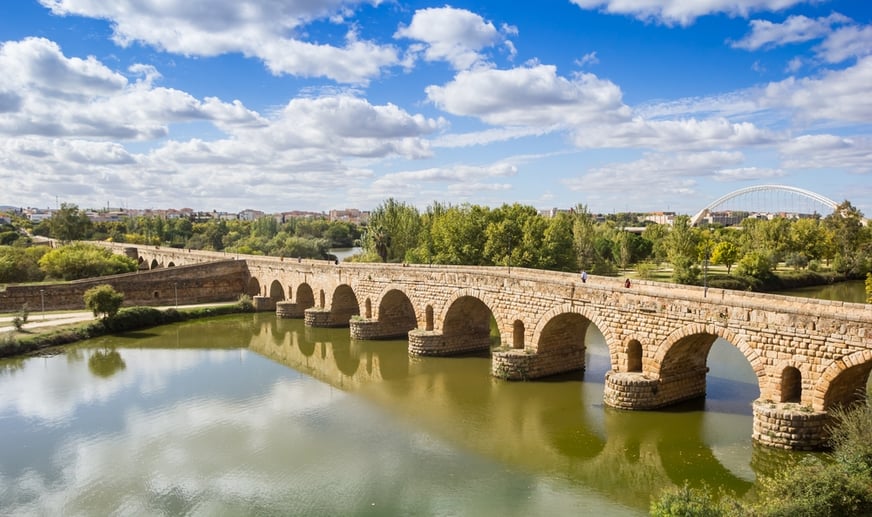
The 60 arches of Mérida’s Roman bridge stretch nearly half a mile from the gates of the Alcazaba across the Guadiana river. It is one of the longest Roman bridges still standing. Constructed from granite blocks and Roman concrete in 25 b.c, when the city was founded, it has been renovated and reinforced many times since. The bridge continued to carry motor traffic until the 1990s when Santiago Calatrava’s bowlike Lusitania bridge was built, leaving the ancient bridge as a pedestrian walkway. It’s a lovely place for a stroll at sunset. Look closely at the cobbled surface—you can see the rutted tracks made by the wooden-wheeled carts that once delivered goods to the gates of the Alcazaba.
The 60 arches of Mérida’s Roman bridge stretch nearly half a mile from the gates of the Alcazaba across the Guadiana river. It is one of the longest Roman bridges still standing. Constructed from granite blocks and Roman concrete in 25 b.c, when the city was founded, it has been renovated and reinforced many times since. The bridge continued to carry motor traffic until the 1990s when Santiago Calatrava’s bowlike Lusitania bridge was built, leaving the ancient bridge as a pedestrian walkway. It’s a lovely place for a stroll at sunset. Look closely at the cobbled surface—you can see the rutted tracks made by the wooden-wheeled carts that once delivered goods to the gates of the Alcazaba.
Details
Bookstore

Available as paperback
and as e-book.