Things To Do in Narbonne
Bookstore

Available as paperback
and as e-book.
Narbonne Attractions
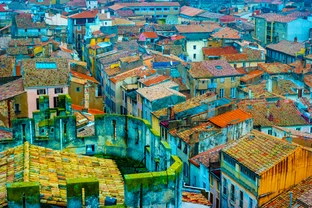
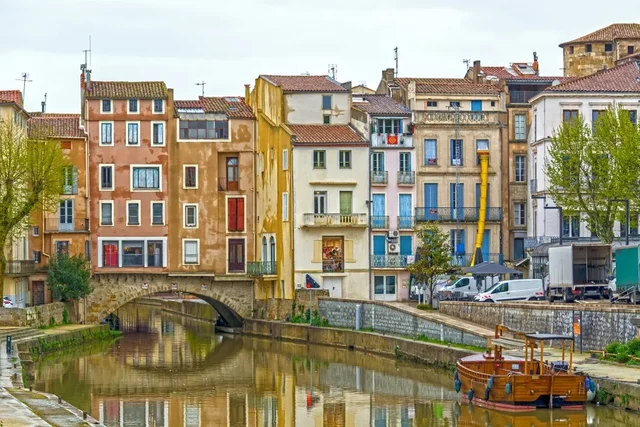
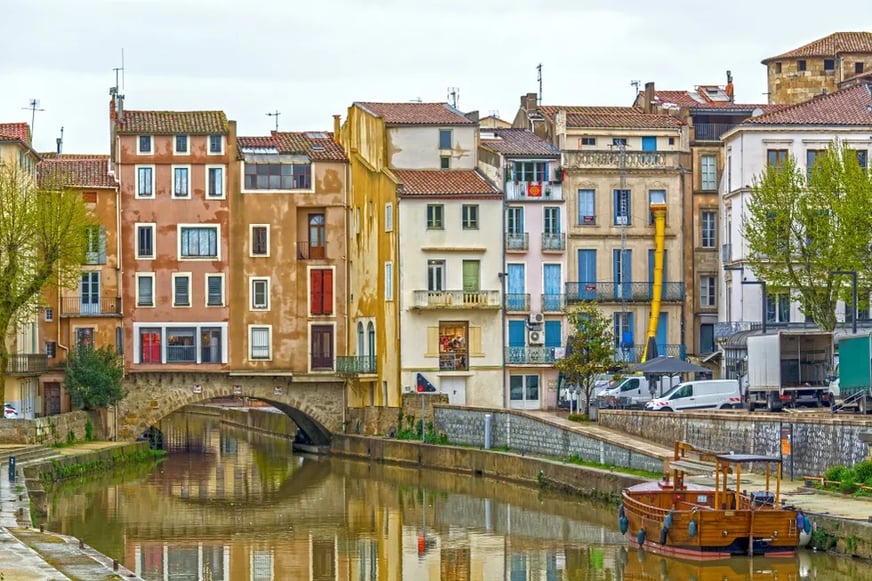
The Canal de la Robine, which connects to the Canal du Midi, bisects the town. The old town, which contains all the sights, is compact and easy to navigate.
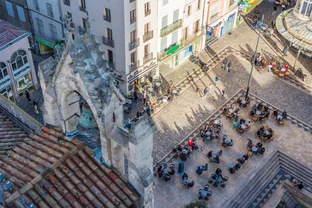
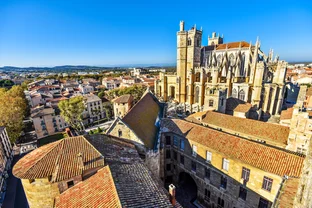
Start at the oldest site, the Horreum, 7 rue Rouget de Lisle (tel. 04-68-32-45-30), an underground warren of granaries and grain chutes built by the Romans in the 1st century B.C. It’s in the restored medieval quarter, which is now full of attractive shops and restaurants. In the center of town, dominating the main place de l’Hôtel-de-Ville, the huge palace and cathedral complex, built from the 12th to the 14th centuries, reveals vaunting ecclesiastical ambitions. The Cathédrale de St-Just et St-Pasteur, rue Armand Gautier (tel. 04-68-32-09-52; free admission; daily June to September 9am–6pm and October to April 10am–12:45pm and 2–6pm), is just a section of the original cathedral plan which was never completed, but it is still magnificent, decorated with 14th-century statues, stained glass, and Aubusson tapestries. Cloisters join it to the Palais des Archevêques (Archbishops’ Palace), which contains the Archaeology Museum with an impressive collection of Roman artifacts and mosaics, and the Museum of Art and History (for all tel. 04-68-90-30-54). Additional sights include the Donjon Gilles-Aycelin, pl. de l’Hôtel-de-Ville (tel. 04-68-90-30-65), a watchtower and prison from the late 13th century, where an observation platform looks out at the cathedral, the plain, and the Pyrénées; and the Maison Charles Trenet, 13 av. Charles Trenet (tel. 04-68-90-30-66), birthplace of the singer/songwriter. There are pleasant walks by the canal, which is lined with 18th-century houses and chais (wine warehouses).
All Narbonne museums and the Horreum have the same opening hours and prices. Admission to one museum is 6€; a pass for all museums (the Pass Monuments & Musées), plus the Donjon Gilles-Aycelin, the Cathedral treasure, and Charles Trenet’s birthplace is 10€ (6€ students and children ages 10 to 17, children 9 and under free). Attractions are open June to September daily, 10am to 6pm, in May from Wednesday to Sunday, 10am to noon and 2 to 5pm.
- Religious Site
Basilique St-Paul-Serge
This early Gothic church was built on the site of a 4th-century necropolis. It has an elegant choir with fine Renaissance woodcarvings and ancient Christian sarcophagi. The chancel, from 1229, is admirable. The north door leads to the Paleo-Christian Cemetery, part of an early… - Religious Site
Cathédrale St-Just
The cathedral's construction began in 1272, but it was never finished. Only the transept and a choir were completed. The choir is 40m (130 ft.) high, built in the bold Gothic style of northern France. At each end of the transept are 59m (194-ft.) towers from 1480. The cathedral also… - Historic Site
Donjon Gilles-Aycelin
A watchtower and prison in the late 13th century, it has a lofty observation platform with a view of the cathedral, the surrounding plain, and the Pyrénées. If you're up for it, take a hike up the steep steps of the watchtower for superb views. - Landmark
Palais des Archevêques
This palace was conceived as part fortress, part pleasure residence. It has three military-style towers from the 13th and 14th centuries. The Old Palace on the right dates from the 12th century, and the so-called "New Palace" on the left dates from the 14th. It's said that the old,…