Things To Do in Nazareth and the Yizreel Valley
Bookstore
Available as paperback
and as e-book.
Nazareth and the Yizreel Valley Attractions
There are four major things for tourists to do in Nazareth: Shop in the market, visit the New Testament sites, enjoy the many Arabic restaurants and sweet shops in the city, and visit the fascinating “Nazareth Village,” a re-creation of what life was like in the tiny hamlet of Nazareth at the time of Jesus.
New Testament Sites: The Basilica of the Annunciation is located on Casa Nova Street, on the spot where, according to Christian tradition, the Angel Gabriel appeared before Mary, to announce she would bear a child. The present Basilica of the Annunciation, completed in 1966, was built over earlier structures dating from 1730 to 1877. Unlike most Christian shrines in Israel, this basilica has a bold, modern design (see below). Around the nave, on the walls, are murals that were created by artists from around the world. Note the Japanese mural of the Madonna and Child on the left (north) wall—Mary’s robe is made entirely of Japanese seed pearls. Summer hours are daily from 8am to 6pm; Holy masses are held in the Grotto of the Annunciation daily at 6:30am and 7am on Sunday. Walk out the north-side door to reach the other religious sites.
The Church of Saint Joseph is 90m (295 ft.) away, set on the site believed to have been occupied by Joseph’s carpentry workshop. Open daily 7am to 6pm.
On the main street in the bazaar is the Greek Catholic “Synagogue” Church, believed to be the site of the ancient Nazareth synagogue that Jesus frequented. Farther along the road is the Franciscan Mensa Christi Church, believed to occupy the spot where Jesus ate with his disciples after the Resurrection.
Mary’s Well, with its source inside the Greek Orthodox Church of the Annunciation, is another important holy site. The church was built at the end of the 17th century over the remains of three earlier churches. At the church entrance, on the archway above the stone staircase leading down to the well, is a mural depicting the Angel Gabriel appearing to Mary.
Our Lady of Fright Chapel, sometimes called the Tremore, is on a wooded hill south of the center opposite the Galilee Hotel. It commemorates the spot where Mary watched while the people of Nazareth attempted to throw Jesus over the Precipice.
Walking the Jesus Trail
For millions of modern travelers, walking in the footsteps of Jesus has meant taking a few steps from a tour bus to the Church of the Annunciation or to the banks of the Jordan River. But thanks to a collaborative effort of local Christians, Muslims, and Jews—headed by the dynamic Maoz Inon and Suraida Nassar—that method of touring is changing. The group has mapped a careful, 65km (40-mile) itinerary (mainly downhill from Nazareth) of the routes Jesus would have taken as he crisscrossed the Galilee on foot from Nazareth to Tzipori, Kana, and down to the Sea of Galilee. Along the way, visitors pass olive groves, ancient springs, historic sites, and ruins. Yes, modern towns and their outskirts are also passed (there’s no way to avoid them), but they don’t account for the majority of the trail.
The route can be hiked by independent walkers or done with organized tours. Included are places to camp, overnight lodgings, and places to eat and buy supplies. Participants can hike as much or as little of the trail as they like. An optional return route to Nazareth includes the ethereal Mount Tabor. For more information, go to www.jesustrail.com.
Nearby Highlights: Mount Tabor and More
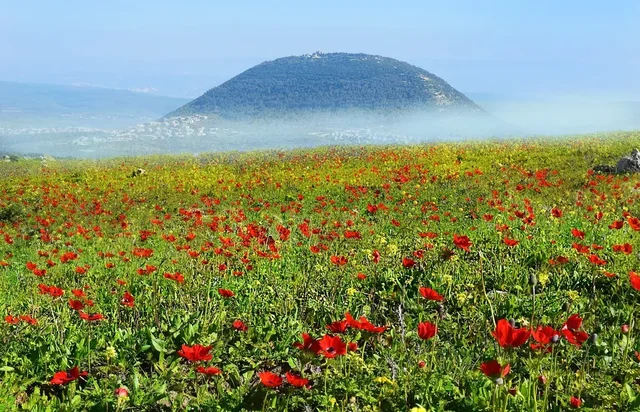
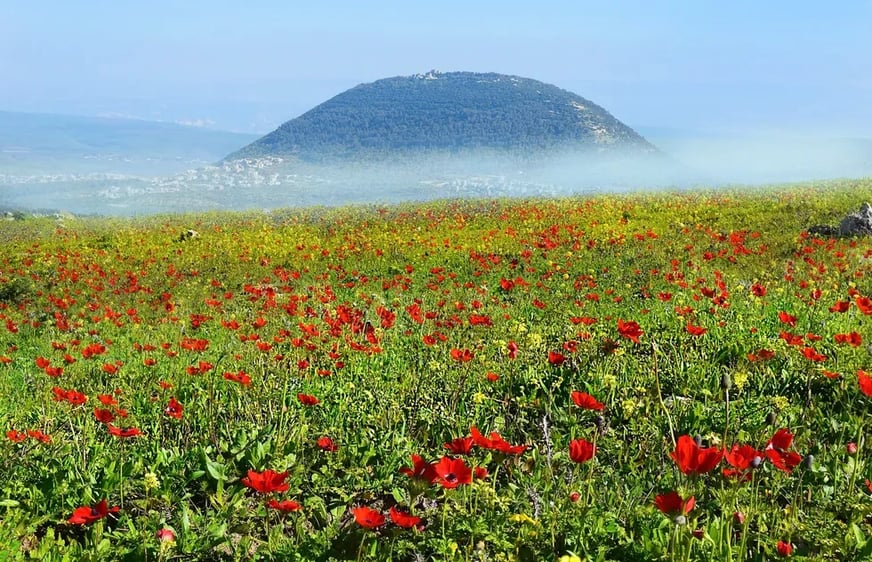
Like the summit of Mount Carmel, near Haifa, where the Prophet Elijah challenged the Canaanite prophets of Baal, the summit of Mount Tabor (see top of page) is believed to have been a Canaanite “high place,” or altar, from at least the 2nd millennium b.c. The defeat of the Canaanites at such a prominent sanctuary (the mountain stands 540m or 1,772 ft. above sea level, making it the tallest of the Lower Galilee Mountains) must have had a stunning psychological effect.
Mount Tabor certainly played a crucial role in the life of Jesus Christ. Just 9.6km (6 miles) southeast of Nazareth, it must have been a dominant feature of the landscape Jesus knew in his childhood. At the summit stands the Basilica of the Transfiguration, which marks the traditional site where Jesus was transfigured as he spoke to Moses and Elijah in the presence of three of his disciples (Luke 9:28–36). The current Basilica was built in the 1920s over the ruins of long-destroyed Crusader and Byzantine churches (visitors can still go into the grottoes of the Crusader church). Also on the mount is the Church of Elias (Elijah), built in 1911 by the Greek Orthodox community. From here on a clear day you can see the Sea of Galilee, Mount Hermon, the Mediterranean Sea, and the Yizreel Valley. At this dramatic mountain, in the period of the Judges (ca. 1150 b.c.), the Prophet Deborah and her general, Barak, led the Israelite tribes to victory over the Canaanite general Sisera of Hazor (Judg. 4:12–16).
At the base of the mountain, in the Arabic village of Shibli, you’ll find the modest but charming Center of Bedouin Heritage (tel. 04/676-7875). It’s open Saturday to Thursday from 9am to 5pm; admission is NIS 12; Shibli also hosts a number of Bedouin-style restaurants, good for an afternoon break.
Another spot for a break in the area is Beit HaMarzipan (Marzipan House) in nearby Kfar Tabor. Using ground almonds grown in the village, the center offers workshops for sculpting marzipan into different shapes—a fun activity for kids who might need some respite from trekking between historic sites. Beit HaMarzipan is open from Sunday to Thursday from 9am to 5pm, and on Fridays from 9am to 4pm.
Mount Tabor is accessible from Nazareth by Egged bus, private car or taxi. Although it looks close, the way is circuitous. If you’re driving from the northern part of Nazareth, take Rte. 754 to Rte. 77; from Rte. 77 at the Golani Junction, turn south onto Rte. 65 to Mount Tabor. From southern Nazareth, take Rte. 60 to Afula; at Afula take Rte. 65 to Mount Tabor. If you are driving or walking, the road up Mount Tabor becomes increasingly steep the higher you ascend, with absolutely hair-raising hairpin turns. Beware of vehicles in front of you conking out and rolling downhill. The descent can seem even more horrific, but the view from the summit is magnificent.
- Natural Attraction
Bet She’arim National Park
Somewhat reminiscent of the Sanhedrin Tombs in Jerusalem, these catacombs are located on the main road from Haifa that heads toward Afula (the principal town of the Jordan Valley). In the late 2nd and early 3rd centuries, the town of Beit She’arim was the home of the Supreme… - Natural Attraction
Megiddo (Armageddon) National Park
In the Old Testament, the name Megiddo appears in a number of places, mostly in relation to war. In the New Testament, the book of Revelation names Armageddon (a corruption of the Hebrew Har Megiddo—Mount Megiddo) as the place where the last great battle will be fought when the… - Historic Site
Nazareth Village
This extraordinary re-creation of houses, farms, workshops, oil and wine presses, and terraced fields as they existed in the time of Jesus could easily have been embarrassingly hokey. It’s not (we promise) because everything seen here is based on knowledge gleaned from archaeological… - Natural Attraction
Tzipori (Sepphoris) National Park
Now a small moshav, or cooperative agricultural community, the ancient city of Sepphoris dates from the era of the Maccabees in the 2nd century b.c. An enormous period of expansion and building that started in the a.d. 1st century turned the city into “the ornament of the Galilee,”…