New York City Self-Guided Walking Tour: Greenwich Village

Greenwich Village started as its own village, a place where, as in Boccaccio’s Decameron, the well-to-do fled on a near-yearly basis to escape the plagues of colonial Nieuw Amsterdam and then New York City (recurrent bouts of yellow fever, mostly). Building began in earnest in the 1820s and 1830s, with wealthy families building row house after row house in what was then a suburb. Soon, of course, the city caught up, the hoi polloi were living just down the block, and the bluebloods did the 19th-century version of urban flight and moved a mile uptown to newer suburbs. Their swank houses were subdivided into cheap apartments and boarding houses, or torn down entirely to create factories. The neighborhood became home to immigrants and later, artists.
The Village always retained its status as a place apart, however, thanks to the confusing configuration of its streets, a jumble of twisting byways and narrow streets. “The streets have run crazy and broken themselves . . . into strange angles and curves,” O. Henry wrote. “One street crosses itself a time or two.” In the 1960s and '70s, the charm of this urban topography, the quiet of the tiny streets cut off from upper Manhattan’s bustle, brought the well-to-do back, and the neighborhood became once more a hideaway for wealthy New Yorkers.
In this walking tour, I hope to give you a taste of all the varied groups of people and social movements that shaped this neighborhood over the years.
GETTING THERE: Take the N or R subway to 8th St. or the 6 to Astor Place.
START: Walk west on 8th St. to Fifth Ave., and then walk downtown to the Washington Square Arch (you should be able to see it from 8th St.).
FINISH: Stonewall Inn, 53 Christopher St.
TIME: 1 1/2 hr.
BEST TIMES: Day or night
1 Washington Square Park
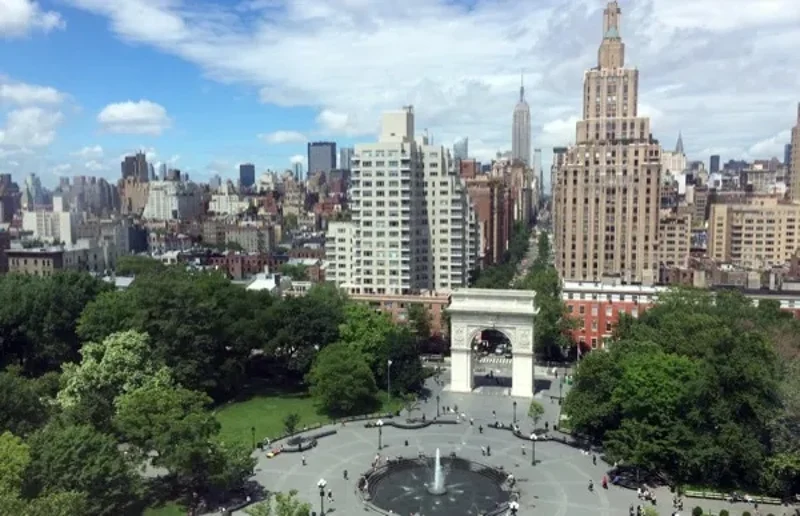
Hangings, protests, burials, parades . . . if there’s another spot in New York that’s seen as much drama as Washington Square Park has, I’ve yet to hear of it. Located north of the first Dutch settlement in Manhattan, the area was originally a marshland, fed by the stream that still runs under nearby Minetta Lane (see stop 10, below). Its first settlers were Nieuw Amsterdam slaves who in 1641 were given partial freedom in return for farming this then-dangerous and remote acreage. For these slaves (primarily older men and women who’d outlived their usefulness to their masters), their freedom was a mixed blessing: They had to hand over a large part of their harvests to the colony, and, perhaps more disturbingly, they became human watchdogs, set here to alert the Dutch should local Indians or British forces try to attack.
In 1797, the drained swamp was designated a potter’s field; it was put to good use a year later when yellow fever swept through what was by then New York City. Over 5% of the population of the city died that muggy, mosquito-infested summer, the poorest of whom were buried here, nearly 20,000 of them. In 1826 it became a military parade ground; tales were told of soldiers doing their drills, boots slipping through the crust of the dirt and crunching down on shroud-covered skeletons. If all this weren’t haunting enough, the square was often used for public hangings, the condemned strung up on a massive elm tree that still stands on the park’s northwest corner.
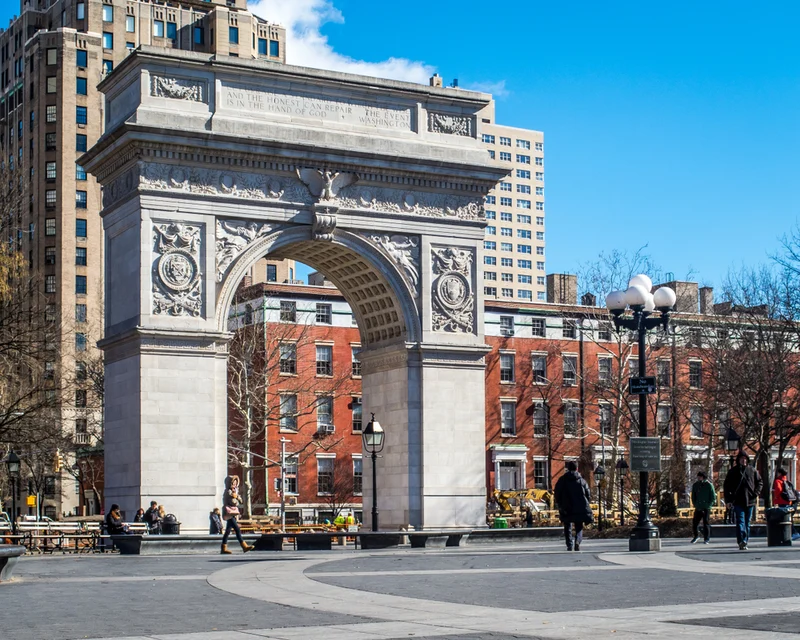
The magnificent white marble arch at the foot of Fifth Avenue was designed by Stanford White, the second such arch he created (the first, made of wood and plaster, was erected in 1889 to mark the centennial of George Washington’s inauguration and to raise funds for this permanent arch, completed in 1892). The sculpture on the right side of the arch, depicting Washington as President, Accompanied by Wisdom and Justice, was added in 1918 by Alexander Stirling Calder, father of the great modern artist and mobile-maker Alexander Calder. On the other side, we see Washington as Commander-in-Chief, Accompanied by Fame and Valor by Herman Atkins MacNeill, also tacked on in 1918.
Over the years, the arch has become a choice target for protesters. In 1918, Dada daddy Marcel Duchamp climbed up the 110 interior steps with his fellow members of the Liberal Club (including a woman who called herself “Woe,” so she could declaim, “Woe is Me!”), carrying Chinese lanterns, food, wine, and cap guns, to declare Greenwich Village an “independent republic.” They were soon brought down by an unamused constable. Less lighthearted was a 1968 takeover by the Students Against Racism and War, who barricaded themselves inside to hang a banner protesting the Vietnam War. The door to the inner stairway has been bolted ever since.
Cross the street, turn left (west), and walk until you see:
2 22 Washington Square N
Dash-dot-dot-dash: You’ve now reached the birthplace of the telegraph. Inventor Samuel Morse lived in this New York University building (he was a painting instructor) when, in 1836, he formulated the rudiments of the telegraphic alphabet, better known as Morse Code. A year later, on September 2, 1837, he was able to gather 1,700 feet of copper wire, which he coiled around his room, sending the world’s first wire dispatch from one end to the other.
Retrace your steps and cross Fifth Ave., looking at the magnificent row houses of:
3 Washington Square North
You’re now looking at the longest unbroken string of Greek Revival town houses anywhere in the United States. Aren’t they lovely? New York University owns most of these (in fact, they own much of the neighborhood), but in the 1830s, when these were built, they were strictly for individual owners of the highest social class. Henry James’ grandmother lived here, and he used the area as inspiration for the famed novel Washington Square (later turned into the play and film The Heiress).
The use of Greek Revival architecture was no accident. In the mid-1820s, support for the Greeks—a Christian nation fighting for independence from the “heathen” (their term) Ottoman Empire—was all the rage among the upper echelons of Manhattan society. It’s one reason (along with the notion that America was a modern version of ancient Greek democracy) why classical columns started popping up on buildings all over town, with Greek symbols incorporated into fences (as you’ll see in front of you), pedestals added to facades, and so on.
By the early 20th century, this strip had become run down, and many of the Village’s best-known “Bohemians” moved in, including painters Edward Hopper and Thomas Eakins, and writer John Dos Passos. All three lived at #3 Washington Square North, though not at the same time.
Turn right (downtown) onto Washington Square E, then take a left onto Washington Place and walk to the corner of Greene St.:
4 29 Washington Place (at the corner of Greene St.)
On March 25, 1911, a horrific tragedy on this site reshaped the laws of New York State and the history of the American labor movement. On that Saturday, some 600 young women, mostly Jewish and Italian immigrants between the ages of 13 and 23, were hard at work in a garment factory on the eighth, ninth, and tenth floors of this building. At 5pm, just as the workers were getting ready to leave, a fire sprung up in the southeast corner of the eighth floor—no one has ever been able to determine the cause—and within minutes all three floors were an inferno. An inescapable one, it turned out, because many of the doors had been locked from the outside (to prevent theft, the owners said later). Minutes after that, one of the fire escapes collapsed, and the elevator operator fled in terror. A brave pedestrian named Joseph Zito ran into the building, got the elevator working, and made five trips up through the flames, saving 25 to 30 workers on each trip. Fleeing the flames, several young women jumped to their deaths in front of horrified passersby. Those trapped inside suffocated from the smoke, while still others were crushed in a heap at the locked doors. In all, 146 people were killed at the Triangle Shirt Waist Factory, most within the first 10 minutes of the hour-long blaze.
After many protests, the state legislature responded to the tragedy by re-writing the labor code, making it the most stringent in the nation. The labor movement, struggling up to this point, gathered steam and the International Ladies Garment Workers Union (ILGWU) became a force in the industry.
Walk back to Washington Square and follow the perimeters of the park south to 4th St. Turn right and walk to Thompson St.:
5 Judson Church (239 Thompson St.)
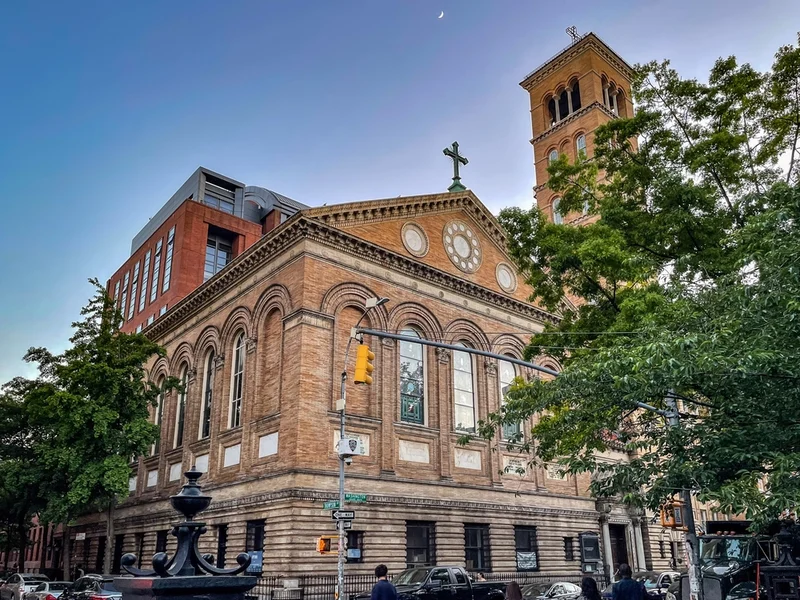
Facing onto the south side of Washington Square Park, Judson Church has a rich legacy of social activism.
This boxy Romanesque church from 1929 was another masterwork by architect Stanford White, who took his inspiration from the churches of Florence—hence the thin, ochre bricks. The church was a center for immigrant life at the turn of the 20th century and became known in the 1950s and ‘60s for the progressive politics of minister Howard Moody, who sheltered protestors from the police and helped to overturn a short-lived ban on folk singing in the park. Today’s performers (and there are always groups making music in the park) owe a debt of gratitude to Moody.
Keep walking west, passing:
6 New York University Law School
When journalist John Reed (the subject of the Warren Beatty bio-pic Reds) was a tenant of a famous boardinghouse that once stood here, he wrote a poem about his artsy neighbors, whom he called “Inglorious Miltons by the Score/ And Rodins, one to every floor.” Be sure to take a look at the street names on this side of Washington Square Park. All were chosen to honor Washington’s Revolutionary War generals.
Walk west to MacDougal St., turn left, and stop beside the legendary:
7 Provincetown Playhouse (133 MacDougal St.)
The more theatrical strain of Greenwich Village bohemianism found its home at the little theater that once stood here (only the name remains), at one time one of the most influential playhouses in the city. That’s thanks largely to Eugene O’Neill, who managed it, and whose important early works were first performed here, including Emperor Jones, The Hairy Ape, and The Great God Brown. Overturning barriers, the theater cast African Americans to play African Americans, and even featured a kiss between a Black man and a white woman (a radical move in 1926, and one that resulted in threats from the Ku Klux Klan). Other famous names who contributed to the theater include Edna St. Vincent Millay (her anti-war classic Aria de Capo debuted in 1919), John Reed, and e. e. cummings. Among the famous actors who trod these boards, Bette Davis made her stage debut here.
Stroll south, crossing W. 3rd St. until you see:
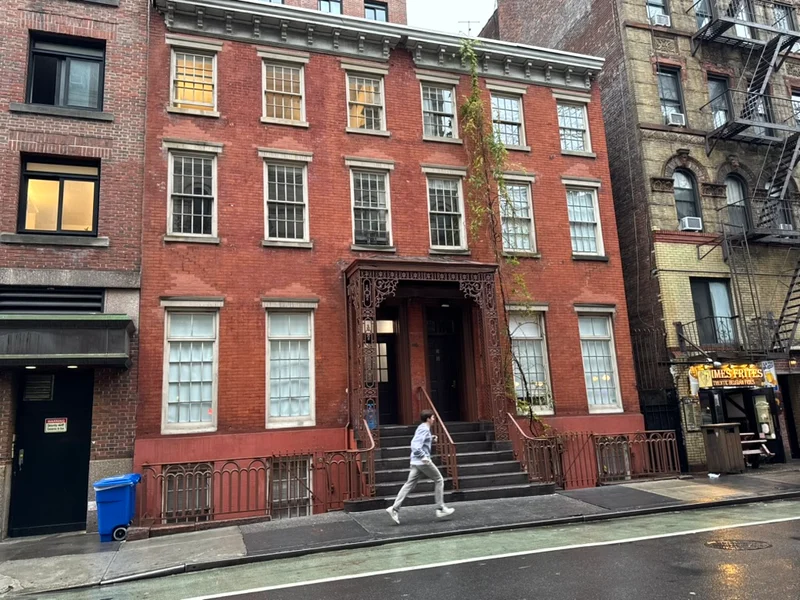
8 130 MacDougal St.
This perfect little brick federal town house is where Louisa May Alcott probably wrote Little Women (can’t you just picture Professor Baer calling on the young writer here?). Alcott never had her own Professor; her health damaged by her work as a nurse in Washington, D.C., during the Civil War, she never married, instead spending her limited energies on writing and lobbying for women’s suffrage.
Take a Break
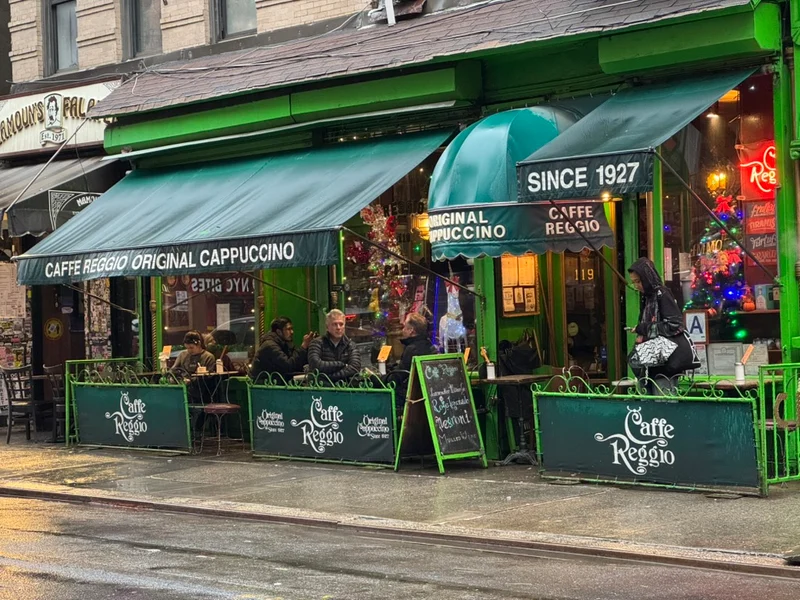
For a pastry and some java, head to Caffe Reggio (119 MacDougal St.; tel. 212/475-9557). Founded in 1927, it claims to have introduced cappuccino to America, and has the huge copper machines to prove it. The Caffe has been featured in such films as Godfather II and Inside Llewyn Davis. For something a bit more substantial, go for the city’s best pita sandwiches at Mamoun’s Falafel (119 MacDougal St. no phone).
Continue downtown until you reach Minetta Lane and take a look at:
9 Minetta Tavern (113 MacDougal St.)
Formerly a speakeasy called the Black Rabbit, this was a major literary hangout back in the day, serving poetry-inspiring booze and heaping plates of spaghetti to such notables as Ezra Pound, e. e. cummings, and Ernest Hemingway in the '20s; and Allen Ginsberg, Jack Kerouac, and Alan Corso in the '50s. Little-known fact: The very unbohemian Readers Digest was founded on this very spot, published from the basement of the restaurant for half a dozen years before moving into proper offices. Today the restaurant is owned by Keith McNally of Balthazar (p. ###) and retains most of its original 1937 fixtures.
Turn onto Minetta Lane and walk halfway down (if you reach Sixth Ave., you’ve gone too far) to an unmarked, twisting street that’s actually:
10 Minetta Street
Listen carefully: A stream still runs below this street, and on the rare quiet day, it’s possible to hear it gurgling faintly below your feet. The Algonquin’s called it Manette, which means “Spirit Water”. The Dutch term for it was “Mintje Kill” (little stream). Minetta is a corruption of one of those two terms—or perhaps both. Though the street is now one of the most charming in the city, when the stream was at street level this area was a muddy ghetto called “Little Africa,” inhabited entirely by free Blacks in the 1820s and beyond. In 1863, when the riots surrounding the Civil War’s first draft lottery morphed into race riots, this was one of the few safe places in the city for Black Americans. For 5 days, hundreds of white hooligans raged through the streets beating and lynching Blacks, even burning down an orphanage for Black children. It was the most violent riot of the century; 105 people were killed and many more maimed for life. But the narrow layout of Minetta Street allowed armed residents to successfully guard their homes and families from harm.
Soon after the Civil War, Minetta Street became known for its “black and tan” clubs, the few spots in the city where Black and white New Yorkers would socialize. In the Prohibition era, nearly half the buildings on the street housed hidden speakeasies. In the 1950’s, a coffee house called The Commons was on the street, and was a center for the Beatnik movement of the time, hosting jazz and poetry readings. It was replaced by music and comedy club The Fat Black Pussycat (look at the wall above theMexican restaurant to see its name fading on the brick). Mama Cass Elliot made her debut here as did Bill Cosby, Richie Havens and Tiny Tim.
Head back to Minetta St. and walk west to Sixth Ave., crossing it and walking west on:
11 Bleecker Street
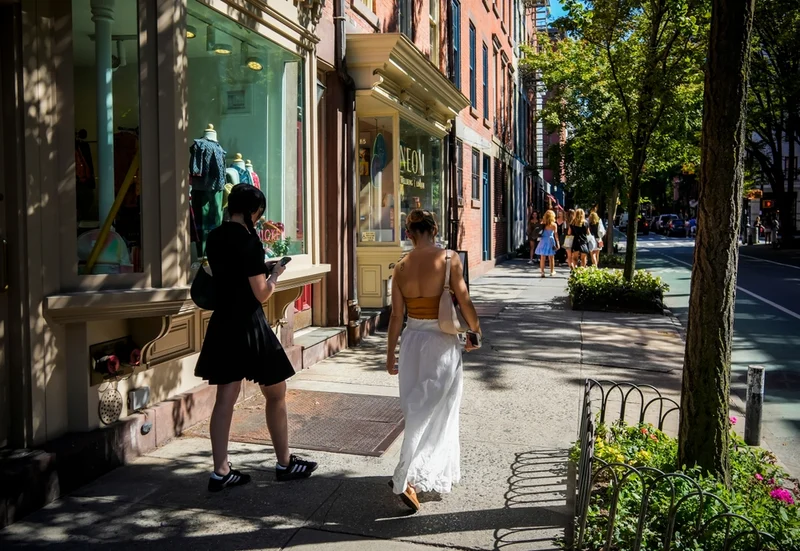
This stretch of Bleecker Street contains some of the finest noshes in the city, as it’s home to historic Faiccos Italian Specialties (at #260) owned by the same family since its founding in 1900 and selling the best sopressata in the United State (no joke). When the store opened it was just one of many Italian stores in what was then the part of the city’s much larger Little Italy, which flourished from the 1890’s well into the early 1970’s. Inhale deeply—this is the most aromatic stretch of this walking tour.
Walk to Seventh Ave., but instead of crossing, loop to the right to Barrow St. Continue in the same direction until you get to:
12 One If by Land, Two If by Sea (17 Barrow St.)
Attention Hamilton fans! In the 1790s the widowed Aaron Burr moved into this 1767 carriage house with his daughter Theodosia. After the tragic duel, Burr lost not only his political career but much of his property, including this building. The structure then became an engine house for the local firehouse, and in the 1890s a saloon and brothel. The restaurant that’s here today is still a stop on ghost tours, as many claim it’s haunted by Aaron, Theodosia, and some of the ladies of the night who worked here. The specters are blamed whenever a customer’s earring goes missing.
Continue walking to W. 4th St., turn left, and walk to the:
13 Stonewall National Monument and Stonewall Inn
Oddly enough, it was an organized-crime sting operation that precipitated the raid that gave birth to the contemporary gay rights movement. By the 1960s, the Genovese crime family owned most gay bars in the Village, where they served watered-down liquor to a community that didn’t have many other places to meet; they also blackmailed wealthier customers with the threat of outing. The family regularly paid off the police, but on June 28, 1969, the Stonewall wasn’t tipped off in advance. When eight police officers showed up at 1:20am and started loading employees and customers into a police van, patrons began pelting them with pennies, cans, bottles, and bricks. As the melee escalated, thousands of people rioted for another 5 days before order could be restored. While these protests weren’t the start of the gay rights movement, many feel that they were the galvanizing force. Today, pride celebrations in New York, and worldwide, take place on the anniversary weekend of the riots.
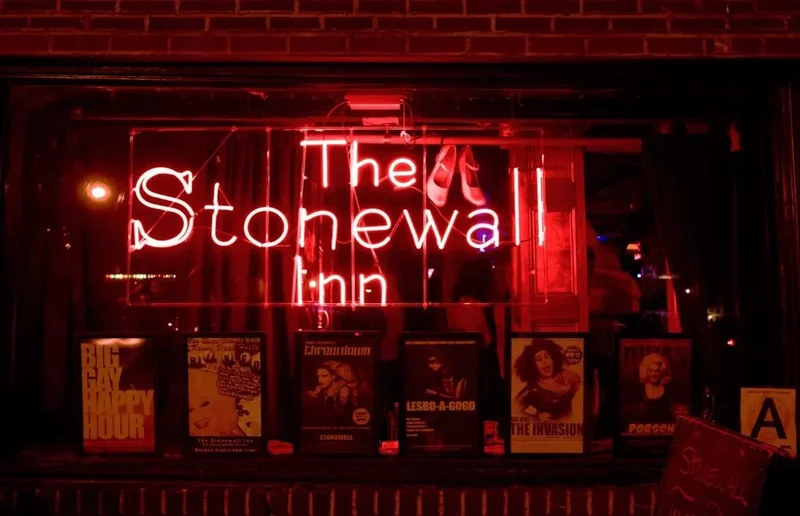
New York Cty's Stonewall Inn
Travis Wise / FlickrIn 2016, President Barack Obama designated as a national monument the Stonewall Inn, Christopher Park, and the surrounding streets. It became a National Park in 2024. If you want to end your tour with a celebratory toast, head into the Stonewall Inn for a beer or cocktail. It’s still a gay bar, and a very friendly place (all are welcome).