Things To Do in Olite
Bookstore
Available as paperback
and as e-book.
Olite Attractions
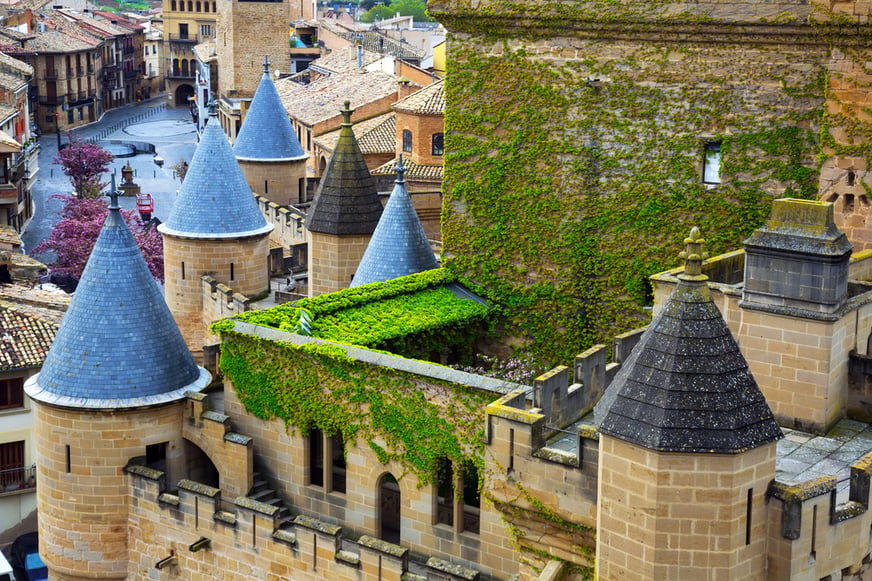
In the 15th century, this Gothic town was a favorite address of the kings of Navarra. Carlos III put Olite on the map, ordering in 1402 the building of the Palacio Real (Plaza Carlos III el Noble; tel. 691-021-667), one of the most luxurious castles of its time. Acquired in 1930 by the Spanish government for a full restoration, it’s a romantic place to visit, with its twirly, turreted towers and lookouts. It’s open July and August 9am‒8pm daily, April-June, September and Easter week 10am–7pm Sunday to Thursday (Friday and Saturday until 8pm.) In other months, opening hours are shorter. Tickets can be bought online, advisable in high season and holidays. Admission is 4.40€ adults, 2.50€ seniors and ages 6 to 13. A guided tour is available for 7.50€/5.50€ but has to be booked at least a day in advance. You can also self-guide with a multilingual audio guide for an additional 4€ or just satisfy yourself with the English-language leaflet dispensed with your ticket.
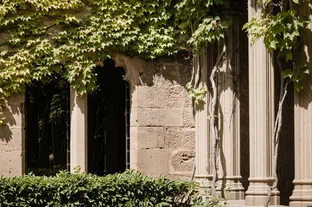
Next to the castle on Plaza de los Teobaldos stands the town’s Gothic church, Santa María la Real de Olite, with a splendid 12th-century doorway decorated with flowers—a favorite backdrop for wedding photographs. The church is open generally 11am‒1pm and 4‒6pm, though times vary according to season. Admission is 2€.
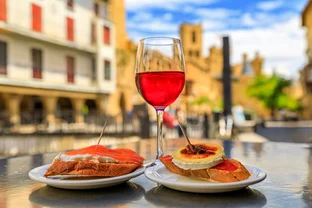
Sharing the tourist office building on Plaza de los Teobaldos, the Enozentrum (tel. 848-42-32-23) is a museum chronicling the history of winemaking in Navarra since Roman days, right up to recent advances in viticulture and technology. Does that sound dry? Not at all: A huge investment has gone into this place, with a child-friendly film and multilingual information panels. You could easily spend an hour here; admission is free, and a glass of wine is offered at the end of your visit. April through October it’s open Monday to Saturday 10am‒2pm and 4‒7pm, and Sunday 10am- 2pm. Friday and Saturday; the rest of the year it’s only open Saturday (10am‒2pm and 3‒6pm) and Sunday (10am‒2pm).
The red Navarra wines are well-rated in Spain, usually a close third behind Rioja and Ribera del Duero, as ancient vineyards have met modern viticulture and an eager domestic and increasingly international market. Local rules permit “French” grapes like Cabernet Sauvignon and Merlot as well as the traditional indigenous varieties like Tempranillo and Graciano. Wine is nowadays a solid cornerstone of the region’s tourism, and several bodegas (wineries) can be visited near Olite; the tourist office carries a list of wineries that offer tours in English, though many of these may require pre-booking. For a free wine-focused treat, head to the southern end of Olite town, where the Cosechero Reunidos Coop (Plaza San Antón, 1; tel. 94-874-00-67) offers two subtitled videos and a chance to see the ovum, a strange egg-shaped “barrel” with properties claimed to do magical things to wines. It has a shop, of course, and is open Monday to Friday 10am‒2pm and 4:30 -7pm, Saturday and Sunday 10am‒2pm.
You might also consider checking out the Monasterio de la Oliva (tel. 94-872-50-06), which is 34km (21 miles) south of Olite. It was founded by Navarra king García Ramírez in 1164 and is an excellent example of Cistercian architecture. This monastery, one of the first to be constructed by French monks outside France, once had great influence; today the most notable feature is its 14th-century Gothic cloisters. The late 12th-century church has a distinguished portal and two rose windows. The monastery was built to solidify the Christian hold on what was, in the 12th century, a borderland between Muslim and Christian rule. The Cistercians not only brought their signature architecture and stern Christianity from Burgundy, they also brought wine grapes and the know-how to cultivate them. Today the lands around the monastery produce more good wine than any time in the last 800 years.
It’s a modest detour from the monastery across the regional border to the southernmost tip of La Rioja to visit the town of Alfaro , which has a tourist office (tel. 94-118-01-33) at Plaza de España 1, open Tuesday to Saturday 10am to 2pm and 5 to 8pm, Sunday 11am to 2pm. The massive 17th-century baroque church on the same plaza is the Colegiata de San Miguel. From February to August, more than 400 nests of white storks cover the towers and roofs of the church. Ornithologists say it is the world’s largest single concentration of the species, and many studies of stork behavior have been researched in Alfaro. By late August, they begin their migration back to North Africa. The Mirador de Cigueñas (or “stork overlook”) is along one side of the church and provides an ideal vantage for photography.