Things To Do in Pamplona
Bookstore
Available as paperback
and as e-book.
Pamplona Attractions
In its historic core—best explored on foot—the Pamplona of legend lives on, though the city outskirts have been engulfed by modern real-estate development. The city walls and those of the ciudadela (citadel) are together more than 5km in length, one of the best-preserved Renaissance military complexes in Europe. There are many delightful green spaces, including Parque de La Taconera, a spacious swath of fountain-filled gardens and parkland west of the old quarter, popular with university students, languid deer, and strutting peacocks.
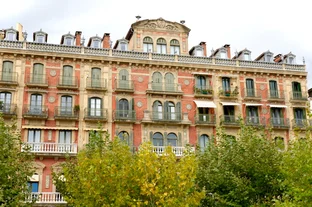
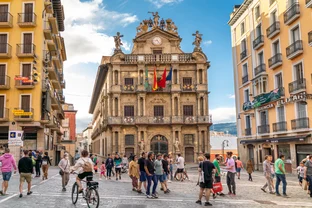
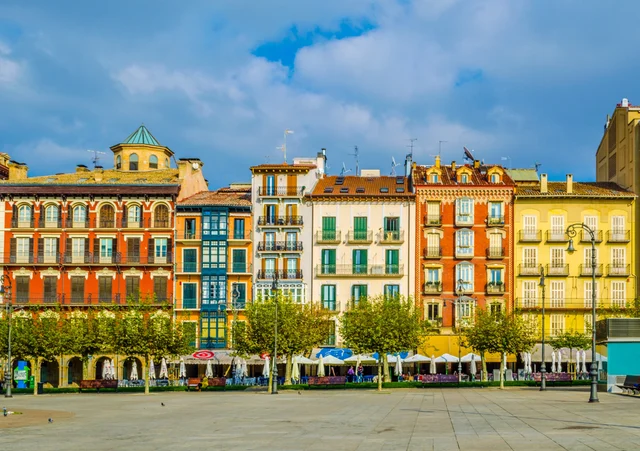
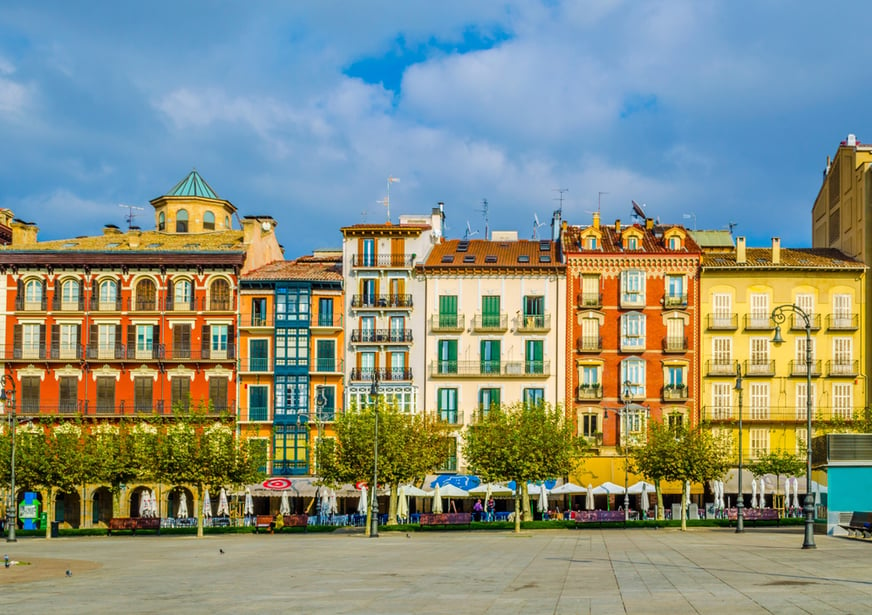
The heart of Pamplona is the Plaza del Castillo (pictured above) formerly the bullring, built in 1847. Today it is the seat of the autonomous provincial government. This elegant tree-lined paseo used to become a virtual communal bedroom during the Fiesta de San Fermín, when visitors without hotel reservations literally slept outdoors in the square; nowadays, they favor the city parks and gardens.
The narrow streets of the Old Quarter extend from three sides of the square. The present bullring, the Plaza de Toros, is just east and south of this square alongside Paseo Hemingway. Running parallel to the east of the square is Calle Estafeta, a narrow street that is the main course of the running of the bulls. With its bars and tascas, it attracts university students and is lively year-round. The bulls also run through the barricaded streets of Santo Domingo, charge into the town hall square, then along Mercaderes and finally Estafeta before finishing their mad rush in the Plaza de Toros itself.
Tips for Pamplona's Running of the Bulls
Beginning at noon on July 6 and continuing to July 14, the Fiesta de San Fermín is one of the most popular events in Europe, a bucket-list favorite drawing hundreds of thousands of tourists who severely overtax Pamplona’s limited facilities (and put a strain on their own capacities to consume alcohol). But there is much more than just drinking. Visitors can expect great food, processions, concerts, and displays of rural sports.
The actual bull-runnings start on July 7. Get up very early (or don’t go to bed at all) because to watch you’ll need to be in position behind the barricades along Calle Estafeta no later than 6am (the run starts at 8am). Actually, taking part is dangerous: Several people die each year in such events across Spain. Each bull-running ends at the bullring, and you will need a ticket to witness the final part of the running as the mighty beasts enter it.
Tickets for a good seat in the ring itself go on sale the day before each corrida (bullfight). They can be bought at the bullring’s ticket offices or online. Tickets cost around 6€ and sell out quickly; tourists often must use The fiesta draws well over half a million visitors, many of whom camp (illegally) in the city parks. Temporary facilities are set up, but there are never enough beds. Hotel reservations should be made a year in advance and confirmed at least 6 months beforehand—the tourist office will not make any recommendations during the festival. If you look respectable, some Pamploneses may rent you a room, but they may gouge you for the highest price they think you’ll pay, and your room might turn out to be a dirty floor shared with others in a slumlike part of the city. Many young visitors sleep on the grounds of the Ciudadela and Plaza Fueros traffic ring, but muggings can occur and sleeping outdoors is officially not permitted. Longtime visitors to Pamplona advise that it’s better to sleep in a group, on top of your belongings, and during the day. If you can’t find a room, that is.
As for bars and restaurants, ignore all the times given in the listings on this website. Most establishments operate round-the-clock during the festival.
Warning: Some people go to the festival not to watch the bulls but to pick pockets. Also, don't take needless risks, such as leaping from a building in the hope friends below will catch you. Many people do this, and not all are caught.
- Cathedral
Catedral de Santa María
An easy walk from the city center, this is the most significant historic landmark in Pamplona. Dating from the late 14th century, it was built on the site of an earlier Romanesque basilica. The interior is Gothic with lots of fan vaulting (check out especially the Barbazán Chapel,… - Museum
Museo de Navarra
“To make the past present” is this museum’s motto, written large above the entrance of what was once a hospital. Its earliest piece, a stone carving called the Mapa de Abauntz, dates from roughly 12,000 years ago, when much of Navarra was covered by glaciers. This carving is a…
Pamplona Shopping
You’ll find Navarrese handicrafts (and tacky souvenirs) everywhere in shops across the old town. For a good-quality, edible memento, visit Gurgur, Calle Estafeta, 21 (tel. 94-820-79-92), which is packed to the roof with largely Navarrese products such as txistorra sausage, Pamplona chorizo, Navarrese chocolate, jams, honey, wine, and much more. Another gastronomic diversion on Calle Estafeta is El Churrero de Lerín, at number 5. Chocolate con churros may not specifically be a Pamplona specialty, yet this tiny little place is an institution for the sweet-of-tooth. Satisfied customers graffiti their appreciation on the tiled walls! To discover your inner cowboy, look for products from Las Tres ZZZ, founded in 1873 and now in its fourth generation of producing wineskins from which to quaff your vino (an essential accessory at festival time). The company has given up its city center shop, but you will spot their wineskins for sale in many central souvenir outlets, both in traditional goatskin and more modern materials such as corduroy and synthetics.
Pamplona Nightlife
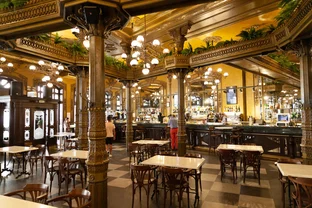
It’s not hard to find good nightlife in Pampolan. Three streets in particular—San Nicolás, Estafeta, and Jarauta—are lined with tascas, bars, bodegas, and pubs. San Nicolás is the pick, but away from these four streets you’ll find a trio of bars that boast significant atmosphere and history. Dating from 1888, the stunning Art Deco Café Iruña, Plaza del Castillo, 44 (tel. 94-822-20-64), contains the Rincon de Hemingway bar, frequented by the writer and marked with his statue. You’ll be dazzled more by the cafe’s ornate interior than its cuisine, but in summer you’ll also be tempted to lounge on its lively outdoor terrace. Popular with office workers, the lunchtime menú del día is 23€, slightly pricier on weekends and evenings. Breakfasts and pintxos are also available. The cafe is open Monday to Thursday 8am‒2am, Friday to Sunday 9am‒2am.
Almost as old is Café Roch, Calle de las Comedias, 6, which is far from fancy, but exudes a cozy atmosphere of its own. Its recent ownership history is a bit chaotic, but the short menu of delicious fried croquettes has remained constant throughout the turmoil. There are half-a-dozen flavors to savor, so take your time. Limited opening hours are daily 11am - 3pm and 6 – 9pm.
Not nearly as old as either Iruña or Roch, but still steeped in atmosphere and attitude, is Bar Gaucho, Calle Espoz y Mina, 7 (tel. 94-822-50-73), just off the main square. So proud are the owners of this bar dedicated to pintxos that they have written three books on how to make their delicious delicacies. Snuggle into a corner of this quirky place, admire all the awards that decorate the walls, and wait for your choice—maybe grated spider crab with cheese? Gaucho opens Thursday to Saturday 8am‒midnight, Sunday 10am‒midnight. As it’s tapas only, they do not take reservations.