El Valle de los Caídos (Valley of the Fallen)

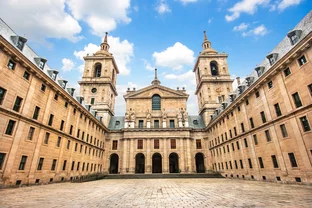
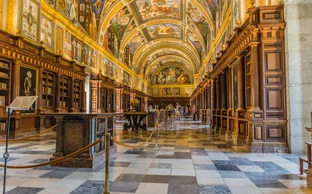
This is Franco's El Escorial, an architectural marvel that took 2 decades to complete, dedicated to those who died in the Spanish Civil War. Its detractors say that it represents the worst of neofascist design; its admirers say they have found renewed inspiration by coming here.
A gargantuan cross nearly 150m high (492 ft.) dominates the Rock of Nava, a peak of the Guadarrama Mountains. Directly under the cross is a basilica with a vault in mosaic, completed in 1959. José Antonio Primo de Rivera, the founder of the Falange party, is buried here. When this Nationalist hero was buried at El Escorial, many people, especially influential monarchists, protested that he was not a royal. Infuriated, Franco decided to erect another monument. Originally it was slated to honor the dead on the Nationalist side only, but the intervention of several parties led to a decision to include all the caídos (fallen). In time, the mausoleum claimed Franco as well; his body was interred behind the high altar.
A funicular extends from near the entrance to the basilica to the base of the gigantic cross erected on the mountaintop above (where there's a superb view). When operating (it's closed indefinitely at the moment), the funicular runs daily from 10:30am to 1:15pm and 4 to 6pm.
On the other side of the mountain, about a 10-minute walk from the mausoleum, is a Benedictine monastery that is sometimes referred to as "the Hilton of monasteries" because of its seeming luxury.
Note: As of this writing, both the entire monument and the funicular service are closed to the public. There are no immediate plans to re-open. Consequently, the former afternoon bus service from San Lorenzo del Escorial no longer operates. You can only view the building from outside and if you want to do this, the best way to get there is by hired car via the following route. Drive to the entrance of the Cuelgamuros Valley, about 8km (5 miles) north of El Escorial in the heart of the Guadarrama Mountains. Once here, continue 6km (3 1/2 miles) west along a wooded road to the underground basilica.
This is Franco's El Escorial, an architectural marvel that took 2 decades to complete, dedicated to those who died in the Spanish Civil War. Its detractors say that it represents the worst of neofascist design; its admirers say they have found renewed inspiration by coming here.
A gargantuan cross nearly 150m high (492 ft.) dominates the Rock of Nava, a peak of the Guadarrama Mountains. Directly under the cross is a basilica with a vault in mosaic, completed in 1959. José Antonio Primo de Rivera, the founder of the Falange party, is buried here. When this Nationalist hero was buried at El Escorial, many people, especially influential monarchists, protested that he was not a royal. Infuriated, Franco decided to erect another monument. Originally it was slated to honor the dead on the Nationalist side only, but the intervention of several parties led to a decision to include all the caídos (fallen). In time, the mausoleum claimed Franco as well; his body was interred behind the high altar.
A funicular extends from near the entrance to the basilica to the base of the gigantic cross erected on the mountaintop above (where there's a superb view). When operating (it's closed indefinitely at the moment), the funicular runs daily from 10:30am to 1:15pm and 4 to 6pm.
On the other side of the mountain, about a 10-minute walk from the mausoleum, is a Benedictine monastery that is sometimes referred to as "the Hilton of monasteries" because of its seeming luxury.
Note: As of this writing, both the entire monument and the funicular service are closed to the public. There are no immediate plans to re-open. Consequently, the former afternoon bus service from San Lorenzo del Escorial no longer operates. You can only view the building from outside and if you want to do this, the best way to get there is by hired car via the following route. Drive to the entrance of the Cuelgamuros Valley, about 8km (5 miles) north of El Escorial in the heart of the Guadarrama Mountains. Once here, continue 6km (3 1/2 miles) west along a wooded road to the underground basilica.
Details
Bookstore

Available as paperback
and as e-book.