Real Monasterio de San Lorenzo de El Escorial

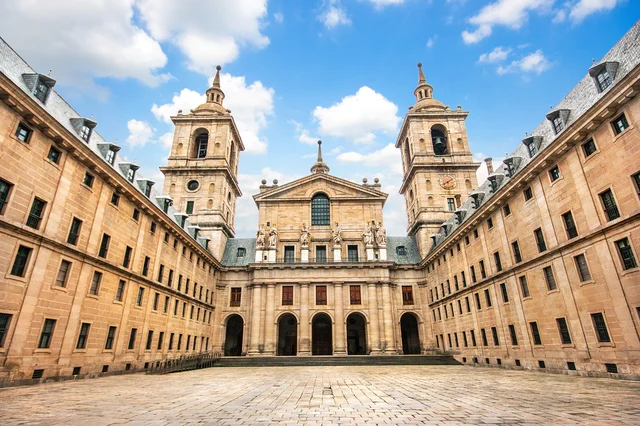
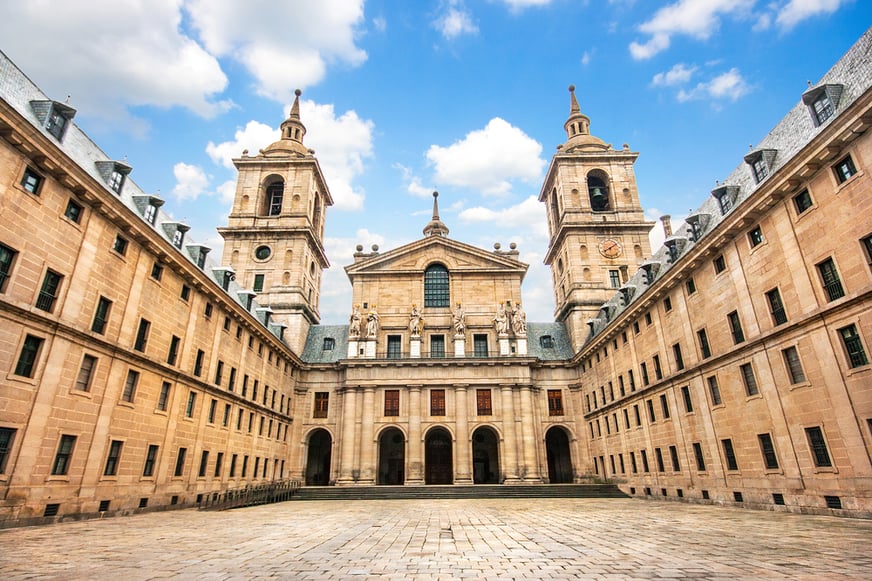
Felipe II ordered the construction of this forbidding edifice in 1563, two years after moving his capital to Madrid. Following the death of the original architect, Juan Bautista de Toledo, it was completed by Juan de Herrera, considered the greatest architect of Renaissance Spain. (Note the similarities to Herrera’s work on Madrid’s Plaza Mayor). The monastery palace is laid out in the form of a grid iron, in honor of St. Lawrence who was burned to death upon one. Built in granite around a vast quadrangle, it has some 1,700 rooms, 24km (15 miles) of corridors, and took 21 years to complete. The overall effect is prison-like, “cold as the grey eye and granite heart of its founder,” according to Richard Ford, the great 19th-century writer on Spain.
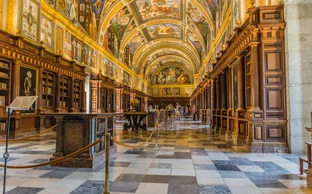
Guided tours in English take place at midday and cost an additional 6€ on the price of your ticket, but a self-guided tour with the informative audio guide, available on a tablet or on your phone, gives you more freedom to catch your breath as you move through a seemingly endless succession of rooms. The most intimate and interesting are the Salones Reales (Royal Apartments) from where Felipe II ran half the world using scribbled notes of paper. You can see his modest desk and clock, and the tiny bed where he would rest his gouty leg. It was positioned so he could hear Mass being celebrated in the basilica at the center of the complex. The basilica has 43 altars beneath a dome that emulates St. Peter’s in Rome, on which Juan Bautista de Toledo is thought to have cut his architectural teeth. Below is the Panteón de los Reyes (Crypt of the Kings), which holds the tombs of most of the Spanish monarchs from Carlos V to the present day. The Sala de Batallas (Hall of Battles) is decorated with meticulous frescoes detailing Spanish military victories, and the vaulted ceiling of the magnificent Biblioteca (Library) has allegorical scenes depicting the arts and sciences. Room after room is bordered in beautiful blue and white azulejos, ceramic tiles made in Talavera de la Reina. Toward the end of the tour you’ll reach the Palacio de los Borbones, where the style changes completely. The first Bourbon king, Felipe V, imported Versailles-style furnishings and dressed the cold, stone walls with tapestries designed by Goya. But the Bourbons never spent much time here—austerity wasn’t their thing.
At the time of writing the palace’s art and architecture galleries were undergoing a major overhaul aimed at opening up even more of El Escorial’s treasures to the public.
Felipe II ordered the construction of this forbidding edifice in 1563, two years after moving his capital to Madrid. Following the death of the original architect, Juan Bautista de Toledo, it was completed by Juan de Herrera, considered the greatest architect of Renaissance Spain. (Note the similarities to Herrera’s work on Madrid’s Plaza Mayor). The monastery palace is laid out in the form of a grid iron, in honor of St. Lawrence who was burned to death upon one. Built in granite around a vast quadrangle, it has some 1,700 rooms, 24km (15 miles) of corridors, and took 21 years to complete. The overall effect is prison-like, “cold as the grey eye and granite heart of its founder,” according to Richard Ford, the great 19th-century writer on Spain.
Guided tours in English take place at midday and cost an additional 6€ on the price of your ticket, but a self-guided tour with the informative audio guide, available on a tablet or on your phone, gives you more freedom to catch your breath as you move through a seemingly endless succession of rooms. The most intimate and interesting are the Salones Reales (Royal Apartments) from where Felipe II ran half the world using scribbled notes of paper. You can see his modest desk and clock, and the tiny bed where he would rest his gouty leg. It was positioned so he could hear Mass being celebrated in the basilica at the center of the complex. The basilica has 43 altars beneath a dome that emulates St. Peter’s in Rome, on which Juan Bautista de Toledo is thought to have cut his architectural teeth. Below is the Panteón de los Reyes (Crypt of the Kings), which holds the tombs of most of the Spanish monarchs from Carlos V to the present day. The Sala de Batallas (Hall of Battles) is decorated with meticulous frescoes detailing Spanish military victories, and the vaulted ceiling of the magnificent Biblioteca (Library) has allegorical scenes depicting the arts and sciences. Room after room is bordered in beautiful blue and white azulejos, ceramic tiles made in Talavera de la Reina. Toward the end of the tour you’ll reach the Palacio de los Borbones, where the style changes completely. The first Bourbon king, Felipe V, imported Versailles-style furnishings and dressed the cold, stone walls with tapestries designed by Goya. But the Bourbons never spent much time here—austerity wasn’t their thing.
At the time of writing the palace’s art and architecture galleries were undergoing a major overhaul aimed at opening up even more of El Escorial’s treasures to the public.
Details
Bookstore
Available as paperback
and as e-book.