Things To Do in Sarlat-la-Caneda
Bookstore

Available as paperback
and as e-book.
Sarlat-la-Canéda Attractions
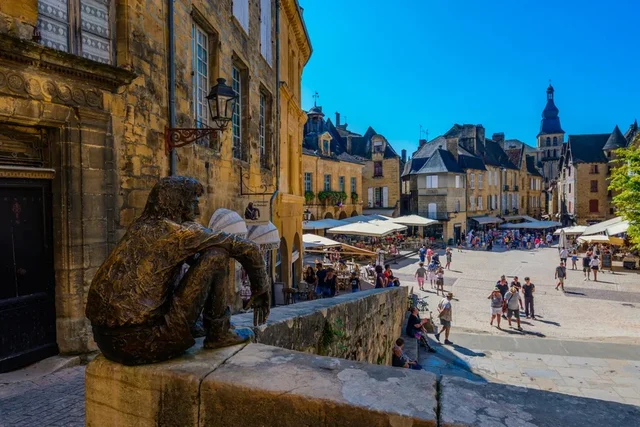
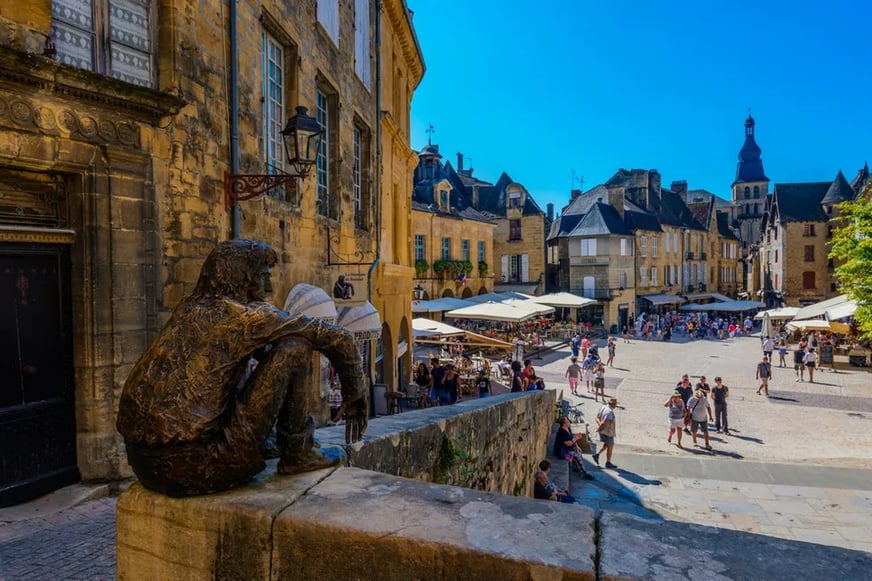
Start your tour of Old Sarlat at place du Peyrou and allow at least 2 hours to wander around. Opening onto place du Peyrou is the Cathédrale de Saint Sacerdos, which enjoyed its greatest prestige when it was an Episcopal seat between 1317 and 1790. The cathedral has a Romanesque bell tower, but most of the structure dates from the 16th and 17th centuries with the interior in the late Gothic style. The structure is to the right of the tourist office. Leave by the south doorway.
Behind the cathedral is Lanterne des Morts, or “Lantern to the Dead,” which was reputedly built in the 1100s to honor St. Bernard’s pilgrimage to Sarlat, and a fine example of early medieval sepulchral architecture.
Also opening on place du Peyrou, Maison de la Boétie stands opposite the cathedral. You can admire its facade, as it’s the most charming Renaissance house in Sarlat. Dating from 1525, the house has mullioned windows and a painted gable. It was once inhabited by the town’s most famous son, Etienne de la Boétie, who was born about the time the house was completed. A criminal magistrate, he had a lifelong friendship with Montaigne, who was at La Boétie’s bedside when he died in 1563. That death inspired Montaigne’s famous essay “Friendship.”
The second square to visit is place du Marché aux Oies, known for its bronze statue of three geese by Lalanne. For centuries, this market sold live fowl, and the statue commemorates that long-ago role. The most stunning Renaissance facade on this square belongs to the Hotel Chassaing.
One of Sarlat’s most colorful medieval streets is rue des Consuls, whose greatest buildings include Hôtel Plamon, its Gothic windows making it look like a church. Beyond the doorway of Plamon is a series of five arcades on the ground floor opening onto a covered market. A trio of Gothic bay windows on the second floor has been restored to its original appearance.
If you follow Jardin des Enfeus (behind the cathedral), you reach rue Montaigne, where the great 16th-century philosopher was born and once lived. The buildings along this street are extremely photogenic.
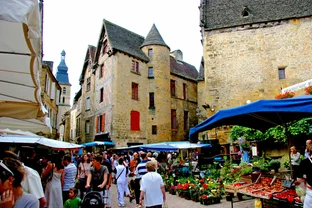
Feel free to roam the back streets of Sarlat. You can allow yourself to get lost, as you’ll invariably wind up back at place de la Liberté, in the center of town, and the 18th-century Hotel de Ville, or City Hall.
Sarlat is celebrated by French gastronomes for its truffle market, Le Marché aux Truffes, held December to mid-March at the bottom of rue Fénelon Saturdays from 9am to noon and on Place de la Liberté Wednesdays after 2:30pm December to February. The first weekend of March honors Sarlat’s other specialty: Goose, with its raucous Fest’Oie a festival, which involves demonstrations of goose taming, goose plume calligraphy and goose carving, and plenty of goose eating in all its forms, from foie-gras to carcass soup. Sarlat is also known for its wines, and the best selection is found at Julien de Savignac, pl. Pasteur (tel. 05-53-31-29-20).
A Side Trip to Gorodka
After a few days exploring the prehistoric and medieval riches of the Dordogne, a trip to Gorodka-Za village of modern art (www.gorodka.com; tel. 05-53-31-02-00 or 06-83-36-77-96), 4km (2 miles) from Sarlat in La Canéda, is a refreshing change. The brainchild of artist Pierre Shasmoukine, you might find exhibits by various artists-in-residence, live theater shows, or sculptures and multimedia exhibits, either dotted around a forest with three separate walkways or within eight art galleries displaying over 500 works. It’s a particularly interesting place at night, as many of the works of art start glowing and moving when you least expect them to. The site seems to be constantly threatened by local opposition, but it remains for now one of the most unusual and inspiring sites in the region. Gorodka can be visited daily July and August from 6pm to 11pm, and in winter by appointment. Admission is 10 euros for adults, free for children under 10.
- Museum
Château des Milandes
Although very impressive, this château is outshone by the star-power of its former owner, the internationally renowned singer and entertainer, Josephine Baker. Born Freda Josephine McDonald in St. Louis, Missouri, Baker rented the château from 1940 and eventually bought it in 1947.…Around Town
- Tour/Cruise
Gabarres de Beynac
Another gabarre option about 20 minutes south of Sarlat-la-Canéda in the village of Beynac-et-Cazenac, is Gabarres de Beynac. Children go free here on the morning sailings, up to 11:30am, and dogs are allowed on board. The departure point is at the end of the car park, opposite the…Around Town - Tour/Cruise
Les Gabarres Norbert
About 20 minutes south of Sarlat-la-Canéda is La Roque-Gageac. Here, you can take a trip on a gabarre, the traditional flat-bottomed boat that used to ply up and down the shallow Dordogne, taking goods from one town to the next. Today they are used for guided river cruises and offer…Around Town