Things To Do in Segovia
Bookstore

Available as paperback
and as e-book.
Segovia Attractions

12 Results
- Historic Site
Alcázar de Segovia
There is a good reason why this fortress looks like a late-19th-century romantic ideal of a medieval castle. Most of it burned in 1862 and was rebuilt to emulate the storybook castles of 16th-century northern Europe rather than the messy fortress-castle of Spain’s warrior monarchs of… - Religious Site
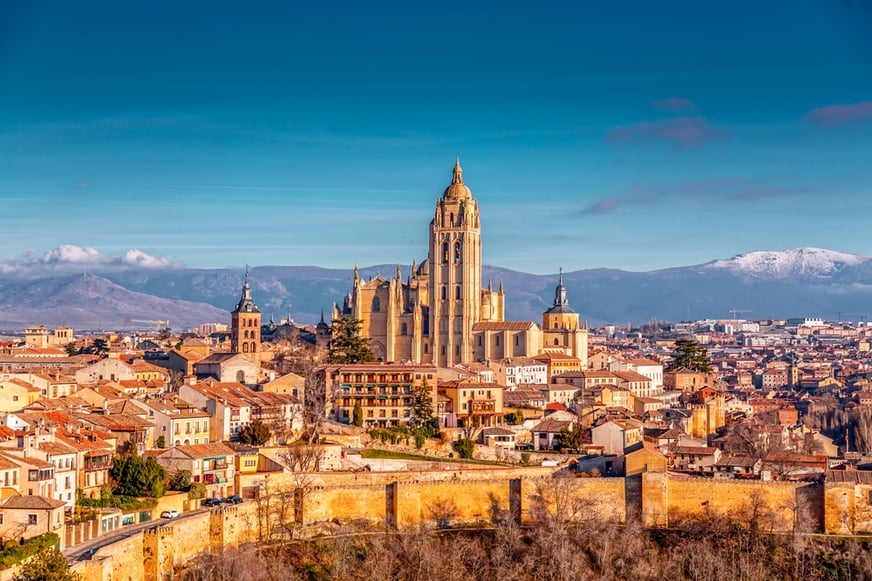
Cabildo Catedral de Segovia
Segovia’s original Gothic cathedral was destroyed in 1520 during the short-lived uprising of the Castilian cities against the Habsburg kings. When the smoke cleared and the lords of Segovia were crushed, Carlos V ordered it rebuilt in the same style, making it Spain’s last Gothic… - Museum
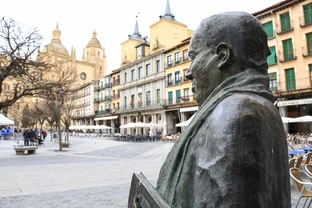
Casa-Museo Antonio Machado
When the great Spanish poet taught French in Segovia from 1919 to 1932, he lived in this boardinghouse. The modest structure is more a remembrance—almost a shrine—than a true museum. Documents, drawings, and other mementos try to conjure the poet, but they aren’t half as evocative as… - Religious Site
Convento de los Padres Carmelitas Descalzos
The 16th-century mystic and theologian San Juan de la Cruz founded and personally helped build this monastery in 1586. Upon his death in 1591, his body was returned here for burial, where it still rests in the left side chapel of the convent’s church (pictured above). Saint John of… - Religious Site
Iglesia de la Vera Cruz
Built in the 12th century by the Knights Templar more as a shrine than a parish church, this Romanesque edifice still resonates with the rough faith of the warrior monks who founded it. The 12-sided shape (copied from Jerusalem’s Church of the Holy Sepulchre), the style of the… - Religious Site
Monasterio Santa María del Parral
The restored “Monastery of the Grape” was established for the Jerónimos by Enrique IV, king of Castilla (1425–74) and half-brother to Isabel I. The monastery lies across the Río Eresma about a half-mile north of the city, and it’s worth visiting for the exquisite carvings and… - Religious Site
Monasterio del Parral
The restored "Monastery of the Grape" was established for the Hieronymites by Henry IV (1425-74), a Castilian king known as "The Impotent." The monastery lies across the Eresma River about .8km (a half-mile) north of the city. The church is a medley of styles and decoration -- mainly… - Museum
Museo Zuloaga
This fascinating little museum occupies the medieval Iglesia San Juan de los Caballeros, where ceramic artist Daniel Zuloaga based his family pottery studio starting in 1908. The firm made many of the scenic tiles that decorate the building facades all over Spain, and museum exhibits… - Museum
Museo de Arte Contemporáneo Esteban Vicente
Spanish-born Estéban Vicente (1903–2001) found his artistic niche as a member of the pioneering New York school of Abstract Expressionists but chose to donate a significant body of his work to his home country. The collection includes oil paintings, collages, a tapestry, and a number… - Landmark
Palacio Real de La Granja
San Ildefonso de la Granja was the summer palace of the Bourbon kings of Spain, who replicated the grandeur of Versailles in the province of Segovia. Set against the snowcapped Sierra de Guadarrama, the slate-roofed palace dominates the village that grew up around it (which, these… - Landmark
Puerta de San Andrés
The early medieval walls of Segovia were rebuilt between 1088 and 1122, and portions have been fixed up in recent decades. This interpretation center on the parapets above the gate offers sweeping views of the Judería and the surrounding countryside, and great explanations of how the… - Historic Site
Roman Aqueduct (Acueducto Romano)
Roughly 2,100 years ago, Roman engineers constructed this architectural marvel—a 15km (9[bf]1/3-mile) conduit to bring water from the Guadarrama mountains to Segovia. The graceful feat of engineering remains as impressive as it was in the age of the Caesars. While much of the…
Segovia Nightlife
Some of the most spontaneous good times can be created around the Plaza Mayor, Plaza Azoguejo, and the busy Calle del Carmen that runs into the Plaza Azoguejo. Each of those sites contains a scattering of simple bars and cafes that grow more crowded at night as the days grow hotter.
But just wandering around the city after dusk is a great summer activity because Segovia literally spotlights many of its chief attractions on Friday, Saturday, and Sunday evenings from dusk until midnight from June 24 until mid-September. In addition to the Acueducto, lights play across the Alcázar, the cathedral, town hall, eight major churches, and two monasteries. The lighting both enhances the beauty of the buildings and provides atmospheric illumination to enjoy the city after dark.