Things To Do in Versailles
Bookstore

Available as paperback
and as e-book.
Versailles Attractions
Back in the 17th century, after having been badly burned by a nasty uprising called Le Fronde, Louis XIV decided to move his court from Paris to Versailles, a safe distance from the intrigues of the capital. He also decided to have the court move in with him, where he could keep a close eye on them and nip any new plots or conspiracies in the bud. This required a new abode that was not only big enough to house his court (anywhere from 3,000 to 10,000 people would be palace guests on any given day), but also one that would be grand enough to let the world know who was in charge.
A chateau was already on the site when Louis came to town; his father, Louis XIII, had built a small castle, “a hunting lodge,” there in 1623. This humble dwelling simply would not do for the so-called “Sun King,” who brought in a flotilla of architects, artists, and gardeners to enlarge the castle and give it a new look. In 1668, the King’s architect, Louis Le Vau, began work on the enormous “envelope,” which literally wrapped the old castle in a second building. From the front, you can see the remnants of the old castle; the buildings that surround the recessed central courtyard (called the Marble Court) are what’s left of that structure.
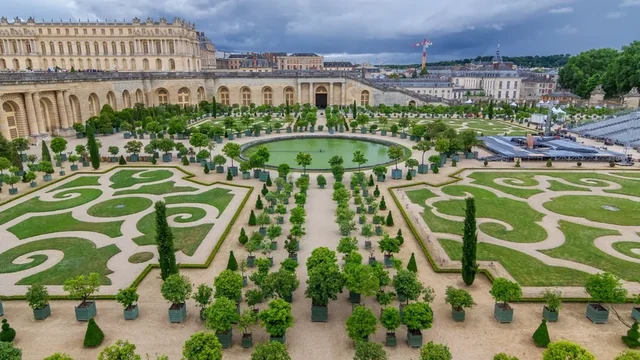
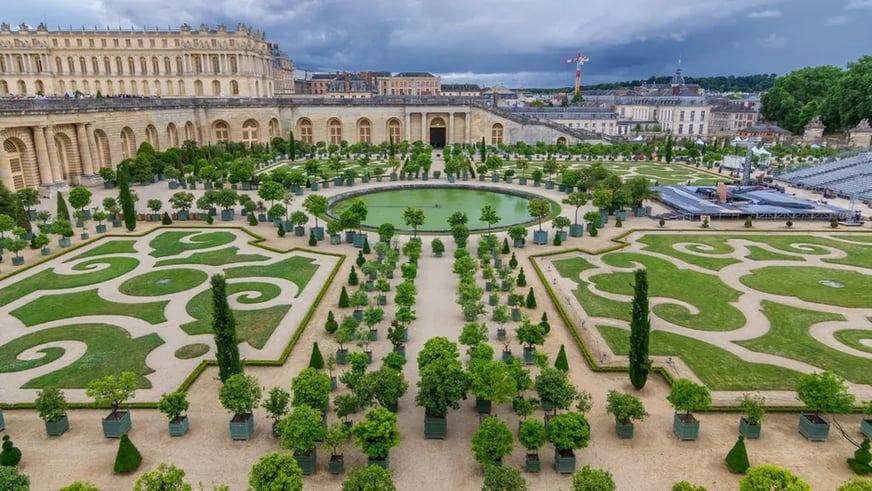
Meanwhile, legendary garden designer André Le Notre was carving out formal gardens and a huge park out of what had been marshy countryside. Thousands of trees were planted, and harmonious geometric designs were achieved with flower beds, hedges, canals, and pebbled pathways dotted with sculptures and fountains.
Construction, which involved as many as 36,000 workers, ground on for years; in 1682 the King and his court moved in, but construction went on right through the rest of his reign and into that of Louis XV. Louis XVI and his wife, Marie Antoinette, made few changes, but history made a gigantic one for them: On October 6, 1789, an angry mob of hungry Parisians marched on the palace and the royal couple was eventually forced to return to Paris. Versailles would never again be a royal residence.
The palace was ransacked during the Revolution, and in the years after it fell far from its original state of grace. Napoleon and Louis XVIII did what they could to bring the sleeping giant back, but by the early 1800s, during the reign of Louis-Philippe, the castle was slated for demolition. Fortunately for us, this forward-thinking king decided to invest his own money to save Versailles, and in 1837 the vast structure was made into a national museum. Little by little, precious furniture and art objects were retrieved or re-created; paintings, wall decorations, and ceilings were restored. Restoration is ongoing, so be prepared for the unexpected. Even if a few areas are closed, the place is so huge that should you can still tour yourself into a 17th-century stupor.
Exploring the Town
If you have some extra time, or want to escape the hordes of tourists at the château, take a stroll through the center of Versailles, and you'll see the real life of this elegant Parisian suburb. The heart of the town is the Saint-Louis Cathedral. To make room for the burgeoning palace, the village church of Saint-Julien of Brioude was demolished in 1679. With Versailles' rising importance, Louis XIV commissioned a new church, not surprisingly in honor of his namesake; St-Louis. Finished almost a century later in the Rococo style, it was converted into a "temple of abundance" during the revolution and, with the revival of religion, consecrated a cathedral in 1843.
A short distance from the cathedral is the daily vibrant Notre Dame market, a gastronomic paradise held in the 1841 covered market building and overflowing into the neighboring streets on Tuesdays, Fridays and Sundays. Antiques fans will be in heaven exploring the dozens of shops in the Passage de la Geôle, occupying the former royal jail. More shops can be found in the picturesque Les Carrés Saint-Louis. Built by Louis XV in 1755, these square blocks of low slate-roofed houses make up one of the first ever shopping malls. Even if you're not looking to buy, it's fun to imagine what could fill the gorgeous 18th-century mansions scattered around Versailles, constructed by aristocrats during the city's heyday as the seat of the French government.
- Landmark
Domaine de Marie Antoinette
A long walk across the garden (or reachable by the little train; 7.50€) will take you to the Grand Trianon (Grand Pavilion), decked out in pink-and-white marble. At this point, you will be in the Domaine de Marie Antoinette (if you don’t have a Château passport or museum pass, you’ll…Versailles
- Attraction
The Château of Versailles
The rooms in the “envelope,” or the newer part of the building, were designed to impress, which they do. They include a series of rooms called the Grand Apartments, used primarily for ceremonial events (a daily occurrence), the Queen’s Apartments, and the Galerie des Glaces. These,…Versailles - Park/Garden
Versailles Gardens
The entire 800-hectare (2,000-acre) park is laid out according to a precise symmetrical plan. From the terrace behind the castle, there is an astounding view that runs past two parterres, down a central lawn (the Tapis Vert), down the Grand Canal and seemingly on into infinity. Le…Versailles
Versailles Shopping
Founded by the Sun King himself, Louis XIV, Marché Notre-Dame, pl. du Marché Notre-Dame, is the major public market in Versailles, housed in a series of red-brick buildings. The present look dates from the 19th century. Indoor shops selling local cheeses, meats, and fresh fruits are open Tuesday to Sunday 7am to 7:30pm (until 2pm Sunday), but the outdoor stalls in the center of the square flourish only on Tuesday, Friday, and Sunday, from about 9am to 2pm. It’s best to go before noon; some of the stalls start shutting down in the early afternoon.
Close to the mammoth market, Passage de la Geôle (www.antiques-versailles.com; tel. 01-30-21-15-13) is open Friday to Sunday 10am to 7pm, housing antiques shops of furniture and objets d’art at “all prices.”