Museo de Zaragoza

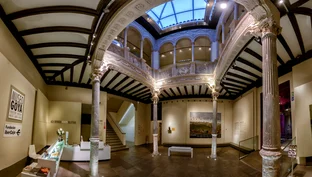
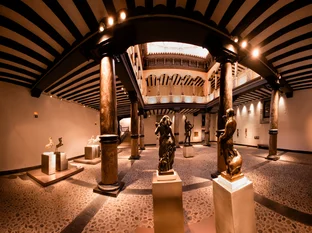
There’s a marvelously old-fashioned feel about this museum of local antiquities, beginning with its flamboyant Beaux-Arts building, which was constructed for the Hispano-French Exposition of 1908 (commemorating the centenary of Napoleon’s siege of the city). The building survived fierce bombardment during the Spanish Civil War, and the heroic statues that surround it speak of a pre-war era that romanticized antiquity: Three main sculptures represent Painting, Architecture, and Sculpture itself, and a pair of Art Nouveau sculptures allude to Archaeology. Most of the ground-floor exhibits are the results of local digs, and represent prehistoric, Carthaginian, Roman, and Muslim eras in Zaragoza. Most notable is a fine bust of Caesar Augustus, for whom the original Roman city was named.
There’s a marvelously old-fashioned feel about this museum of local antiquities, beginning with its flamboyant Beaux-Arts building, which was constructed for the Hispano-French Exposition of 1908 (commemorating the centenary of Napoleon’s siege of the city). The building survived fierce bombardment during the Spanish Civil War, and the heroic statues that surround it speak of a pre-war era that romanticized antiquity: Three main sculptures represent Painting, Architecture, and Sculpture itself, and a pair of Art Nouveau sculptures allude to Archaeology. Most of the ground-floor exhibits are the results of local digs, and represent prehistoric, Carthaginian, Roman, and Muslim eras in Zaragoza. Most notable is a fine bust of Caesar Augustus, for whom the original Roman city was named.
Details
Bookstore

Available as paperback
and as e-book.