
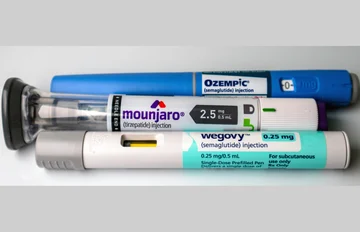
Millions of people use injectable weight-loss drugs such as Ozempic, Wegovy, Zepbound, and Mounjaro.
But the nature of these prescription medications—which have to be stored within a specific temperature range and self-administered via single-use injection pen on a weekly basis—presents some challenges for travelers.
Here's what you need to know in order to transport your shots safely—and legally—by car or plane.
Keeping Weight-Loss Injection Meds at the Right Temperature When You Travel
First, let's talk storage and refrigeration.
The drugs semaglutide (sold under the brand names Ozempic and Wegovy) and tirzepatide (Zepbound and Mounjaro) should both be kept refrigerated at a temperature between 36 F and 46 F (2 C to 8 C).
So to keep your medication cool while in transit, you might want to pack it in an insulated bag or travel cooler equipped with ice packs.
You don't want the solution in the injection pen to freeze, however. In fact, if the medication freezes you shouldn't inject it. So avoid placing semaglutide or tirzepatide directly on a frozen-solid ice pack.
In most cases, the Transportation Security Administration's liquid rules require ice packs to be entirely solid—with no melted parts and no slush—to remain in carry-on bags on flights.
But the TSA makes an exception for "medically necessary" ice packs "in reasonable quantities," which are allowed through airport security checkpoints "regardless of their physical state of matter (e.g., melted or slushy)."
You will, however, need to notify TSA officers that you're traveling with prescribed medication.
To prevent exposing the drug to extreme temps in a plane's cargo hold, keep your injection pens among your carry-on belongings when you fly. Another reason that's a wise move: The airline could lose your checked luggage.
Likewise, keep the meds with you in the car during a road trip rather than storing them in the glove compartment or trunk.
And make sure in advance that you'll have access to a fridge in your accommodations at the destination where you're headed. After all, you'll need somewhere to store the stuff during your vacation.
How Long Can Injectable Weight-Loss Meds Stay Out of the Fridge?
Though it's not ideal, these drugs can remain safe and effective to use after spending a fair amount of time at room temperature.
Wegovy (semaglutide) can stay out of the fridge for up to 28 days, while Mounjaro and Zepbound (tirzepatide) will keep for up to 21 days. (Ozempic should be refrigerated before first use and then can remain at room temperature for up to 56 days.)
But the room temperature in that theoretical room can't get colder than 36 F (2 c) or hotter than 86 F (30 C) without the potential of damage to the drug. Naturally, the heat risk is especially high during summer travel.
Just as you should discard an injection pen if the liquid inside is frozen, you should also get rid of the pen if it shows signs of damage caused by heat, like if the solution has a color, is cloudy, or contains solid particles. The liquid should be clear, colorless, and particle-free.
TSA Rules for Flying with Weight-Loss Shots
The TSA permits liquid medications, including prescribed weight-loss injection pens, in carry-on as well as checked luggage. Opt for carry-on for better temperature control and to avoid getting separated from your meds due to lost checked luggage.
The TSA recommends clearly labeling the medication or leaving it in its original packaging to make things easier.
For screening, you will need to separate the meds and any accompanying props such as ice packs from your other belongings and notify an agent.
To be on the safe side, consider bringing along your prescription or a note from your doctor.
Traveling Internationally with Weight-Loss Injection Meds
Packing your prescription and a note from your medical provider is even more important for trips to another country.
Just because the U.S. Food and Drug Administration has approved Wegovy et al. doesn't mean other nations can't restrict or outright ban certain medications.
Many countries limit the amount you can bring in and some require getting advance approval in the form of medical certification.
"If you were to go to the UAE [United Arab Emirates] you would need pre-approval from the Ministry of Health. Or if you were to go to Japan, you would require an import certificate," Asimah Hanif, a doctor with the U.K.'s National Health Service, was quoted in Scotland's Daily Record newspaper. "In Singapore you would need approval from the health services authority before travel."
Step one before traveling internationally with any medication, according to the U.S. Centers for Disease Control and Prevention, is to check with the embassy of the destination you're visiting about any potential restrictions or red-tape requirements you need to fulfill so that your medications aren't confiscated by government authorities.
Places in Asia and the Middle East are reportedly the most strict about letting in prescribed injection pens. But you could run into trouble anywhere if you fail to declare the meds at customs, leave your prescription at home, or carry around unlabeled vials of who-knows-what.
No matter where you're headed overseas, make sure to keep medicines in their original, labeled containers; bring printed copies of your prescriptions; and ask your doctor to write a note you can show to international authorities.
While you've got your physician's attention, you might also ask about ways to manage side effects such as nausea while on the road and what to do in order to minimize your chances of missing a dose due to time zone changes and other disruptions to your usual routine.
For more advice on going abroad with medicine, see the CDC's Travelers' Health website.