Americans despise resort fees. But in a shockingly short span of time, we became blasé about them. Appallingly, the people once renowned for feisty individualism and a testy spirit of fairness have rolled over like docile lap dogs—we sigh and pay hidden charges as if staying in hotels had always been this way.
It wasn't. This is not normal. Can you remember how terrible you felt the first time you encountered a hidden resort fee or urban fee? We've all been in the position of missing the disclosure of resort fees because notices were buried in small print, behind links, or at the end of the process. It wouldn't be legal for a person selling a house to reveal when the keys were handed over that the place actually costs $50,000 more, but somehow it's legal to do the same sort of thing when hotel rooms are rented.
But the problem with resort fees isn't just that they blindside consumers. There are other more destructive effects, too. Resort fees have civic costs.
Resort fees are a tax dodge.
With resort fees, hotels perform an accounting sleight of hand. Your true cost of renting a room may be, say, $200, but if managers carve off $30 as a "resort fee," the hotel can save on taxes.
KillResortFees.com, a consumer advocate site, put it this way a few years ago, using a New York City hotel as an example:
"The facility fee / resort fee / second room rate at The Row Hotel is only subject to 8.875% taxation. The advertised room rate is subject to the 14.75% NYC hotel occupancy tax. New York City loses 5.875% on every single resort fee in every single room in the City. This (as of July 18, 2017) comes out to NYC losing $8,826,397.21 in tax revenue per year due to hotel resort fees."
This costs the communities that support these hotels, and that's not fair.
Resort fees repel foreign visitors to the United States.
Resort fees are a distinctly American plague. Travel in Europe, where taxes are always included in the final price, and you won't find them—people gape at you with astonishment when you try explaining the concept. In fact, you pretty much won't find resort fees outside of North America, with a few repugnant minor exceptions.
So when visitors come to the U.S., they're dumbfounded and furious. Shock over these fees has generated some horrible press discouraging vacations in the United States. "The hidden fees costing British travellers to the U.S. hundreds of pounds," the Telegraph cautions. "Hotels in popular US cities were found to charge up to £50-a-day extra," warns the Daily Mail.
There's no denying that this is terrible P.R. at a time when America needs better news. There's plenty of evidence that the practice is one of the factors that pushes visitors to take their plans—and their money—to other countries.
Here's just one Canadian, who pushed back on social media when Allegiant Airlines tweeted an entreaty to vacation in Southwest Florida.
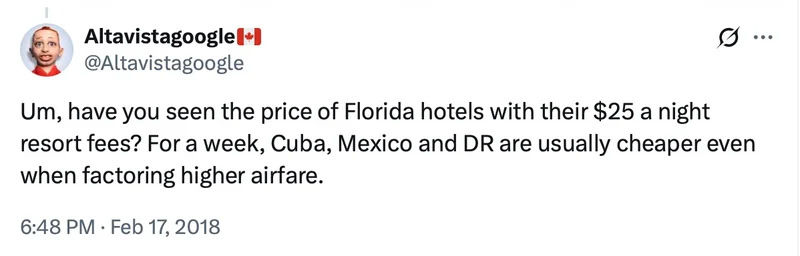
It's a fiercely competitive travel market. Why would a visitor choose the U.S. when sneaky resort fees wreck its value as a vacation destination?
Resort fees cheat travel advisors.
Hotels only pay commission on the base room rate—not on add-on fees. Casino.org reports that OTAs (online travel agencies) typically receive 10–25% back off the room rate as payment for bookings, but they get nothing from the resort fee.
Now that many hotels in major American destinations like Orlando and Las Vegas routinely charge $50 or more per night in resort fees, that's a lot of bread being taken from the mouths of hard-working travel agents.
Resort fees undercut fair competition.
As with so many breakdowns in the modern economy, we can blame mishandling of the Internet for this. The main reason hotels love resort fees, besides shifty tax benefits, is that they make their properties look more attractive in online search results. They game the system.
If a hotel subtracts a fraction of the true cost and hides it in the back end, then the property suddenly looks a lot more affordable in reservations searches. In fact, the hotel may dishonestly bump cheaper properties out of the top search results—despite the fact that when all is said and done, it's not the cheapest at all. Resort fees tilt the playing field, and that negatively impacts honest hoteliers.
If the fee-charging hotels were honestly competitive, they would proudly stand behind the full tariff, without games.
Resort fees undermine trust.
You can argue your way out of some fees (we have some techniques you can try), but you shouldn't have to. Ever since the pilgrims of The Canterbury Tales crowded the Tabard Inn and the Thénardiers of Les Misérables fleeced pockets of drunken guests, getting a bed for a night has often come with the risk of side swindles. Yet that's precisely the model that the "hospitality" industry espouses by claiming you need to pay twice to use the facilities. Modern resorts advertise pools and fitness centers up front as part of their pitches to get our business. Let's not pretend they're separate from the hotel.
The only reason this bait-and-switch scheme even works is that so many hotels—with corporate brands leading the group degradation—have agreed to do it at the same time. The mass adoption was a way of squashing honest competition and has numbed the American consumer's resistance to the corruption.
Which brings us to the other reason it works: The current American government, well-oiled by the grease of donations from the hotel business, has no interest in halting the practice. While consumers have begged their leaders to protect them from added fees, U.S. politicians have only had the courage to require businesses to disclose them, not ban them.
We all learned it in grammar school, and now it's hammered home every day by the headlines: Just because something is technically legal doesn't make it right.
As travelers, we all need to recalibrate our sleaze detectors—and reactivate our dormant senses of fairness—to call out hotels for deliberately taking advantage of customers and the system. Hoteliers like to say they're part of the "hospitality" industry. It's time to live up to that word.