

U.S. airlines have turned seat assignments into a profit center. It didn't used to be this way, but that's where we are now. We pay for what we used to get for free.
Passengers intentionally buy window seats for a lot of reasons. Some might plan to use the view to entertain small children. Others might require a window to counteract claustrophobia or motion sickness. And other customers might pay the extra money for the seat because they need the bit of additional space that windows provide at shoulder level for tall people and folks with arm ailments.
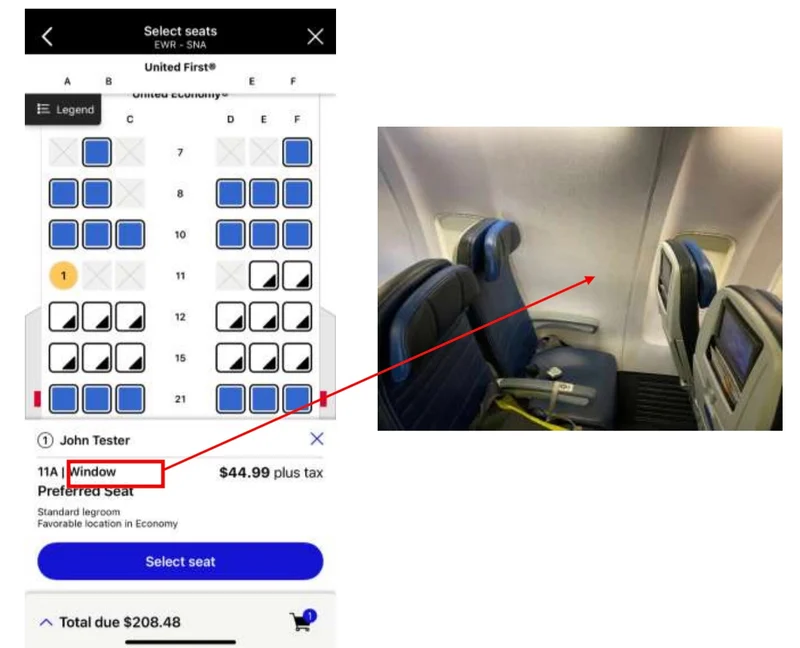
But often—at least once or twice a flight for some aircraft models—airlines sell a seat as a "window" location when, in fact, it faces a blank wall of unbroken fuselage. Because the airlines have pushed cabin capacity to an extreme, many aircraft are crammed with so many seats that not every outermost chair lines up with a window.
Millions of flyers know that crestfallen feeling of boarding a plane and finding that their promised portal is just an opaque wall. It's enough to make a stressed traveler want to hurl themselves out a window, if only one was there.
Some other airline passengers are doing something about it. They're crying foul and have filed a class action lawsuit against Delta Air Lines and United Airlines to halt the practice.
Airlines sued for selling walls as windows
On August 19, separate suits were filed by the same law firm in district courts in New York and California.
"For many years, United has knowingly and routinely sold windowless 'window' seats to consumers," the United lawsuit alleges. "For instance, certain models of United’s Boeing 737 and Airbus A321 aircraft are built with at least one seat that would traditionally have a window, but do not include one due to the placement of air conditioning ducts, electrical conduits, or other interior components. United operates hundreds of these aircrafts, which each make several flights every day."
Each time, United could charge "between $44.99 and $159.99 for the option to select the seat," the suit says.
The lawsuits calculate that both Delta and United have likely sold over a million windowless “window” seats, collecting money from the purchases.
"At no point during the seat selection process on the app does United provide an option to verify whether the selected 'window' seat actually includes a window, nor does it allow consumers to preview or confirm the physical configuration of the aircraft before completing the transaction," the lawsuit alleges. "Nor does United disclose that a 'window' seat may be a Windowless Seat at any point during the transaction process."
The similarly worded lawsuit filed against Delta stresses that "Delta exerts substantial influence over the domestic and international air travel markets, and is a common carrier subject to laws prohibiting deceptive business practices and false advertising."
The lawsuit points out that Delta warns passengers which seat assignments have "limited recline” or “no floor storage," but the carrier is silent when seats sold as "window" do not, in fact, have a window.
The practice is "deceptive and unlawful, and amounts to a breach [of] its contracts with affected passengers," the lawsuit says.
The United lawsuit says attorneys did not target American Airlines and Alaska Airlines in the class action because they "specifically alert the customers that the seat is windowless."
The likely outcome of the class action
As longtime flyers ourselves, we think it should be reasonable to expect a window if you pay for a window. If we weren't being charged extra fees by the airlines for window seating—and for many decades we weren't—we might be more flexible on that expectation.
But now that these corporations have chosen to extract funds from us for the privilege of sitting in so-named window seats, airlines have created an expectation of the delivery of a specific type of seating.
In a functional system, consumers wouldn't have to resort to begging the court system, the remedy of last resort, to force businesses to give customers what they paid for.
We all know how this is likely to turn out, even if the plaintiffs find a sympathetic judge and win. The airlines won't stop selling us these deficient seats.
They'll just add small warnings during the booking process, the way theatre owners might warn ticket buyers of obstructed views.
Or worse, airlines will just rename "window seats" to something more vague, like "leftmost" or "rightmost," to sidestep the work of disclosure altogether.
For travelers, even that pittance of honesty in the face of a largely unresponsive system would be a small victory.