

It's difficult enough comparison shopping for airfares among online ticket agencies and the carriers' own sites. Airline pricing has gotten more complicated and more confusing recently, and the use of AI-generated surge pricing has only made it worse.
Now we've found that some of the largest airlines are engaging in subtle forms of bait-and-switch by posting low fares that many passengers can’t actually find.
It's an ancient grift to tout prices "starting from $X" or "as low as $Y." And that grift is back. Here's a rundown on some hassles we’ve found lately.
American Airlines upgrades don't cover your whole trip
For an American itinerary from San Francisco/SFO to Washington/DCA that flew through Charlotte/CLT: During booking, an offer popped up stating the traveler can "upgrade your flight starting from $80." Sounds pretty good for first class for a transcontinental journey, no?
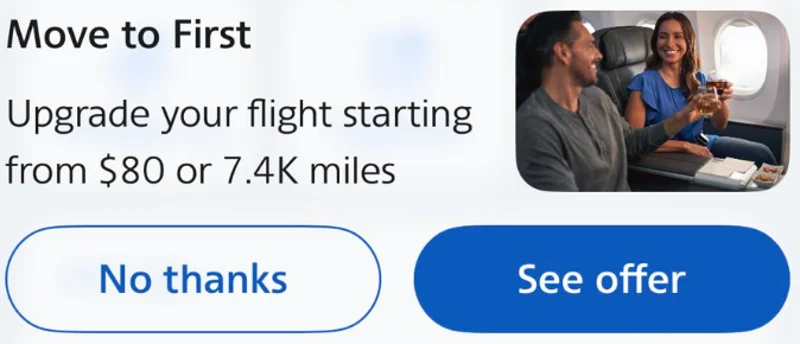
No. We had to click deeper to figure out the $80 only covered the short leg between Charlotte and Washington. That information is only clear if you scrutinize the details—abruptly, only one leg of the journey (the shortest one) is named:
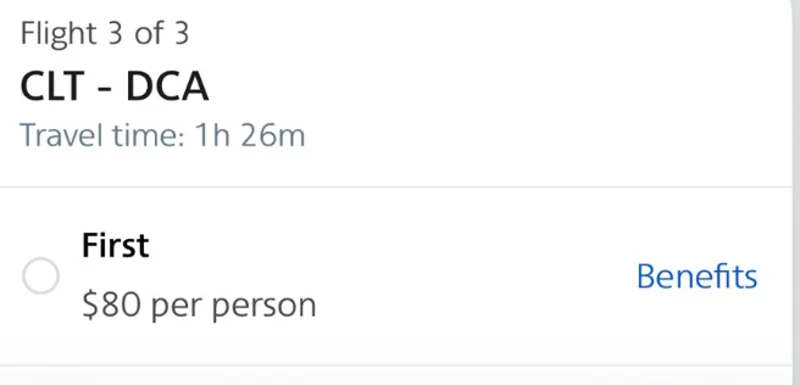
For the longer cross-country leg from SFO to Charlotte, the upgrade price was actually $242. So that "starting from" $80 would actually end up at $322 to truly upgrade your trip.
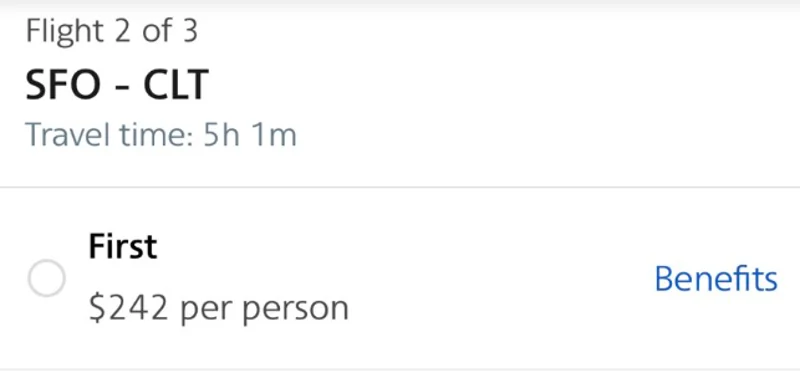
That tactic has no doubt confused many a passenger who absent-mindedly clicked and purchased, mistakenly believing they were upgrading their entire trip.
We asked American Airlines for comment but did not receive a response by press time.
Southwest advertises fares you can't find
A common device at Southwest is a big banner ad on the homepage, such as one pitching $64 one-way fares from New York/LGA.
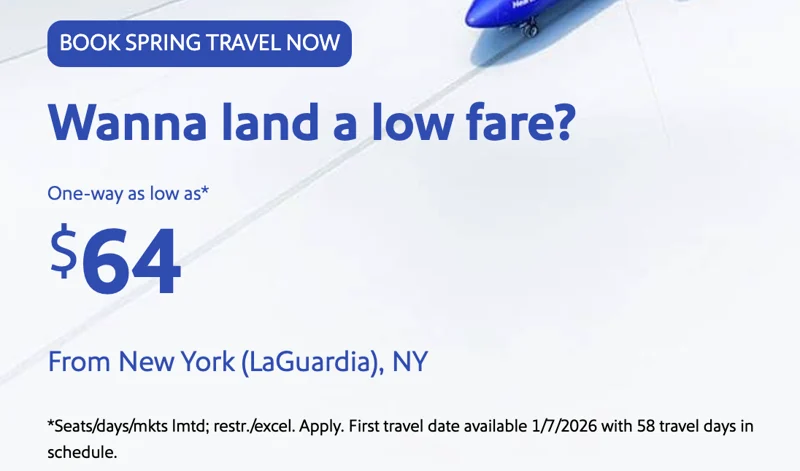
There's just one problem. Buried in those fine print hieroglyphics ("markets limited," "discounted excursion fares," etc.) was no mention of exactly where those $64 flights from LaGuardia would take you. You’re on your own to try to find any.
We searched for a half an hour on Southwest’s site for appropriate departure dates over a month for multiple destinations from Boston to Florida. The lowest fare we ever found was $76, while many airfares were over $200.
After that half hour of fruitless searches, we finally backed out of Southwest's site and Googled "southwest airlines LGA deals" instead. Voila! Only after searching on Google were we finally directed to the correct low fare on Southwest.com—one that inexplicably was not linked via that banner box that initially advertised it to us.
Once we dug in by web search, we eventually found bargains, albeit for the airline’s dreaded basic economy product, which comes with a ton of restrictions. But those fares were never shown to us by Southwest when we clicked its in-house ad for $64 flights. Good luck navigating these tricky waters yourself!
We can’t be the only customers who could only find Southwest’s advertised fares by leaving the ads on Southwest’s site and doing a web search instead.
We asked Southwest Airlines for comment but did not receive a response by press time.
Alaska Airlines' promoted fares are scarce
On Alaska's homepage, we saw a big box offering "More Ways to Winter" deals.

The lowest one-way fare shown was $59 on a few routes, including from both Portland/PDX and Seattle/SEA to Eugene, Oregon/EUG.
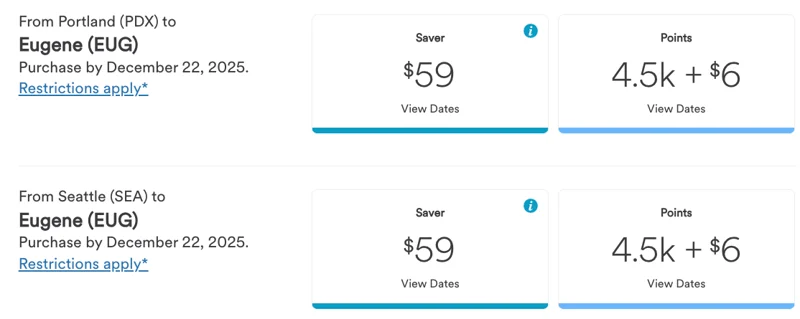
But the ad didn't warn about any of the many mandatory restrictions that we could only find behind clicks. You will only be told about those if you click yet another link: Booking 21 days in advance. Availability on Tuesdays, Wednesdays, and Saturdays. Blackout days during holiday weekends. And that's just for starters.

Another issue with this $59 fare was availability. There were days the promoted price was available on 2 flights per route, or just on 1 flight. But there were also days for which it was available on zero flights. When it wasn't an option, the lowest fare was usually much higher (i.e., $139).
Who is policing airline advertising?
These are trying times for air travelers, as existing passenger protections are under fire from within at the Department of Transportation. As we explained here in July, Americans have fewer passenger rights than much of the rest of the world.
But in September we reported a real shocker: Airlines for America, the lobbying group for the largest U.S. carriers, put forth a "wish list" of passenger protections it would like the DOT to weaken or eliminate. And two days after our report, the DOT issued a regulatory agenda that looked "copy-pasted" from the airline lobby.
We're in unchartered skies here. Recently DOT Secretary Sean Duffy absolved Southwest of an $11 million fine for stranding more than 2 million passengers during its December 2022 holiday meltdown. Then DOT eliminated an $11.9 million fine against American for violating disability rules and mishandling wheelchairs.
With actions like this, can anyone credibly believe the DOT will get tough with Southwest or American over confusing pricing?
No matter the airline you're dealing with in the United States, it's now imperative not to assume that airline’s ad or popup window is telling you the whole story.
Without strongly enforced consumer protections, you must read the fine print, which means all the exclusions, limited quantity of av available seats, blackout dates, non-refundability, and any other pitfalls that could be undisclosed.
William J. McGee is the Senior Fellow for Aviation & Travel at American Economic Liberties Project. An FAA-licensed aircraft dispatcher, he spent seven years in airline flight operations management and was Editor-in-Chief of Consumer Reports Travel Letter. He is the author of Attention All Passengers and teaches at Vaughn College of Aeronautics. There is more at www.economicliberties.us/william-mcgee/.