

“People don’t think of Boston as a music city,” says Matt Bowker of Soundscape Tours. “I think it punches above its weight.”
Granted, Boston doesn’t instantly evoke in the popular imagination the sorts of musical connections associated with destinations such as Nashville, Tenn.; New Orleans, La.; or Surfin’, U.S.A.
But on the rock-themed history tours Bowker leads on foot and, starting earlier this year, by bus, a convincing and arguably underreported case is made that the last 60 years or so of popular music would have sounded a lot different without Boston artists, live venues, audiences, and future superstars passing through while on the come up.
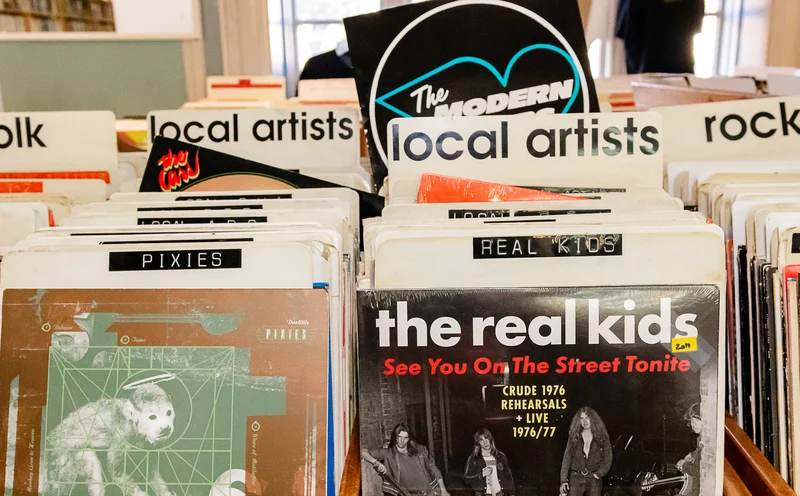
Bowker is himself a musician, formerly of the local indie band Mount Peru. His demeanor as a docent calls to mind a knowledgeable record store employee, but not the mean kind. Evincing more crate-digger enthusiasm than rockist snobbery, he carts around a boom box and a selection of LPs to play curated clips and supply visual aids on tours (and during interviews).
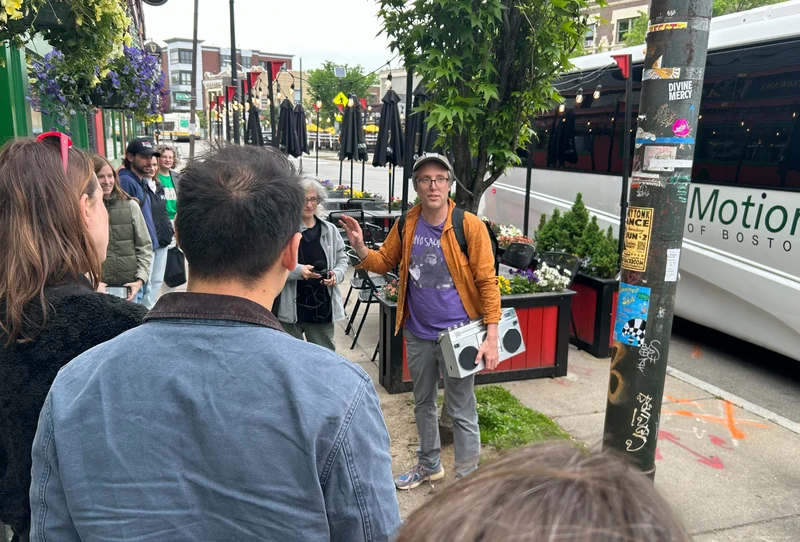
A stroll through Kenmore Square's punk past
The 90-minute walking tour, “Walkin’ Bout a Rock ‘n’ Roll Revolution,” centers on the Kenmore Square neighborhood, where Red Sox home Fenway Park is located. In the 1970s and beyond, this was the hub of the Hub’s rock scene, owing in large part to the Rathskeller, a legendary venue better known as the Rat and comparable to New York City’s CBGB in both impact and griminess.
“The Rat’s got a reputation as being a haven for punk bands,” Bowker told Frommer’s, “but it wasn’t just punk bands that played there. It was new wave bands; it was any important bands performing in the late ‘70s, early ‘80s.”
Notable acts on the bill over the years: the Cars, Pixies, Dinosaur Jr., Sonic Youth, the Police, R.E.M., and the locally beloved Dropkick Murphys. “There were shipping crates for the stage,” says Bowker, “so if you rocked too hard, the stage would break down.”
Closed in 1997, the Rat was eventually demolished to make way for the Hotel Commonwealth (500 Commonwealth Ave.). But the tour locates the neighborhood’s holdovers from its rock heyday, according to Bowker. “There’s a record store called Nuggets [486 Commonwealth Ave.] that’s been there since the late ‘70s. And it smells like it.”
Appropriately, the route starts and ends at the Verb Hotel (1271 Boylston St.), which Bowker describes as “an unofficial music museum” with its displays of vintage concert posters, guitars, and other memorabilia.
The Mighty Mighty Bus Tour: vanished venues and longstanding survivors
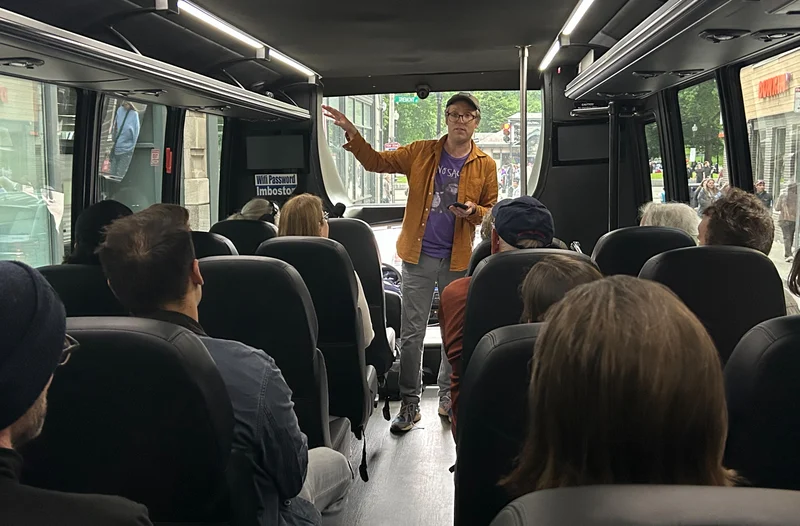
Offered on a once-per-month basis since May, Soundscape’s excellently named “Mighty Mighty Bus Tour” (a reference to Boston’s homegrown Mighty Mighty Bosstones) allows for a longer (about 2 hours) and more thorough survey of the region’s music history.
Along the way, Bowker recounts the impact of two now-vanished venues (also touched on in the walking version). The first is the South End’s Boston Tea Party, a favorite late-‘60s haunt for the Velvet Underground and, as legend has it, the birthplace of headbanging during a Led Zeppelin show. The address, 53 Berkeley St., is now occupied by a 7-Eleven.
Also gone: the Storyville jazz club, played by Billie Holiday, Duke Ellington, and many other luminaries. The Back Bay club, which was originally located at the Copley Square Hotel (still at 47 Huntington Ave.), was the brainchild of George Wein, best known as the founder of Rhode Island’s Newport Jazz Festival and a cofounder of the Newport Folk Festival.
The 1965 iteration of the latter event was of course the site of Bob Dylan’s seismic switch from acoustic to electric instruments, as depicted in the 2024 movie A Complete Unknown.
Given that the idea for the Newport festivals was “hatched at the Storyville venue,” Bowker argues, “it’s not too much to say that Dylan going electric—one of the huge moments in popular music—happens because of a conversation that starts at Storyville.”
The most significant difference between the walking tour and the bus tour is that the vehicular version crosses the Charles River to make stops in Cambridge, which has a vibrant and influential music history of its own.
The tour visits the venerable Middle East club in Central Square, where much of the region’s indie and underground focus shifted in the ‘80s, and also goes to Harvard Square, a capital of the New England folk revival that lives on at longstanding spots such as Club Passim (47 Palmer St.). Opened in 1958 as Club 47, Passim has hosted pretty much every folkie and folk-adjacent singer-songwriter you can think of, from Joan Baez to Tracy Chapman, and the place still has live music almost every night.
Why Boston?
When asked to explain why the Boston area has played such an influential—albeit often overlooked—role in rock and other forms of music in recent decades, Bowker cites several factors.
“I don’t think it’s a coincidence that Boston is a hub for innovation. There’s something about the city that really inspires creativity,” he says. And with all the universities in the area, “you’ve got a density of young people willing to take chances. You’ve got warehouses where you can make loud noises. And then you’ve got these music schools” like the top-notch Berklee College of Music and the New England Conservatory.
As the bus tour nears its end, Bowker highlights the current generation of musicians working in Boston. Eventually, the group parts ways after a pint at Cambridge Irish pub McCarthy’s (1912 Massachusetts Ave.) and its tiny adjoining bar and music venue, Toad.
Live performances usually get going there around the time the tourgoers arrive, Bowker says. “My hope is they stick around and listen to music.”
Soundscape Tours' Walkin' Bout a Rock 'n' Roll Revolution tours take place on Fridays, Saturdays, and Sundays and cost $42.40 per person. The next Mighty Mighty Bus Tour is scheduled for Saturday, July 25, and costs $79.49 per person.
For more information or to buy tickets, go to soundscape-tours.com.